Best Carbon Fiber Pickleball Paddle - Recommended Review
Introduction
Pickleball is no longer a backyard pastime. It is the fastest-growing sport in the United States, with participation surpassing 36 million players and expanding rapidly across Europe, Asia, and Australia. As the sport matures, so does the equipment — and no upgrade has changed the game more fundamentally than the shift to carbon fiber paddle faces.
Walk into any competitive court today and you will see carbon fiber everywhere. Players who made the switch describe a consistent experience: more spin, more control, more confidence at the kitchen line. Those who have not made the switch are often left wondering whether the upgrade is genuine or just marketing. The short answer is that the material difference is real — but only when the paddle is designed and manufactured correctly.
This guide cuts through the noise. It covers what actually separates a high-performing carbon fiber pickleball paddle from an average one, which specifications matter for different playing styles, and what the top-performing options look like across budget, skill level, and court role. Whether you are buying your first serious paddle or upgrading after years of play, this review gives you the technical foundation to make the right choice.
Why Carbon Fiber Has Become the Face Material of Choice
To understand why carbon fiber dominates the current paddle market, it helps to understand what a pickleball paddle face actually does. The face material is the first point of contact between paddle and ball — it determines how much energy transfers to the ball (power), how much spin the surface can generate (grit), and how precisely you can control ball placement (feel).
Carbon fiber brings a combination of properties that no previous paddle surface material could match simultaneously. It is approximately five times stronger than steel at 60% of the weight. Its stiffness-to-weight ratio is the highest of any commercially available paddle face material. And crucially for pickleball, its surface texture at the fiber weave level creates a natural grit that allows the paddle face to grip the ball momentarily on contact — generating topspin, backspin, and side spin that simply are not achievable at the same level with smooth fiberglass or polished graphite surfaces.
The result is a surface that is simultaneously powerful, spin-capable, and precise — three properties that traditionally existed in trade-off with each other. Fiberglass faces offer excellent power through their springback (sometimes called the trampoline effect) but sacrifice surface grit and control. Graphite faces are extremely light but lack the surface texture depth of carbon fiber. Carbon fiber navigates between these extremes and, in most playing styles and skill levels above beginner, outperforms both alternatives.
This is not a recent development. Carbon fiber has been used in high-end tennis and badminton equipment for decades. But its adoption in pickleball has accelerated dramatically in the last three years, driven by improvements in thermoform manufacturing technology and the entry of serious materials engineering into paddle design — producing carbon fiber pickleball paddle products that perform at a level the sport had not previously seen.
What Separates a Great Carbon Fiber Pickleball Paddle from an Average One
Not all carbon fiber is created equal, and not all carbon fiber paddles are built the same way. The difference between a $40 paddle marketed as "carbon fiber" and a $180 paddle built with T700 raw carbon fiber and precision manufacturing is substantial — and understanding why requires looking at four key technical parameters.
Carbon Fiber Grade: T700 vs T300 and What the Numbers Mean
The "T" designation in carbon fiber grading refers to the Toray tensile strength classification system. T700 carbon fiber has a tensile strength of approximately 700 kgf/mm², compared to T300 at approximately 300 kgf/mm². But tensile strength alone does not tell the complete pickleball performance story.
What matters most for paddle face performance is the combination of tensile strength and weave pattern, because the weave determines the surface texture that generates spin. T700 fiber is thinner and more tightly woven than T300, creating a finer, denser surface texture with more individual fiber contact points per square inch. When the ball contacts a T700 surface, more fibers engage with the ball surface simultaneously — generating more friction, more spin transfer, and a more controlled feel.
T300 fiber, while technically still "carbon fiber," has a coarser weave and lower modulus. Entry-level paddles using T300 fiber deliver some of the carbon fiber stiffness benefit but significantly less of the spin and surface feel advantage. Players who have used both consistently report that T700 paddles feel noticeably crisper and more spin-responsive.
Raw carbon fiber surface takes the material advantage further. Some manufacturing processes coat the carbon fiber face with a clear protective finish that, while protecting the surface, fills in the micro-texture of the weave and reduces spin potential. Raw carbon fiber faces leave the weave texture exposed, maximizing grit and spin generation — at the cost of slightly faster surface wear. For spin-oriented players, the raw surface is worth the trade-off.
Core Thickness: The Hidden Performance Variable
The paddle core — almost universally a polypropylene honeycomb structure in modern paddles — sits between the two face skins. Its thickness, typically 13mm or 16mm, has a more dramatic impact on paddle feel and play style than most players expect.
16mm core paddles have a thicker, more cushioned feel on contact. The ball dwells on the face slightly longer during impact, giving the player more time to control the shot. This makes 16mm paddles significantly more forgiving on off-center hits and more conducive to the soft game — drops, dinks, resets, and third-shot drops. For players who prioritize control and kitchen game play, the 16mm core is almost always the better choice.
13mm core paddles are stiffer and more responsive. The shorter dwell time creates a crisper, more powerful contact that rewards players with consistent technique. Drives, overheads, and pace-setting shots feel more explosive from a 13mm core. The trade-off is less forgiveness: off-center hits and timing errors produce less controlled results than with the thicker core.
The 16mm core has become the standard in the current competitive market for good reason — as the kitchen game (dinking and soft play) has become more central to advanced pickleball strategy, paddles designed to excel at soft-game precision have gained an advantage. But for players who play aggressively from the baseline or prefer hard-driving rally play, the 13mm core's extra snap is worth the reduced forgiveness.
Paddle Shape: Standard vs. Elongated
The USAPA (USA Pickleball Association) sets the maximum combined length and width at 24 inches for approved paddles. How that dimension is distributed between length and width defines the two primary shape categories.
Standard shape paddles typically measure approximately 15.5 to 16 inches in length and 8 to 8.5 inches in width. The wider face creates a larger sweet spot and more forgiveness — balls hit toward the edges of the paddle face stay in the rally rather than producing uncontrolled shots. Standard shapes are faster to maneuver and more comfortable at the kitchen line for extended dink exchanges.
Elongated shape paddles typically measure 16.5 to 17 inches in length at a reduced width of 7 to 7.5 inches. The extended reach is valuable in two ways: it extends the player's effective reach for balls hit to the body or wide to the forehand, and the longer lever arm from handle to head increases the angular velocity of the swing — translating to more pace on drives and overheads. The trade-off is a narrower sweet spot and slightly reduced maneuverability in close-quarters kitchen exchanges.
Recreational and developing players typically benefit more from standard shapes. Advanced players who have reliable technique and want to maximize weapon potential — particularly from the baseline or in transition — often prefer elongated paddles.
Weight and Balance: Getting the Feel Right
Carbon fiber's lightweight nature gives paddle designers flexibility — they can achieve structural stiffness without sacrificing swing weight. Most quality carbon fiber paddles fall in the 7.5 to 8.5 ounce range, but the distribution of that weight matters as much as the total.
Under 7.3 oz (Lightweight): Fast, highly maneuverable, easy to react quickly at the kitchen line. Reduced power on drives. Well-suited for players with arm sensitivity issues or those who prioritize net play.
7.5 to 8.1 oz (Mid-weight): The sweet spot for most players. Enough mass for comfortable drives without sacrificing the quick response needed for kitchen exchanges. First-time carbon fiber buyers are almost always best served starting here.
8.2 oz and above (Heavier): More momentum through the swing, more natural power on drives and overheads. Slightly more fatiguing for extended play. Best for experienced players who want power characteristics and have the conditioning to maintain technique with a heavier paddle.
Grip Size: The Overlooked Fit Variable
A grip that fits the hand correctly reduces the unconscious tension players use to compensate for a grip that is too large or too small. That tension directly reduces touch and feel — particularly in soft-game situations where the subtlety of pressure is everything.
Standard grip circumference for most adult players falls between 4 1/8 inch and 4 1/4 inch. Players with larger hands may prefer 4 3/8 inch. The simplest field measurement: with the paddle in your dominant hand in a continental grip, there should be approximately a finger-width gap between your fingertips and your palm — not zero gap (grip too small) and not more than a finger width (grip too large).
Handle length matters separately from circumference. Standard handles of approximately 5 inches accommodate a single-handed grip comfortably. Extended handles of 5.5 to 6 inches allow players who prefer a two-handed backhand to position both hands comfortably — a preference more common in players transitioning from tennis.
Recommended Carbon Fiber Pickleball Paddles by Category
Best Overall Performance: The 16mm Control-Power Balance
The most recommended category in competitive play is the 16mm T700 carbon fiber paddle with a standard shape — the configuration that consistently earns top rankings across independent review sites, player communities, and competitive evaluation. This category is defined by:
T700 or higher carbon fiber face with raw or lightly finished surface for maximum grit
16mm polypropylene honeycomb core for control-oriented feel and forgiveness
Standard shape (approx. 15.5–16 inches length, 8–8.5 inches width) for large sweet spot
Mid-weight (7.6–8.0 oz) for balanced maneuverability and drive pace
USAPA approved for tournament eligibility
Paddles in this category have dominated competitive rankings from 2023 through 2025 because they are matched to the strategic reality of modern pickleball: games are largely decided at the kitchen line, third-shot drop execution is critical, and control under pressure separates winning play from average play. The 16mm T700 configuration serves all three of these requirements better than any other specification combination.
Best for Spin Generation: Raw Carbon T700 Configuration
For players whose game is built around generating topspin, backspin, and sharp angles, the raw carbon fiber face is the non-negotiable specification. The uncoated surface maximizes the fiber weave's contact with the ball, creating spin rates that coated surfaces cannot match.
In this category, the elongated shape is particularly popular — the longer face creates more contact surface area for spin generation on drives, and the extended reach gives the player more ability to get under balls for topspin lobs and drop shots. The trade-off in sweet spot size is accepted by players at the intermediate-to-advanced level who have developed reliable stroke mechanics.
Look for: T700 raw carbon face, 13–14mm core (slightly less dwell time to preserve the crisp feel that spin shots require), elongated shape, 7.5–7.8 oz range.
Best Budget Option: Maximum Value Under $100
The entry of T700 carbon fiber into the sub-$100 price range represents one of the most significant developments in pickleball equipment in recent years. Until approximately 2022, carbon fiber paddles below $100 were reliably using T300 fiber with coated finishes — delivering partial benefits of the material at a budget price point.
Budget T700 paddles — primarily from Chinese manufacturers who have brought precision carbon fiber construction to the consumer market at competitive price points — now offer genuine T700 raw carbon faces, 16mm PP cores, and USAPA-approved constructions for $40 to $90. The manufacturing quality at this price point is not identical to $200 flagship paddles — edge guard quality, handle wrap durability, and consistency between units show the price difference — but the core performance characteristics of T700 carbon fiber at a $60 price point are genuinely impressive.
For new players evaluating whether the carbon fiber upgrade is worth it, starting with a quality budget T700 paddle is an intelligent approach. The face performance is real; the durability is adequate; and the investment risk is low enough to evaluate the technology before committing to a premium budget.
Best for Beginners: Prioritizing Forgiveness Over Maximum Grit
Counterintuitively, the most spin-capable carbon fiber paddle is not the best choice for beginners. New players benefit most from forgiveness — a paddle that returns acceptable results even when technique is inconsistent. Maximum grit amplifies both good and bad mechanics; a beginner generating unintentional spin with poor swing path will struggle to control the ball.
For beginners, the recommendation shifts toward: heavier face coating (reduces grit to a manageable level), standard shape (larger sweet spot), 16mm core (maximum forgiveness), and mid-weight (7.6–8.0 oz). This specification produces a paddle that rewards developing technique without punishing inconsistency.
As technique develops and players reach the 3.5 DUPR rating range, the upgrade to a raw carbon face with maximum grit starts to pay off. At that point the player's stroke mechanics are consistent enough to direct the additional spin capability rather than be at its mercy.
Best for Advanced and Tournament Players
At the advanced level, paddle specification becomes a strategic tool. Tournament players evaluate paddles not as general equipment but as an extension of their specific game style:
Kitchen specialists: 16mm core, standard shape, heavier weight (8.0–8.2 oz) for stable soft-game execution. The added weight reduces the tendency to "push" dinks — the mass provides consistent paddle path through the short swing of a controlled dink.
Bangers and baseline players: 13mm core, elongated shape, slightly lighter (7.5–7.7 oz) for quick reset speed after drives. The stiffer core gives explosive drive response; the lighter weight allows fast recovery to the kitchen.
All-court players: 16mm core, standard shape, 7.8 oz, raw T700 face. This is the specification that the most widely recommended paddles in competitive play converge on — versatility that does not significantly sacrifice any single performance dimension.
Best for Seniors and Recreational Players
Joint health, arm fatigue, and reaction time all change with age — and the right paddle specification can meaningfully address each. For senior players:
Lightweight (7.0–7.5 oz): Reduces cumulative stress on elbow, shoulder, and wrist over extended play.
Wider grip (4 3/8 inch): Reduces grip compensations associated with reduced grip strength.
Vibration dampening: Better construction quality consistently correlates with lower vibration transmission — a relevant factor for players with tennis elbow or arm sensitivity. Thermoform manufacturing technology, which bonds the paddle layers under heat and pressure rather than adhesive alone, produces noticeably lower vibration profiles than adhesive-only construction.
16mm core: Maximum forgiveness reduces the requirement for precise timing on every shot — particularly valuable when reaction times are slower.
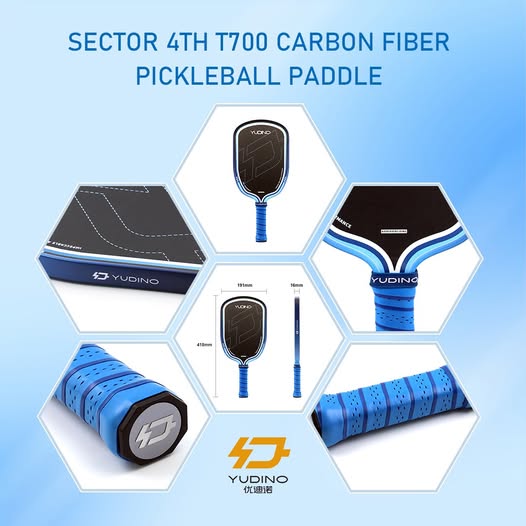
Carbon Fiber vs. Fiberglass vs. Graphite: The Definitive Comparison
The three most common paddle face materials in the market today each deliver a distinct performance profile. Here is how they compare:
| Property | Carbon Fiber | Fiberglass | Graphite |
|---|---|---|---|
| Spin generation | ⭐⭐⭐⭐⭐ Highest grit | ⭐⭐⭐ Moderate | ⭐⭐⭐ Low-moderate |
| Power / pop | ⭐⭐⭐⭐ Stiff + fast | ⭐⭐⭐⭐⭐ Springback effect | ⭐⭐⭐ Moderate |
| Control / touch | ⭐⭐⭐⭐⭐ Excellent | ⭐⭐⭐ Moderate | ⭐⭐⭐⭐ Good |
| Feel / feedback | Crisp, defined | Soft, forgiving | Light, less feedback |
| Durability | High (T700) | Moderate | Moderate-high |
| Weight | Very light | Moderate | Lightest |
| Price range | $40–$250+ | $25–$150 | $50–$180 |
| Best for | Intermediate–Advanced | Beginners–Intermediate | All-round / beginners |
The key insight from this comparison is that carbon fiber does not simply win on every dimension — fiberglass outperforms it in raw power/pop for drive-oriented play, and graphite paddles are lighter. Carbon fiber's advantage is its combination of spin capability and control at a stiffness level that is very difficult to match with other materials.
For players at the 3.0 DUPR rating and above, the carbon fiber's spin and control advantages directly translate to more strategic options on every point. Below 3.0, where technique is still developing, fiberglass forgiveness may actually be the better developmental tool.
USAPA Approval: Why It Matters and What to Check
The USA Pickleball Association (USAPA) tests and approves paddle models for tournament play. The approval requirements include:
Maximum combined length + width of 24 inches
Smooth, non-reflective paddle face
No sharp edges or protrusions
Materials that do not delaminate or alter ball trajectory in ways inconsistent with standard play
For recreational players, USAPA approval is optional — no one is testing your paddle in a Sunday morning recreational game. But for anyone who plays organized competitive play, leagues, or tournaments, USAPA-approved paddles are required. Paddles that are not on the approved list cannot be used in sanctioned events, regardless of their performance characteristics.
The practical implication for buyers is straightforward: if tournament play is any possibility now or in the future, buy USAPA-approved paddles from the start. Most quality paddles in the $60-and-above range target USAPA approval as a selling point — but the approval should be verified against the current USAPA approved paddle list, as models can be removed from the list if equipment standards change.
Thermoform Construction: The Manufacturing Difference That Changes Performance
Thermoform technology represents the most significant manufacturing advancement in paddle construction in recent years. Traditional paddle assembly bonds the face skins to the honeycomb core with adhesive — a process that, while adequate, creates microscopic gaps and inconsistent bonding pressure across the face surface. These inconsistencies produce variation in the feel of the paddle across different areas of the face.
Thermoform construction bonds the face skins to the core using heat and pressure applied uniformly across the entire face in a controlled manufacturing environment. The result is a more complete, more consistent bond between every point of the face skin and the core — producing a paddle that feels more uniform across the face, transmits vibration more consistently, and maintains structural integrity longer under the stress of regular play.
Paddles manufactured with thermoform technology reliably outperform equivalent specification adhesive-construction paddles in durability and consistency. The process is also more demanding manufacturing-wise, which is why thermoform paddles are more commonly found in the $100-and-above range — though the technology has been filtering into budget categories as it scales.
For players who are serious about equipment performance and longevity, thermoform construction is the specification to look for when comparing paddles at similar price points.
Common Buying Mistakes That Players Make
Buying on brand name without checking specifications. A recognizable brand name does not guarantee T700 fiber, 16mm core, or quality construction. Two paddles from the same brand can use completely different specifications at different price points. Always check the material grade, core thickness, and construction method — not just the brand.
Selecting grip size by instinct rather than measurement. Most players who complain about arm fatigue or loss of touch in the kitchen are using the wrong grip size. It takes 30 seconds to verify correct grip size using the measurement method described above. This single parameter affects every touch shot in your game.
Prioritizing weight over feel. Lighter is not automatically better. A paddle that is too light for a player's swing speed produces inconsistent results on drives because the paddle deflects unpredictably on contact. Match the weight to your natural swing — most players are in the 7.6 to 8.0 oz range.
Ignoring USAPA approval status. If you play any organized competition, verify approval status before purchasing. Non-approved paddles cannot be used in sanctioned events — a $200 paddle that is not on the approved list is useless in a tournament.
Expecting carbon fiber to fix technique problems. A carbon fiber pickleball paddle amplifies good technique and bad technique equally. Players who have not developed consistent soft game mechanics will generate unintended spin with a raw carbon face that reduces rather than improves their consistency. Match the paddle specification to your current skill level, not the skill level you aspire to reach.
Buying the cheapest available "carbon fiber" option. Carbon fiber is a generic material description. A $15 paddle marketed as carbon fiber may be using T300 fiber with a thick protective coating that negates most of the material's benefits. Budget T700 options from reputable manufacturers exist in the $50 to $90 range — that is the starting point for genuine carbon fiber performance.
Frequently Asked Questions
Q: Is a carbon fiber pickleball paddle worth the price upgrade from fiberglass?
A: For players at the 3.0 rating and above, yes — consistently. The spin generation and control precision that T700 carbon fiber delivers are directly applicable at that level and above, and the playing experience difference is noticeable within the first session. For beginning players still developing consistent stroke mechanics, fiberglass's additional forgiveness is sometimes the better developmental choice. The upgrade is worth it when your technique is consistent enough to direct the spin rather than be surprised by it.
Q: What is the difference between raw carbon fiber and standard carbon fiber paddle faces?
A: Raw carbon fiber faces leave the fiber weave texture exposed without a protective finish coating. This maximizes surface grit — the micro-texture of the weave contacts the ball directly, generating more spin per swing than a coated face. The trade-off is that raw surfaces wear faster; the grit diminishes over time with regular play, and the open weave is more susceptible to moisture and abrasion damage. Coated faces sacrifice some spin potential for extended surface durability. For spin-priority players, raw carbon is the preference; for players who prioritize paddle longevity, the coated surface makes more practical sense.
Q: How long does a carbon fiber pickleball paddle last?
A: With regular recreational play (3 to 5 times per week), a quality carbon fiber paddle typically maintains its performance characteristics for 1 to 2 years before surface wear becomes noticeable in play. Raw carbon faces may show grit reduction earlier — at the 9 to 14 month mark for frequent players. Signs that a paddle has worn beyond effective performance include visibly smooth face areas where grit texture is gone, delamination at the edge guard, or core damage (soft spots on the paddle face that feel different from the surrounding area). Proper care — keeping the paddle dry, storing it in a protective case, and cleaning the face with a damp cloth — meaningfully extends service life.
Q: Do I need a USAPA-approved paddle for recreational play?
A: No. USAPA approval is only required for sanctioned tournament and league play. For recreational games, open courts, and social play, any paddle can be used regardless of approval status. The approval matters the moment you enter a formal competitive environment. Since approved paddles span from budget to premium price points, there is no cost reason to buy a non-approved paddle unless you have a specific performance preference that is only available in a non-approved model.
Q: What is the best carbon fiber paddle for someone switching from tennis?
A: Tennis players transitioning to pickleball often find that their existing power and swing mechanics transfer effectively — but the reduced court size and kitchen line play require a recalibration toward touch and soft-game control. For tennis players, the recommendation is typically a standard-shape, 16mm core paddle with T700 carbon fiber at mid-weight (7.8–8.0 oz). The 16mm core gives the soft-game forgiveness that tennis players need while learning the short-swing dink game; the T700 face provides the spin capability that transfers from topspin-oriented tennis technique. An extended handle (5.5 inches) accommodates the two-handed backhand preference common among tennis players without requiring a complete grip style change.
Conclusion
The carbon fiber pickleball paddle market in 2025 offers exceptional options across every budget and playing level — but the quality difference between a well-specified carbon fiber paddle and an average one is significant enough to make informed selection genuinely important.
The core specifications that determine whether a paddle performs at its potential are the material grade (T700 or above for serious play), the core thickness matched to your playing style (16mm for control and kitchen play; 13mm for power and pace), the construction method (thermoform for consistency and longevity), and the fit parameters of weight and grip size that match your physical characteristics and swing style.
The playing level match matters as much as the technical specifications. A raw T700 carbon fiber paddle maximizes spin and control for a player with consistent technique — and introduces unpredictability for a player whose mechanics are still developing. A budget T700 paddle that is right for your skill level outperforms a premium paddle that is mismatched to your game.
The decision is not simply about buying the most expensive or most technically advanced paddle on the market. It is about matching the specification to the player, which is the same decision that separates genuinely useful equipment guidance from generic product marketing. With the framework in this review, you have the technical foundation to make that match correctly.
Looking for custom specifications or OEM carbon fiber pickleball paddle production? Our manufacturing team provides material grade verification, construction method selection, and regulatory compliance support for professional equipment requirements.