Carbon Fiber Pickleball Paddle for Spin: The Complete Guide
Everything you need to know about choosing, using, and sourcing the right carbon fiber paddle to maximize spin — from the material science to the on-court strategy.
Introduction: Spin Has Changed the Game — Has Your Paddle Caught Up?
Pickleball is not the same sport it was five years ago. The recreational game where players simply rally the ball back and forth has evolved into a competitive discipline where spin is a primary strategic weapon at every level above beginner. Topspin thirds that dip sharply into the kitchen. Heavy slice drops that skid low through the Non-Volley Zone. Sidespin dinks that pull opponents off position. Topspin lobs that arc deceptively before dropping beyond reach. These are not advanced techniques reserved for professionals — they are patterns that 4.0 players regularly face and aspiring players at 3.5 actively work to develop.
This evolution has fundamentally changed what a performance paddle needs to deliver. Five years ago, power and control were the marketing axes around which paddle development revolved. Today, spin generation has emerged as the third axis — and for many competitive players, the most important one. The question is not whether your paddle should help you generate spin. It is whether your current paddle is preventing you from generating the spin your technique is capable of producing.
The answer, for a significant fraction of players, is yes — and the solution begins with the face material.
A carbon fiber pickleball paddle — particularly one built with the right weave, surface treatment, and construction for spin — generates spin more efficiently and more consistently than graphite, fiberglass, or composite paddles that dominated the market a decade ago. The physics behind this advantage are well-established. The engineering that translates those physics into a reliable, approved, performance-grade paddle is specific and demanding. And the selection criteria that determine which carbon fiber paddle is actually optimized for spin, as opposed to merely marketed that way, are the subject of this guide.
Whether you are a player trying to unlock your spin potential, a coach selecting equipment for a training program, or a buyer sourcing paddles for a spin-focused performance retail line, the following pages give you the complete technical and practical framework to make the right decision.
Part One: The Physics of Spin — Why Paddle Surface Matters More Than You Think
How Spin Is Actually Generated on a Pickleball
Before evaluating paddles for spin, it is essential to understand what physically creates spin on a pickleball during a stroke. The mechanism is more specific than most players realize — and it directly explains why surface material is the dominant equipment variable for spin generation.
When a pickleball contacts a paddle face during a brushing stroke, two forces act simultaneously on the ball:
Normal force: Perpendicular to the paddle face, this force pushes the ball away from the face and determines the ball's direction of travel (its translational velocity).
Friction force: Parallel to the paddle face surface, this force acts on the ball's equator as the face moves across it. When the paddle face moves in the direction of the intended spin — upward for topspin, downward for backspin, sideways for sidespin — friction drags the ball's surface in that direction, creating angular momentum (spin).
The amount of spin generated is directly proportional to the friction force, which is in turn determined by:
The coefficient of friction between paddle face and ball — higher friction = more spin for the same contact
The contact duration (dwell time) — longer contact = more time for friction to act on the ball
The relative velocity — how fast the face moves across the ball during the brush contact
Of these three factors, the coefficient of friction is the one most directly controlled by paddle face material and surface treatment. This is why a carbon fiber pickleball paddle with appropriate surface texture generates more spin than a smooth graphite paddle even when the player uses identical technique — the carbon fiber surface simply grips the ball more effectively, converting brush contact into rotational energy more efficiently.
The Surface Texture — Spin Connection
The surface texture of a paddle face determines how the face physically interacts with the ball's surface at the microscopic level during contact. A rough, textured surface has more contact points with the ball's outer polymer layer — each contact point generates a friction force contribution. More contact points at the same contact pressure create a higher effective friction coefficient and therefore more spin generation.
This is why carbon fiber weave patterns — particularly 12K and 18K woven carbon, and especially raw (uncoated) surfaces — are specifically engineered for spin in performance paddles. The fiber crossover points in a woven carbon weave create a regular geometric texture of peaks and valleys. As the paddle face moves across the ball surface during a spin stroke, these peaks engage the ball's surface systematically, generating friction forces that transfer efficiently to ball rotation.
Compare this to a smooth graphite or fiberglass paddle surface: the absence of significant surface structure means less engagement, lower effective friction coefficient, and less spin for the same player technique.
The practical implication: A player who generates moderate spin on a smooth paddle will generate substantially more spin on a textured carbon fiber pickleball paddle with the same stroke mechanics. The paddle is not making the player a better athlete — it is translating their athletic input into spin output more efficiently.
USAPA Regulation: The Legal Spin Ceiling
USAPA (USA Pickleball Association) regulates paddle surface texture to ensure competition fairness. The Surface Roughness Standard defines a maximum permissible texture level — beyond which a paddle is considered to provide an unfair spin advantage and is disqualified from sanctioned play.
This regulatory ceiling is the engineering target for performance spin-optimized paddles: manufacturers work to produce surfaces that approach the maximum permitted texture without exceeding it, giving players the full allowed spin advantage within competition rules.
Raw carbon fiber surfaces — particularly 18K weave — naturally approach this regulatory ceiling in ways that coated or painted surfaces rarely achieve. This is the technical reason raw carbon fiber is associated with maximum spin capability in the competitive market: the uncoated fiber texture is the most direct expression of what the material can produce, and that texture sits near the top of what USAPA permits.
For players and buyers: any carbon fiber pickleball paddle marketed for maximum spin performance that is also intended for competition use must carry current USAPA approval. The approval is model-specific and should be verified against the official database before purchase for competitive use.
Part Two: Carbon Fiber Construction for Spin — Material Variables That Determine Performance
Weave Pattern: The First and Most Important Variable
The weave pattern of the carbon fiber face determines the surface texture geometry — the structure that physically engages the ball during spin strokes. This is the single most important material variable for spin performance, and the choice between 3K, 12K, and 18K weave is the most consequential decision when selecting a spin-optimized carbon fiber pickleball paddle.
3K Carbon Fiber Weave (3,000 filaments per bundle)
3K weave creates the finest, most uniform texture of the standard weave options. The fiber bundles are narrow, the crossover points are closely spaced, and the resulting surface pattern is a fine, regular grid. The surface texture is noticeable but moderate — significantly more engaging than a coated fiberglass surface, but less aggressive than 12K or 18K.
Spin capability: Above average. 3K surface generates more spin than graphite or fiberglass alternatives, and the regularity of the texture creates predictable spin output — the player gets consistent spin on consistent strokes. However, it does not approach the regulatory ceiling.
Best for: Players who want carbon fiber's material advantages (stiffness, power, feedback) and meaningful spin improvement, but who prioritize control and feel over maximizing spin output. Good for players building spin technique rather than those fully exploiting it.
12K Carbon Fiber Weave (12,000 filaments per bundle)
12K weave creates a markedly coarser texture than 3K. The fiber bundles are wider, the crossover points more pronounced, and the surface shows a visible, structured pattern of peaks. The texture is clearly more aggressive to the touch — the face grips the palm noticeably when slid across it.
Spin capability: Very high. 12K surface generates spin approaching the upper performance range for standard weaves. The combination of textured peaks and valley geometry creates efficient ball engagement during brush contacts. This is the most popular weave specification in competitive spin-optimized paddles because it balances maximum spin capability with manageable feel across all shot types including dinks and drops.
Best for: Competitive 4.0–5.0 players who actively use spin as a primary strategic weapon across all game zones. The most versatile high-spin option in the carbon fiber market.
18K Carbon Fiber Weave (18,000 filaments per bundle)
18K weave creates the most aggressive surface texture available in standard carbon fiber weaves. The fiber bundles are at maximum density, the crossover peaks are the most pronounced, and the surface feels distinctly grippy — approaching sandpaper-like engagement with the ball surface.
Spin capability: Maximum within standard weave construction. 18K raw carbon fiber surfaces approach the USAPA roughness ceiling more closely than any other standard weave option. Players who use 18K specifically report spin rates on topspin drives and brush drops that feel qualitatively different from what they achieved on other paddle surfaces.
Best for: Advanced players at 4.5–5.0+ who have fully developed spin-heavy game patterns and want every possible spin advantage within the rules. Requires technique maturity — the surface amplifies all contact including imperfect ones, and its aggressiveness can produce unintended spin variation for players whose contact is not yet consistent.
Raw vs. Coated Surface: The Processing Decision That Changes Everything
Equally important as weave pattern is the surface treatment decision: raw (uncoated) versus coated. This distinction, discussed in depth in the Raw Carbon Fiber article in this series, has profound implications for spin performance.
Coated surface: A polymer coating applied over the carbon fiber composite smooths the weave texture, fills in some of the valleys between fiber crossovers, and creates a more uniform surface. The coating reduces the effective friction coefficient of the face relative to the uncoated fiber. A coated 18K surface is less spin-aggressive than an uncoated (raw) 18K surface of identical weave and grade.
Raw surface: The uncoated carbon fiber weave is exposed directly as the playing surface. The full texture geometry of the weave is expressed — peaks, valleys, and directional fiber structure are all present at the ball contact level. The raw surface achieves the highest achievable friction coefficient for a given weave pattern, maximizing spin generation potential.
The practical performance difference: players who switch from coated carbon to raw carbon of the same weave pattern consistently report 15–30% higher spin rates on comparable brush strokes. This improvement is not technique-dependent — it reflects the material interaction difference between the coated and raw surface.
For players who are specifically looking to maximize spin performance, a raw surface carbon fiber pickleball paddle is the specification choice that delivers the full spin potential of the carbon fiber material. The trade-off — reduced moisture resistance, slightly more demanding technique requirement — is accepted by competitive players who prioritize spin performance.
Fiber Grade and Its Role in Spin Consistency
The carbon fiber grade — T700 versus standard industrial carbon — matters for spin in a way that is less obvious than surface texture but equally important for consistent performance: material uniformity.
Standard grade carbon fiber shows greater variation in fiber diameter, weave geometry, and surface properties within and between production batches. On a raw surface, this variation manifests as local differences in texture and friction — the surface grips the ball differently at different points across the face. This inconsistency means spin generation varies depending on where the ball contacts the face, which reduces the repeatability of spin-heavy patterns.
T700 grade carbon fiber is produced to tighter dimensional tolerances, with more consistent fiber diameter, surface chemistry, and weave geometry. On a raw surface, T700's manufacturing precision creates a more uniform texture across the face — the friction coefficient is consistent from the center to the edges. Players experience predictable spin output regardless of contact location, which allows spin-heavy patterns to be built as reliable, repeatable shots rather than variable outputs.
For players who want to build a serious spin game — topspin drives that consistently dip at the same point, slice drops that reliably skid at the same angle, sidespin dinks that consistently pull opponents in a specific direction — T700's surface consistency is the material foundation of that repeatability.
Part Three: Spin Technique and How Paddle Specification Enables It
The Spin Strokes That Carbon Fiber Enables
Understanding which specific shots benefit most from a spin-optimized carbon fiber pickleball paddle helps players evaluate whether spin capability is actually a priority for their game.
Topspin Third-Shot Drive
The third-shot drive with topspin has become a primary offensive pattern at the 4.0+ competitive level. The topspin causes the ball to travel with a downward-curving trajectory after the apex — making it harder for opponents to volley aggressively and more likely to produce a pop-up return or force a reset. On a raw carbon surface, players can generate meaningful topspin with a drive that still travels fast — the surface enables spin without requiring the player to sacrifice pace for brush angle.
Without sufficient surface texture, generating topspin on a hard drive requires exaggerating the brush angle until it compromises pace. With a raw 12K or 18K carbon fiber surface, the grip enables topspin generation at more moderate brush angles, allowing the player to maintain drive velocity while still generating useful ball rotation.
Heavy Slice Drop
The slice drop — a third or fifth shot that crosses the net with backspin and lands softly in the kitchen — is one of the most valuable patterns in competitive doubles pickleball. The backspin causes the ball to check up on bouncing rather than skidding through, giving the hitting team time to advance to the NVZ. On an aggressive carbon fiber surface, a brush-down contact generates enough backspin to reliably produce this checking behavior.
Players who report the most improvement after switching to raw carbon fiber paddles frequently cite their drop shot as the primary beneficiary. The surface enables the slice drop to be a reliable pattern rather than an occasionally successful experiment.
Sidespin Dink
At the highest levels of competitive doubles, sidespin dinks — dinks hit with a sideways brushing contact that produce lateral ball movement after bouncing — are used to push opponents off their position, force awkward contact angles, and set up Erne opportunities. Generating meaningful sidespin in the compact, wrist-limited mechanics of the dink game requires excellent surface grip.
On a high-texture carbon fiber surface, even the reduced swing speed of dink strokes generates detectable sidespin. On a smooth surface, the same compact stroke mechanics produce essentially no sidespin — the ball simply bounces straight. This difference becomes the basis of a whole pattern category that rough-surface players have access to and smooth-surface players do not.
Topspin ATP (Around the Post)
ATP shots — hit around the net post on wide balls — do not have to cross the net and therefore can be hit at court-level trajectory. Adding topspin to an ATP allows the ball to dip quickly after the peak of its arc, making it more difficult to retrieve. On raw carbon fiber, ATP topspin generation is more accessible because the surface grip does not require extreme brush angles to produce meaningful ball rotation.
How Technique and Surface Work Together
A crucial point that experienced coaches and high-level players consistently emphasize: paddle surface is a multiplier of technique, not a replacement for it. A raw carbon fiber paddle in the hands of a player who pushes the ball flat will not magically produce spin — the contact mechanics that create spin must be present in the stroke.
What the surface does is determine the efficiency of spin generation for a given technique input. A player brushing up at 30° from vertical with a raw 18K carbon surface will produce significantly more topspin than the same brush angle with a smooth graphite surface. The raw carbon did not change the player's stroke — it changed how much spin that stroke produces.
This efficiency relationship has an important practical implication: improving your technique and improving your surface specification are both investments in spin performance, and they compound. A player who develops a good brushing technique AND uses an appropriate raw carbon fiber surface will generate far more spin than one who develops only technique on a smooth surface or has excellent surface but poor technique.
The Spin Adjustment Period
Players who upgrade to a raw carbon fiber paddle specifically for spin performance almost universally report an adjustment period of 2–4 weeks. During this period:
Dinks and drops that previously went where intended may go slightly longer or shorter, because the surface is adding spin to contacts that were previously hit flat — changing ball behavior after the bounce
Drives may curve more than expected, requiring adjustment of aim
The increased grip feels unfamiliar on some soft shots, requiring deliberate relaxation of contact to prevent unintended hard hits
These are not signs of a problem — they are signs of a surface that is working as designed. The adjustment period is the process of recalibrating technique to use the surface intentionally rather than being surprised by it. Players who persist through this period consistently report that their spin game emerges on the other side meaningfully improved.
Part Four: Selecting a Spin-Optimized Carbon Fiber Paddle — The Decision Framework
Step 1: Assess Your Spin Game's Current State
Before specifying a spin-optimized carbon fiber pickleball paddle, honest assessment of your current spin usage is essential. The right specification depends on where you are, not where you intend to be:
Spin is currently aspirational (below 3.5 level): You intend to develop spin patterns but have not yet built reliable brushing mechanics. At this stage, a 12K coated carbon fiber surface is appropriate — it offers spin improvement over graphite/fiberglass while being more forgiving of flat or inconsistent contact than a raw surface.
Spin is emerging (3.5–4.0 level): You generate spin intentionally and are building specific spin shot patterns, but they are not yet fully reliable. A 12K raw carbon or 18K coated surface is the right progression — meaningful spin enhancement with manageable surface aggressiveness.
Spin is a primary weapon (4.0–4.5): You deliberately use spin across multiple shot categories and have developed reliable brushing mechanics. A 12K or 18K raw carbon surface — preferably T700 grade for surface consistency — is the appropriate specification.
Spin is the foundation of your game (4.5+): You build entire point-winning sequences around spin patterns and need the maximum spin generation within regulation limits. 18K raw T700 or titanium carbon fiber is the specification to evaluate.
Step 2: Choose Surface Specification
Based on your spin game assessment:
| Level | Face Specification | Rationale |
| Emerging (sub-3.5) | 12K coated carbon | Spin improvement without maximum surface demand |
| Building (3.5–4.0) | 12K raw or 18K coated | Step up in spin with controlled aggressiveness |
| Competitive (4.0–4.5) | 12K raw T700 | High spin with T700 consistency for repeatability |
| Elite (4.5+) | 18K raw T700 or titanium | Maximum spin within USAPA limits |
Step 3: Match Core Thickness to Your Spin Strategy
Core thickness interacts with spin generation in a less obvious but significant way — through ball dwell time.
16mm core + spin surface: The longer dwell time of a 16mm core gives the friction force more time to act on the ball during each contact. In spin stroke mechanics where the contact duration is an asset, this additional time produces slightly more spin rotation for the same swing mechanics. 16mm is particularly beneficial for spin in the kitchen game — where contact forces are lower and every additional fraction of dwell time helps the surface grip translate into rotation.
13mm core + spin surface: The shorter dwell time of 13mm means spin is generated more from immediate high-velocity contact than from extended contact duration. 13mm is better suited to drive-based topspin (where swing speed is high and dwell time is less critical) than to finesse spin shots in the kitchen.
Recommendation for spin-focused players: Unless your spin game is primarily drive and baseline oriented, 16mm core is the preferred specification for spin optimization — the dwell time advantage compounds with the surface grip advantage.
Step 4: Consider Weight and Balance for Spin Strokes
Swing speed is the third input to spin generation — and swing speed is partly determined by paddle weight and balance.
For spin on drives (topspin third-shot drive, spin ATP): Slightly head-heavy balance (more mass in the hitting zone) increases momentum on full swings, which translates to higher ball rotation rates on brush contacts with good swing speed.
For spin in the kitchen (sidespin dinks, slice drops): Balanced to slightly handle-heavy configuration enables faster hand speed and wrist action in compact strokes — the arm mechanics of kitchen spin shots are different from baseline spin shots, and a paddle that is too head-heavy becomes slow to maneuver in fast exchanges.
Recommended weight ranges:
| Spin Application | Weight | Balance |
| Drive-spin dominant | 7.8–8.3 oz | Slightly head-heavy |
| Kitchen-spin dominant | 7.3–7.7 oz | Balanced to handle-heavy |
| All-around spin | 7.5–8.0 oz | Neutral balance |
Part Five: YUDINO's Spin-Optimized Carbon Fiber Paddle Range
Engineering for Spin: YUDINO's Development Philosophy
YUDINO's approach to spin-optimized carbon fiber pickleball paddle production is grounded in the understanding that spin performance is a systems engineering challenge, not a single-variable optimization. Face texture is the most visible element — but fiber grade consistency, curing parameter control, core specification, and surface handling protocols all contribute to whether a paddle actually delivers its spin potential reliably.
The company's manufacturing experience in export markets — particularly the United States, where competitive pickleball players are among the most technically informed and demanding consumers in the global market — has driven continuous refinement of the construction elements that determine real spin performance versus marketing claims.
Titanium Carbon Fiber: The Spin Durability Solution
YUDINO's titanium carbon fiber paddle is the flagship spin product in the range. The titanium-enhanced fiber construction addresses a specific and important problem that emerges with raw carbon fiber spin paddles in heavy competition use: texture degradation.
A raw carbon fiber surface — the texture that delivers maximum spin — is an unprotected surface. As the paddle accumulates ball contacts over months of use, the fiber crossover peaks that create the spin-generating texture gradually wear. The surface becomes smoother over time, and spin performance degrades. Players who depend on spin as a primary weapon notice this degradation as their topspin drives become less aggressive and their slice drops lose their check behavior — long before the paddle has any structural damage.
Titanium integration hardens the raw carbon fiber surface, increasing the surface's resistance to this wear mechanism. The titanium-enhanced fiber crossover peaks maintain their texture geometry through significantly more ball contacts than standard carbon fiber. Players who use titanium carbon fiber paddles consistently report that the spin performance they experience in month 8 of ownership is meaningfully closer to month 1 performance than they experienced with standard raw carbon paddles.
For competitive players who depend on spin and need that dependency to be reliable across a full competitive season, this durability advantage is a real performance benefit — not a theoretical one.
T700 Raw Carbon: Precision Spin at Scale
YUDINO's T700 carbon fiber paddles — available in 12K and 18K weave options — represent the application of aerospace-grade fiber consistency to spin paddle production. As discussed in the T700 Guide in this series, the tighter manufacturing tolerances of T700 fiber create more uniform surface geometry across the paddle face.
For spin specifically, this uniformity means:
The friction coefficient is consistent across the full face, not just at the center
Spin generation behaves predictably regardless of where the ball contacts the face
Spin patterns built on T700 are more reliable and repeatable than on standard-grade carbon
YUDINO's T700 raw surface paddles are produced under specific surface handling protocols that protect the uncoated fiber during manufacturing, inspection, and packaging. The raw surface quality that leaves YUDINO's production facility is the same quality that arrives in the player's hands — not a surface that has been degraded by careless post-production handling.
18K Woven Carbon: Maximum Surface Engagement
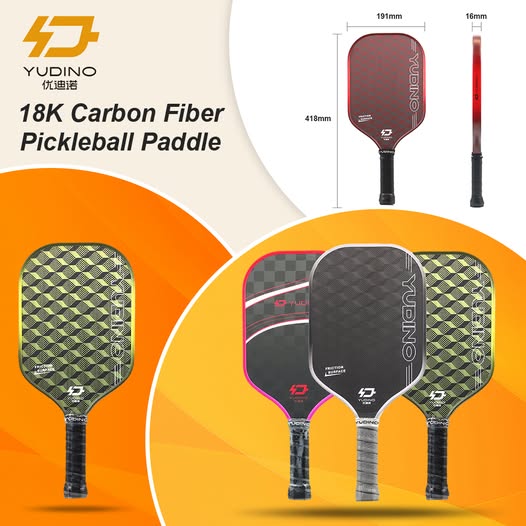
For players at the elite competitive level who want maximum spin generation within regulation limits, YUDINO's 18K carbon fiber paddle delivers the coarsest standard weave texture in the product range. The 18K surface on raw treatment is the specification that most closely approaches the USAPA surface roughness ceiling, giving players the full spin advantage permitted by competition rules.
YUDINO's 18K paddles are designed and tested to remain within USAPA compliance on the raw surface specification — the surface aggressiveness that makes them spin-optimized does not exceed what the regulations allow. Players using 18K YUDINO paddles in USAPA-sanctioned competition can be confident the surface meets current compliance standards.
12K Carbon Fiber: The Versatile Spin Performer
For players who want high spin capability across all game zones without the maximum surface aggressiveness of 18K, YUDINO's 12K raw carbon paddle is the most versatile spin-optimized option. The 12K surface generates very high spin rates on drive and brush contacts while remaining manageable in the touch game — the dink feel is still excellent, drops are controllable, and resets are precise.
The 12K specification is particularly well-suited to players who use spin strategically across multiple shot categories rather than maximizing spin on a narrow set of specialty shots. For the 4.0–4.5 player whose game includes topspin drives, slice drops, sidespin dinks, and spin-based lobs, 12K delivers meaningful spin improvement in all of these contexts without the extreme touch demands of 18K.
Part Six: Spin-Focused Parameter Recommendations
Complete Specification Guide by Player Profile
The Developing Spin Player (3.5–4.0, Building Spin Patterns)
| Parameter | Specification | Reason |
| Face Material | 12K coated carbon or 12K raw | Step-up spin without maximum aggressiveness |
| Core Thickness | 16mm | Dwell time aids spin in developing touch |
| Core Density | Standard | Forgiving feel during technique development |
| Weight | 7.4–7.8 oz | Light enough for kitchen maneuverability |
| Balance | Neutral | Versatile across all shot types |
| Handle | 5 inches standard | General purpose |
| USAPA | Verify for competitive play | Important as skill advances |
The Competitive Spin Player (4.0–4.5, Spin as Primary Weapon)
| Parameter | Specification | Reason |
| Face Material | 12K raw T700 or 18K raw T700 | Maximum spin with surface consistency |
| Core Thickness | 16mm | Dwell time + spin surface for kitchen excellence |
| Core Density | Standard | Spin and touch balanced |
| Weight | 7.6–8.0 oz | Power on drives, agile in kitchen |
| Balance | Neutral to slight head-heavy | Drives and spin exchanges |
| Handle | 5–5.5 inches | Flexible for two-hand backhand spin |
| USAPA | Mandatory — verify current status | Competition requirement |
The Elite Spin Player (4.5+, Spin System as Competitive Foundation)
| Parameter | Specification | Reason |
| Face Material | 18K raw T700 or Titanium Carbon | Regulatory ceiling spin + durability |
| Core Thickness | 16mm (or 16–21mm for kitchen specialty) | Maximum dwell-time spin in kitchen |
| Core Density | Standard or high | Player preference on feel character |
| Weight | 7.8–8.2 oz | Drive spin momentum + kitchen speed |
| Balance | Slight head-heavy to neutral | Versatile across spin shot types |
| Handle | 5.5–6 inches | Two-handed backhand spin capability |
| USAPA | Mandatory — verify current status | Non-negotiable at the competitive level |
OEM Buyer: Spin-Focused Performance Line
| Parameter | Specification | Reason |
| Face Material | Raw 12K T700 or 18K Titanium Carbon | Premium spin credential for performance marketing |
| Core Thickness | 16mm | Broadest competitive player appeal |
| Customization | Full face graphics, edge, handle, grip | Brand differentiation in the spin segment |
| Documentation | USAPA compliance + material cert | Retail and platform requirements |
| Target Price Tier | Premium performance | Spin-optimized paddles command premium positioning |
Part Seven: Common Mistakes When Buying a Spin-Optimized Paddle
Mistake 1: Assuming Any "Carbon Fiber" Paddle Is Spin-Optimized
This is the most prevalent and consequential misunderstanding in the spin paddle market. "Carbon fiber" as a face material designation covers an enormous range of actual surface specifications — from smooth, heavily coated carbon composite that performs similarly to graphite for spin purposes, to raw 18K fiber that approaches the regulatory ceiling for surface aggressiveness.
A player who buys a carbon fiber pickleball paddle expecting spin-optimized performance based on the "carbon fiber" label without investigating surface treatment and weave pattern may find that their new carbon paddle performs no better than their graphite paddle for spin — because the carbon has been processed to a smooth finish that eliminates the texture advantage.
Corrective approach: When evaluating a paddle for spin, ask specifically: Is the surface raw or coated? What is the weave pattern (3K/12K/18K)? Has the surface texture been tested against USAPA standards? A manufacturer who cannot answer these questions directly either does not know the specification of their own product or is deliberately obscuring it.
Mistake 2: Choosing Maximum Spin Surface Before Technique Is Ready
The 18K raw carbon surface delivers maximum spin — but only if the player's technique produces intentional brushing contact reliably. A player whose contact is inconsistent — sometimes flat, sometimes brushed, sometimes topped — will experience inconsistent spin output on a 18K raw surface that is actually worse from a game management perspective than a more moderate surface that produces consistent if lower spin output.
"I switched to a raw 18K paddle because everyone on Reddit was talking about it and my spin game was going to improve. For the first month it was a disaster — I was shanking dinks, overshooting drops, and my drives were all over the place. My coach watched me play and said: your contact is too inconsistent for this surface. Go back to 12K coated for six months and build the contact, then try 18K again. She was right."
This Reddit player's experience is almost universally echoed in spin paddle discussions. The surface is a tool that requires the technique to use it. Buying the most aggressive surface before the technique exists to exploit it is an expensive way to slow down your development.
Corrective approach: Match surface aggressiveness to your current technique consistency, not your aspirational spin goals. If you are not consistently making intentional brushing contact, start with 12K coated or 12K raw before considering 18K.
Mistake 3: Ignoring Core Thickness When Prioritizing Spin
Players who focus entirely on surface specification when selecting for spin and ignore core thickness are leaving performance on the table. The 16mm core's dwell time advantage compounds with the surface grip advantage in the kitchen game — where both are contributing to spin generation simultaneously. A player who correctly selects 18K raw surface but pairs it with a 13mm core for power is optimizing for drives at the expense of kitchen spin, when the kitchen is where spin-based patterns are most strategically valuable.
Corrective approach: For spin-focused paddle selection, specify 16mm core as the default unless the primary application is drive-based spin from the baseline, in which case 13mm may be evaluated.
Mistake 4: Neglecting USAPA Compliance on Spin-Optimized Surfaces
Spin-optimized surfaces specifically exist to approach USAPA roughness limits — which means they are closest to the boundary between compliant and non-compliant. Some paddle models marketed for maximum spin exceed USAPA roughness limits, either by original design (the manufacturer targeted beyond the limit) or by manufacturing variation (some production units exceed the limit even if the intended specification is compliant).
A player who uses a non-USAPA-compliant paddle in sanctioned competition will have the paddle rejected at equipment inspection and must either play with a different paddle or withdraw from the event. Given the specific relationship between spin optimization and USAPA roughness limits, compliance verification is more important for spin-focused paddles than for standard paddles.
Corrective approach: Verify USAPA approval for the specific model and current version before purchasing for competitive use. Do not rely on prior-season approval — USAPA standards evolve and paddle models can be removed from the approved list.
Mistake 5: Buying Without Testing, Especially When Transitioning Spin Styles
A player transitioning from a push-and-place game to a spin-based game faces a particularly significant adjustment when combining technique development with equipment change simultaneously. Buying a raw carbon fiber paddle and changing spin technique at the same time makes it impossible to isolate what is improving technique from what is improving equipment — and if the paddle is wrong for the player's current development stage, both transitions may fail together.
Corrective approach: If possible, demo spin-optimized paddles before purchasing, or purchase from a source with a trial return policy. Demo your current strokes on the new paddle before committing to both the equipment change and the technique development simultaneously. Start with the technique — develop more intentional brushing contact on your current paddle — then switch to the spin-optimized paddle once the contact mechanics are more reliable.
Mistake 6: For OEM Buyers — Not Documenting Spin Performance Claims
OEM buyers who market paddles as "maximum spin" or "spin-optimized" without being able to document the surface specification that supports that claim are creating a liability. As pickleball buyers become more technically educated — and the Reddit and Quora communities have accelerated this education significantly — vague spin claims from brands that cannot back them up with weave pattern, surface treatment, and USAPA compliance data increasingly damage brand credibility.
Corrective approach: For any spin-marketing claim, document the supporting specification: weave pattern, raw vs. coated surface treatment, measured surface texture (if available), and USAPA approval status. Work with a manufacturer who can provide this documentation and include it in product listings, where technically sophisticated buyers increasingly expect to find it.
Conclusion: Spin Is a System — and Carbon Fiber Is Its Foundation
The shift toward spin-based competitive pickleball is not a passing trend — it reflects a fundamental evolution in how the sport is played at every level above beginner. Spin creates tactical complexity, opens new shot categories, and generates errors from opponents in ways that flat-ball pickleball cannot. As more players develop spin technique, the competitive pressure to generate and handle spin increases — and the equipment that best enables spin generation becomes more valuable.
A spin-optimized carbon fiber pickleball paddle is not just an equipment upgrade — it is an enabler of a different, more sophisticated game. The right surface texture, in the right grade of carbon fiber, on the right core specification, translates the player's technique investment into spin output more efficiently than any other paddle material category. The physics is clear. The engineering is established. The product options are better than they have ever been.
But spin is a system, not a product feature. Surface texture is the most important equipment variable — and it must be matched to the player's technique maturity, playing level, and strategic priorities. A raw 18K surface in the right hands is a genuine competitive weapon. In the wrong hands, it is a source of inconsistency and frustration. Getting the match right between player profile and surface specification is the central challenge of spin-focused paddle selection — and it is a challenge that begins with honest self-assessment and ends with appropriate equipment that earns its performance claims.
YUDINO's range of spin-optimized carbon fiber pickleball paddles — from 12K T700 through 18K raw and titanium carbon — is built on verified materials, controlled production, and the export market experience that comes from supplying technically demanding buyers across North America and Europe. The spin capability is real. The documentation is available. The selection guidance is in your hands.
Develop the technique. Match the surface. Build the spin game. In that order.
Contact YUDINO to Find the Right Spin Paddle
Whether you're building your own paddle brand, sourcing OEM/ODM products, or expanding your product lineup with high-performance carbon fiber pickleball paddles, YUDINO is ready to help. Our team can recommend the most suitable surface material, core configuration, thickness, weight balance, handle design, and customization options based on your target market, customer preferences, and player profile.
From material verification and quality control to private labeling, logo printing, packaging design, and global export support, we provide a complete manufacturing solution designed for long-term business success. Every paddle is produced with carefully selected materials, consistent manufacturing standards, and strict quality inspections to ensure reliable performance and stable product quality across every production batch.
Whether you are launching a new product line, developing a premium series, or looking for a dependable manufacturing partner, our experienced export team can guide you through every step—from product selection and prototyping to mass production and international delivery. We are committed to providing responsive communication, flexible customization, and professional technical support throughout your project.
Contact YUDINO today to request product specifications, material samples, OEM/ODM consultation, or a competitive quotation. Let us help you deliver paddles that perform on the court, meet the expectations of today's spin-focused players, and strengthen your competitive position in the fast-growing global pickleball market.