Carbon Fiber Pickleball Paddle vs Kevlar Face
Introduction
Walk into any serious pickleball conversation—on Reddit, in a Quora thread, or at the court between games—and the carbon fiber versus Kevlar debate surfaces fast. Both materials have passionate advocates. Both have real, documented performance advantages. And both get misrepresented constantly by sellers who prioritize marketing language over material science.
The decision matters. Paddle face material is one of the single most consequential choices a player makes, because the face determines how the ball interacts with your paddle on every single shot. Spin, power, control, touch, durability, weather performance—all of it flows from the face material and how it was engineered.
This guide cuts through the noise. We've pulled together technical knowledge from manufacturers, insights from competitive player communities, and real data on how these materials behave under match conditions. Whether you're a spin-oriented player chasing maximum topspin on your drops, a power hitter looking for pop without sacrifice, or a coach advising students on their first equipment upgrade, this comparison will give you the factual foundation you need to make the right call.
Carbon fiber and Kevlar are not simply "better" and "worse." They are different material philosophies with different performance profiles. The question is which philosophy serves your game.
What Is Carbon Fiber and How Does It Work in a Pickleball Paddle Face?
Carbon fiber is a composite material made from thin crystalline filaments of carbon atoms bonded in a lattice structure. Each filament is extraordinarily strong in tension—stronger by weight than steel—and the fibers are woven into sheets that form the basis of paddle face construction.
The weave pattern is where paddle performance engineering becomes genuinely complex. Manufacturers don't just use "carbon fiber"—they specify fiber count, weave density, and surface treatment, and these choices produce dramatically different performance characteristics.
Understanding Fiber Count: 3K, 12K, and 18K
The "K" designation in carbon fiber describes the number of filaments bundled in each tow (strand). This is the foundation of surface performance:
3K carbon fiber (3,000 filaments per tow) produces a tight, fine-textured weave. The result is a relatively smooth surface compared to higher-K counts, with a uniform feel that provides predictable touch. 3K paddles are well-suited to control-oriented players who prioritize placement precision over maximum spin generation.
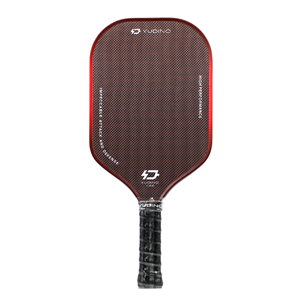
12K carbon fiber (12,000 filaments per tow) creates a visibly more textured surface with larger weave pattern cells. Yudino's 12K tournament paddle series uses thermoformed construction—a manufacturing process that applies heat and pressure during formation to produce a denser, more consistent face with superior structural integrity. The result is a bigger sweet spot, enhanced shock absorption, and a stronger rebound character that serves both power and spin players effectively.
18K carbon fiber (18,000 filaments per tow) generates the most aggressive surface texture in the carbon fiber family. Yudino's 18K Power Pro paddle pairs this high-texture face with a PP (polypropylene) honeycomb core at 16mm interior thickness—a combination engineered to deliver exceptional spin generation while maintaining stability and power balance. The open weave pattern on 18K surfaces grips the ball more aggressively, producing more topspin and sidespin on every contact point.
Titanium Carbon Fiber: The Premium Evolution
Beyond standard carbon fiber weave classifications, advanced manufacturing has produced titanium-infused carbon fiber as a distinct performance tier. Yudino's titanium carbon fiber paddle line integrates titanium alloy compounds into the carbon fiber matrix, producing a face that:
Maintains the natural carbon fiber surface texture that generates spin
Adds structural resilience that extends face integrity over time
Provides a slightly coarser tactile surface specifically designed for precision touch feedback
Delivers a clean, direct response on dinks, drives, and volleys that players describe as "fast and immediate"
Titanium carbon fiber represents the current frontier of carbon fiber paddle engineering—not merely a material upgrade but a rethinking of what a high-performance face can do for technique-driven players.
T700 Carbon Fiber: The Technical Standard
T700 is a specific carbon fiber grade designation referring to the tensile strength rating of the fibers themselves (700 ksi tensile strength). In pickleball paddle construction, T700 carbon fiber is recognized as a quality benchmark—it provides an excellent strength-to-weight ratio, consistent surface properties, and reliable durability. Players seeking T700-grade paddles are typically investing in a measurable step above generic "carbon fiber" claims.
What Is Kevlar and How Does It Differ?
Kevlar is the DuPont brand name for para-aramid synthetic fiber—a polymer-based material known primarily for its extraordinary impact resistance and tensile strength. Most people associate Kevlar with bulletproof vests and body armor, which gives a useful intuitive sense of its properties: it absorbs and distributes impact energy rather than reflecting it.
In pickleball paddle construction, Kevlar is typically used as either:
A complete paddle face material (woven Kevlar sheets bonded over a core)
A hybrid layer added beneath carbon fiber or fiberglass to modify the paddle's energy absorption characteristics
The mechanical properties of Kevlar are fundamentally different from carbon fiber in ways that matter directly to pickleball performance.
Kevlar's Core Mechanical Properties
High impact absorption: Kevlar fibers deform elastically under impact—they flex, absorb energy, and return. This dampening effect produces a "softer" feel at the point of contact.
Lower modulus of elasticity: Kevlar is more flexible than carbon fiber, meaning the face deforms slightly more during ball contact before returning to its original shape. This contributes to the "soft" or "cushioned" feel that Kevlar paddle users report.
Excellent fatigue resistance: Kevlar maintains its structural properties across millions of impact cycles—it resists the small progressive failures that eventually cause carbon fiber faces to develop dead spots.
Higher friction coefficient at raw surface: Woven Kevlar can produce a high-friction surface, though the character of that friction differs from carbon fiber's spin-generating texture.
Yellow coloration: Genuine Kevlar has a distinctive yellow/gold color in its raw state. In paddle construction, this is often covered by surface coatings, but the yellow face material visible on some paddles indicates Kevlar use.
Head-to-Head: Carbon Fiber vs Kevlar Across Every Performance Dimension
This is the core of what players actually need to know. Let's go category by category with honest assessments.
Spin Generation
Carbon fiber wins decisively.
The textured weave of a carbon fiber pickleball paddle—especially in 12K and 18K formats—creates a surface topography that bites the ball on contact and redirects it with topspin or sidespin based on your stroke mechanics. The carbon fiber texture acts like miniature fins that grip the ball's polymer surface during the brief contact window and transfer rotational energy.
Kevlar's surface structure is fundamentally different. Even woven Kevlar generates friction, but the nature of that friction is broad and distributed rather than textured and specific. The energy absorption properties of Kevlar actually work against spin generation: some of the contact energy that should go into ball rotation gets absorbed by the flex in the Kevlar structure itself.
One Reddit player in r/Pickleball summarized the community consensus: "If spin is your game—drops, topspin drives, aggressive dinking—carbon fiber is just a better tool. Kevlar is engineered to absorb, not grip."
Power and Pace
Kevlar provides different power, not necessarily less.
Carbon fiber is stiffer—it transfers energy efficiently and produces a sharp, direct feel that many power hitters prefer. The energy return from a stiff face is fast and immediate.
Kevlar's energy absorption creates a brief "loading" effect during contact—the face yields slightly, then returns. Some players describe this as a "slingshot" effect, where the ball departs with a distinct pop that feels different from carbon fiber but can achieve comparable velocity on flat drives.
For players who rely on hard, flat groundstrokes, both materials can produce adequate power. The character of that power—immediate and direct versus absorbed and released—differs noticeably in hand feel.
Touch and Control
Kevlar has a legitimate advantage here.
The energy-absorbing properties that limit Kevlar's spin generation are exactly what make it exceptional for touch-dependent shots. Drop shots, resets, kitchen dinks—these require the ability to "catch" the ball's energy and redirect it softly. Kevlar's inherent dampening makes this feel more forgiving, particularly for players still developing reset technique.
This is why Kevlar remains popular in certain competitive demographics. Experienced players at the 4.0+ level who have already internalized control technique often find that carbon fiber gives them all the control they need. But developing players—and those coming from soft-touch racquet sports like squash—sometimes find Kevlar's forgiving quality more immediately usable.
A Quora respondent who has coached pickleball for six years wrote: "I've watched players go from Kevlar to carbon fiber and immediately improve their spin stats. I've also watched players move from carbon fiber to Kevlar-hybrid paddles and dramatically improve their net game. The material matters, but it has to match the game style."
Durability
Advantage: Kevlar, at the face level. Advantage: Carbon fiber, for texture retention.
Kevlar's impact resistance is not marketing language—it's structural engineering. Kevlar fiber paddle faces genuinely resist edge chips, face cracks, and mechanical damage from mishandlings better than carbon fiber faces.
However, "durability" in pickleball paddles is not just about physical structural survival—it's about maintaining performance over time. And here, carbon fiber—especially thermoformed and high-K count variants—has an advantage: the textured surface, once established through the manufacturing process, holds up well to normal impact wear. A quality 18K or titanium carbon fiber pickleball paddle will maintain its spin-generating texture longer than most players expect.
Kevlar faces can develop surface glazing—a phenomenon where the surface texture gradually polishes smooth under repeated ball impacts. This is essentially the inverse of carbon fiber performance degradation: both materials degrade over time, but the degradation is faster on Kevlar surfaces that weren't designed for sustained texture retention.
Weather and Temperature Performance
Carbon fiber is more consistent across conditions.
Kevlar absorbs moisture slightly. In wet, humid conditions—outdoor courts in humid climates, covered courts with condensation—Kevlar faces can soften slightly, changing feel and sometimes altering performance characteristics predictably. The performance shift is typically subtle, but players who compete in variable outdoor conditions report greater consistency from carbon fiber faces.
Carbon fiber's thermal expansion coefficient is also more stable than Kevlar's across temperature ranges. Cold-morning outdoor play with carbon fiber produces more predictable paddle performance than Kevlar in the same conditions.
Weight and Feel
Carbon fiber offers more weight distribution flexibility.
Because carbon fiber is stiffer and denser per unit than Kevlar, manufacturers have more control over paddle weight, balance point, and swing weight when designing carbon fiber paddles. This is why the wide variety of swing weights and balance profiles available in carbon fiber paddles exceeds what's available in Kevlar.
Kevlar paddles tend to fall in a narrower range of weight and feel profiles, with most running medium to medium-light weight ranges. Carbon fiber paddle lines span a broader spectrum from lightweight, agile models to heavier, power-oriented designs.
The Hybrid Reality: When Manufacturers Combine Both
One area where the "carbon fiber vs Kevlar" framing becomes oversimplified is in hybrid constructions. Many mid-to-premium paddles use carbon fiber as the primary face material with Kevlar incorporated into the inner layers of the sandwich construction—beneath the carbon fiber surface, above the core.
In these designs, the Kevlar serves as a dampening sublayer. The player experiences the spin and texture properties of carbon fiber on the face while the Kevlar underneath modulates the feel, reducing vibration and adding shock absorption.
This hybrid approach is a legitimate engineering solution—it attempts to capture the best properties of both materials. But it also means that a paddle marketed as a "carbon fiber paddle" may have Kevlar inside, and a paddle marketed as a "Kevlar paddle" may have a carbon fiber surface layer. Players comparing these categories need to read material specifications carefully rather than relying on category labels.
Who Should Choose a Carbon Fiber Pickleball Paddle?
Based on play style analysis and material performance data, a carbon fiber pickleball paddle is clearly the better choice for:
Spin-Dominant Players
If topspin on third-shot drops, heavy sidespin serves, and spin-forward dinking define your game, a carbon fiber face—particularly 18K or titanium carbon fiber construction—is the appropriate tool. No other widely available face material generates friction with the ball as specifically and consistently as a textured carbon fiber weave.
Competitive and Tournament Players
The majority of high-level pickleball competitors use carbon fiber paddles. The reasons are clear: consistent performance across weather conditions, maximum spin generation, and the industry's best selection of weight/balance options for technique-specific customization. USA Pickleball certified carbon fiber paddles from manufacturers like Yudino are built to tournament specifications with multiple friction parameter certifications to ensure compliant, optimized performance.
Players Who Value Consistency
Carbon fiber's mechanical rigidity translates directly into predictability. Once you've developed your technique with a carbon fiber paddle, the paddle performs the same way every session, every shot. There is less paddle-introduced variability in the performance equation, which means your outcomes reflect your technique—useful information for players working to improve.
Power Players Who Don't Want to Sacrifice Spin
An advanced player who drives hard and also relies on spin to keep balls in the court needs both from their paddle. A high-K carbon fiber construction—particularly a thermoformed 12K with a polypropylene honeycomb core—delivers power transfer that matches or exceeds most Kevlar constructions while maintaining the textured face that generates spin. This is a category where carbon fiber has no meaningful competition.
Who Should Consider Kevlar?
Being technically thorough requires honest acknowledgment of when Kevlar makes sense.
Touch-Priority Players at the Net Game Level
Players whose game is built almost entirely around soft game dominance—dink patience, reset proficiency, precise drops—may find Kevlar's energy absorption genuinely useful for developing and executing that style. The forgiving nature of a Kevlar face on soft shots is a real, demonstrable characteristic.
Players Recovering From Arm Injuries
Kevlar's dampening properties reduce the vibration and shock transmission through the handle on off-center hits. Players managing conditions like tennis elbow, wrist tendinitis, or shoulder issues sometimes find Kevlar-faced paddles or hybrid constructions cause less discomfort during extended play. This is a legitimate use case where feel trumps performance metrics.
Beginners Still Developing Technique
For new players who haven't yet developed consistent swing mechanics, the forgiving nature of a Kevlar or Kevlar-hybrid paddle can reduce variability in early skill development. Once technique solidifies, transitioning to carbon fiber typically produces significant performance gains.
Common Mistakes Players Make When Choosing Between These Materials
After synthesizing thousands of player discussions from Reddit, Quora, and competitive pickleball communities, these are the mistakes that appear consistently.
Mistake #1: Choosing Based on Marketing Claims Rather Than Specifications
"Carbon fiber" and "Kevlar" both appear in marketing language that is frequently imprecise. A paddle marketed as "carbon fiber" may use a thin carbon fiber veneer over a fiberglass body—not a true carbon fiber composite face with meaningful weave texture. A "Kevlar" paddle may use only a thin Kevlar inner layer with a completely different face material.
The specification to ask for: what is the face material, what is the weave K-count (for carbon fiber), and is it thermoformed or standard construction? Reputable manufacturers provide this information clearly. Yudino's product line, for example, specifies 3K, 12K, 18K, titanium carbon fiber, and fiberglass distinctly—each category communicates specific performance characteristics rather than using vague "advanced composite" language.
Mistake #2: Assuming Kevlar Is More Durable Than Carbon Fiber in All Respects
Players sometimes choose Kevlar because they assume it will last longer and be more resistant to wear. While Kevlar does resist edge and structural damage well, its surface texture retention is often inferior to high-K carbon fiber. The performance lifespan of a well-maintained 18K or thermoformed 12K carbon fiber paddle typically exceeds that of a Kevlar face paddle at equivalent price points.
Mistake #3: Ignoring Core Construction
Face material is important, but core construction determines an enormous portion of paddle feel and performance. A polypropylene honeycomb core at 16mm—as used in Yudino's 18K Power Pro—produces a different response than a nomex core or a polymer core at 13mm, even with identical face materials. Players who obsess over face material while ignoring core depth and composition are solving half the equation.
The conventional guideline is:
13mm core: faster response, less dwell time, better for power players
16mm core: more dwell time, better touch and control, better for spin and placement players
Mistake #4: Testing a Paddle for Only One Shot Type
Paddle demos at courts or in retail settings often consist of a few casual rallies. Players feel how the paddle behaves in straight exchanges and make a judgment call. But Kevlar vs carbon fiber differences are most pronounced in specific shot types—third-shot drops, reset dinks, spin serves, overhead drives. If your demo doesn't include a meaningful range of these shots, you're evaluating without the relevant data.
Mistake #5: Neglecting Surface Maintenance as a Variable
As discussed in depth in our cleaning guide, a contaminated carbon fiber face loses its spin advantage quickly. Players who don't maintain their paddles consistently may find that their carbon fiber paddle "doesn't perform as expected" when the real issue is accumulated ball polymer and oil buildup. This can create a false impression that Kevlar paddles are more consistent—when the real issue is maintenance, not material.
Mistake #6: Switching Materials to Fix Technique Problems
A player who struggles with third-shot drops might reason that a more forgiving Kevlar paddle will help them develop consistency. This is sometimes true—but more often, the paddle is not the problem. Switching face materials to compensate for technique gaps typically produces a temporary result at best. Investment in instruction and deliberate practice outperforms equipment changes for technique improvement in most cases.
Key Specifications to Evaluate When Comparing Paddles
When you're comparing a carbon fiber pickleball paddle against a Kevlar alternative—or evaluating any paddle purchase—these are the specifications that determine performance:
Face Material and Weave (Carbon Fiber Only)
K-count (3K / 12K / 18K / T700 grade designation)
Surface treatment (raw, textured, coated)
Thermoformed or standard construction (thermoforming produces denser, more consistent faces)
Special materials (titanium carbon fiber, standard carbon composite)
Core Material and Thickness
Polypropylene (PP) honeycomb — most common, good balance of performance and durability
Nomex honeycomb — stiffer, used in power-oriented designs
Aluminum honeycomb — heavier, less common in modern pickleball
Core thickness: 13mm (power-oriented), 16mm (control/spin-oriented), select 19mm models
Paddle Weight
Under 7.2 oz: lightweight, faster swing, less power transfer
7.3–7.9 oz: midweight, most common performance range
8.0 oz+: heavier, more stability and power, higher fatigue factor
Grip Length and Size
Standard grip: 4.25"–4.5" circumference
Elongated handle models: better for two-handed backhand players
Grip length affects leverage and swing balance—important for aggressive baseline players
USA Pickleball Certification
For competitive players, certification status is non-negotiable. Certified paddles have been tested against USAPA surface roughness standards, dimensions, deflection, and weight specs. Uncertified paddles may perform well recreationally but cannot be used in sanctioned tournament play.
Yudino's carbon fiber paddle line carries multiple USA Pickleball certifications, including friction parameter certifications (YUDINO Friction V4 series)—which verifies that the paddle face meets approved standards for surface interaction, not just dimensional compliance.
Real Player Perspectives: What the Pickleball Community Actually Says
Community discussions across Reddit and Quora reveal a consistent pattern of experience that aligns with the technical analysis above.
In Reddit's r/Pickleball, a player with a 4.5 rating wrote: "I played Kevlar for two years because everyone said it was more forgiving. Switched to an 18K carbon face last spring and I genuinely couldn't believe the spin difference. My third-shot drop percentage went up noticeably within a month. I was essentially playing with the wrong tool for my skill level."
A Quora answer from a USAPA-certified pickleball coach explained the transition pattern clearly: "Beginners often benefit from the forgiving quality of Kevlar or Kevlar-hybrid paddles. But most players, once they hit 3.5 skill level and above, develop faster and perform better on a carbon fiber face. The spin advantage compounds as technique improves—a better player extracts more from carbon fiber's surface properties."
Another Reddit thread compared durability across materials: "My Kevlar paddle got surface glazing within about six months of daily play. My carbon fiber paddle has been going strong for fourteen months and still grips the ball the same as day one—though I do clean it religiously."
These perspectives reflect the broader consensus: Kevlar serves specific purposes well, but the carbon fiber pickleball paddle has become the dominant choice for improving and competitive players for reasons that are grounded in material science, not just trends.
Price vs. Value: Understanding What You're Paying For
The price difference between carbon fiber and Kevlar paddles doesn't map cleanly onto quality hierarchy. Here's a realistic breakdown:
Under $60: Budget carbon fiber paddles often use lower-grade carbon fiber veneers over fiberglass or cheap composite bases. Kevlar paddles in this range typically use thin Kevlar layers in hybrid constructions. Performance claims in this price range should be evaluated skeptically.
$60–$120: The most competitive segment. Genuine 3K and 12K carbon fiber paddles with polypropylene honeycomb cores are available here from reputable manufacturers. This range offers the best performance-per-dollar ratio for intermediate players.
$120–$200: Premium carbon fiber territory. Thermoformed 12K and 18K paddles enter this range, along with early titanium carbon fiber models. USA Pickleball certification is standard at this level from reputable brands. Kevlar offerings at this price point are typically high-quality Kevlar-carbon fiber hybrid constructions.
$200+: Top-tier construction. Titanium carbon fiber, premium thermoformed designs, and full-spec competition paddles live here. For competitive players at 4.5+ levels who spend significant hours on court, the investment is defensible.
The value calculus: A $150 thermoformed 12K or 18K carbon fiber pickleball paddle from a manufacturer that provides USA Pickleball certification, transparent material specifications, and replacement/customization options is generally a better investment than a $200 paddle that provides minimal specification detail and relies on brand recognition.
Yudino's Carbon Fiber Paddle Line: Technical Specifications and Player Profiles
Understanding Yudino's approach to carbon fiber paddle engineering helps illustrate how manufacturer decisions translate into player experience.
Competition Series (Titanium Carbon Fiber)
Designed for: Advanced and competitive players who prioritize stability, precision touch feedback, and match-ready performance.
Engineering approach: Titanium alloy integration preserves and enhances the natural carbon fiber surface texture while adding structural resilience. The slightly coarse texture is maintained through thermoforming, ensuring consistent friction characteristics across the entire face. Response is characterized as fast and direct—ideal for players who rely on placement and control at the net game level.
18K Power Pro Series
Designed for: Intermediate-to-advanced players who want maximum spin generation combined with solid power.
Engineering approach: 18K high-density carbon fiber face paired with PP honeycomb core at 16mm thickness. The 16mm core provides additional dwell time compared to 13mm alternatives, giving the ball slightly more contact time with the 18K surface—which translates directly to more spin transfer per stroke. The combination of aggressive surface texture and adequate dwell time makes this arguably the most spin-capable configuration in the line.
12K Tournament Series
Designed for: Competitive players who want a balanced performance profile across spin, power, and control.
Engineering approach: Thermoformed 12K construction produces a denser, more consistent face than non-thermoformed alternatives. Bigger sweet spot compared to standard constructions. Strong shock absorption from the thermoforming process that integrates core and face materials more cohesively than standard bonding. Minimum order of five paddles makes this accessible for coaches and team buyers.
3K Standard Series
Designed for: Developing players, recreational play, and situations where a reliable, consistent performer is needed without aggressive spin demands.
Engineering approach: Tight 3K weave provides a uniform, predictable surface. Durability is excellent because the tight weave pattern is less susceptible to surface texture loss over time. Players developing their technique foundation find the 3K face reliably consistent across sessions.
Making the Final Decision: A Practical Framework
You've read the technical comparisons. You've seen the community perspectives. Here's a practical decision framework to finalize your choice.
Choose a carbon fiber pickleball paddle if:
Spin generation is important or central to your game
You play at 3.5+ skill level or are improving rapidly
You compete in or aspire to play in USAPA-sanctioned tournaments
You play in variable outdoor weather conditions
You want consistent performance with minimal paddle-introduced variability
You're willing to invest in regular surface maintenance
Consider Kevlar or hybrid construction if:
You're managing an arm, wrist, or shoulder injury and need vibration dampening
Soft game touch is your primary priority and you don't rely heavily on spin
You're a beginner building technique foundation and want a forgiving surface
You're coming from a soft-touch racquet sport background
Test before committing if:
You're between 3.0 and 4.0 skill level and still discovering your game style
You've never played with either material before
You're transitioning from another racquet sport
Many manufacturers and specialty retailers offer demo programs. Yudino's product line includes sample availability on select models—the ability to test a paddle before committing to a wholesale or competition-volume purchase is something serious buyers should take advantage of.
Conclusion
The carbon fiber versus Kevlar debate in pickleball is ultimately a question of what your game demands. Kevlar is a legitimate engineering material with real advantages in touch, feel, and vibration dampening. For specific player profiles, it remains a valid choice.
But for the majority of competitive, improving, and spin-oriented players, the carbon fiber pickleball paddle offers performance advantages that are not incremental—they are structural. The textured surface of a 12K, 18K, or titanium carbon fiber face generates spin in a way that Kevlar cannot replicate. The rigidity and energy transfer efficiency of carbon fiber produces consistent, direct power that serves modern competitive pickleball. The consistency of carbon fiber performance across weather, temperature, and play conditions reduces variables in a game where variables matter.
The pickleball paddle market has matured rapidly. Today's best carbon fiber paddles—thermoformed constructions with USA Pickleball certification, verified friction specifications, and engineered weave densities—are precision tools that reward technical skill. The players who understand what they're buying and why are the players who get the most out of their equipment.
Know your game. Know your material. Then invest accordingly.
FAQ
Q: Is a carbon fiber pickleball paddle allowed in tournament play?
A: Yes—provided the specific paddle model carries a valid USA Pickleball (formerly USAPA) certification. Certification verifies that the paddle meets approved standards for surface roughness, dimensions, deflection, and weight. Not all carbon fiber paddles are certified; look for the USAPA approved paddle list or the manufacturer's certification documentation before purchasing for tournament use. Yudino's competition-grade carbon fiber paddles carry USA Pickleball certification, including friction parameter certification that verifies surface interaction compliance.
Q: Do Kevlar paddles last longer than carbon fiber paddles?
A: Kevlar paddles are more resistant to structural damage—edge chips, face cracks—due to Kevlar's impact absorption properties. However, Kevlar faces are susceptible to surface glazing, where the face gradually polishes smooth under repeated ball impact, reducing friction and spin capability. High-quality thermoformed carbon fiber paddle faces—particularly 12K and 18K constructions—often maintain their performance texture longer than Kevlar faces at comparable price points. "Durability" in paddle context must account for both structural survival and performance retention; carbon fiber generally wins on the latter.
Q: Can I switch from Kevlar to carbon fiber without changing my technique?
A: The transition requires some adjustment, primarily in touch shots and reset mechanics. Carbon fiber's stiffer face returns energy faster and provides less inherent dampening than Kevlar, so soft shots that relied on Kevlar's absorption may initially feel harder to control. Most players adapt within one to three weeks of consistent practice. The upside—dramatically increased spin generation—typically manifests faster than the adjustment period for soft game recalibration. Players making this transition are generally advised to spend explicit session time on dinking and reset practice with the new paddle before playing competitively.
Q: What's the difference between standard carbon fiber and titanium carbon fiber in a pickleball paddle?
A: Standard carbon fiber paddle faces use woven carbon fiber sheets bonded over a core, with performance determined by weave density (3K, 12K, 18K) and manufacturing method (standard vs. thermoformed). Titanium carbon fiber integrates titanium alloy compounds into the carbon fiber matrix—the result is a face that combines the natural carbon fiber surface texture with enhanced structural resilience from the titanium component. In practical terms, titanium carbon fiber paddles tend to maintain consistent performance characteristics over more hours of play, deliver slightly sharper touch feedback, and provide a marginally more durable face integrity. They are typically positioned as premium competition-tier products.
Q: How do I verify that a carbon fiber paddle is genuine high-K construction and not a marketing claim?
A: Genuine high-K carbon fiber construction (12K, 18K) produces a visibly distinct surface pattern—you can see the individual weave cells with the naked eye, and the texture is clearly tactile when you run your finger across the face. Under bright light, the weave pattern should be consistent and uniform across the entire face area, with no smooth patches that would suggest a veneer over a different base material. Reputable manufacturers provide material specification sheets, USA Pickleball certification numbers (which can be cross-referenced against the official approved paddle list), and in many cases allow samples for evaluation before larger orders. If a manufacturer cannot provide certification documentation or declines to specify the K-count and construction method, the product claim should be treated skeptically.
Yudino (Liaoning) Sports Goods Co., Ltd. manufactures professional-grade pickleball paddles across the full spectrum of carbon fiber constructions — from 3K entry performance to 18K Power Pro and titanium carbon fiber competition models. All competition-grade paddles carry USA Pickleball certification with verified friction parameter compliance. Sample availability on select models. Wholesale, OEM design, and custom branding available. Contact our team for specifications, pricing, and sample requests.