Carbon Fiber vs Fiberglass Pickleball Paddle: Which Is Better?
When choosing a pickleball paddle, the face material is one of the first specifications buyers should consider. Two of the most common options are carbon fiber and fiberglass.
But which one is better?
There is no universal answer. Carbon fiber and fiberglass paddles differ in feel, power, control, weight, durability, surface performance, and cost. The better choice depends on the player's needs, product positioning, and budget.
For brands, distributors, and retailers, the decision is even more important because the material affects not only paddle performance but also manufacturing cost, target retail price, and product positioning.
This guide compares carbon fiber and fiberglass pickleball paddles and explains which material suits different applications.
1. Carbon Fiber vs Fiberglass: The Basic Difference
Carbon fiber and fiberglass are both composite reinforcement materials used in pickleball paddle construction, but their properties are different.
Carbon Fiber
Carbon fiber is known for its high stiffness-to-weight ratio and responsive feel.
Depending on the construction, carbon fiber paddles can provide:
Precise feedback
Consistent ball response
Good control
Strong energy transfer
Lightweight construction
A premium performance position
Different carbon fiber specifications can also be used to create different paddle characteristics.
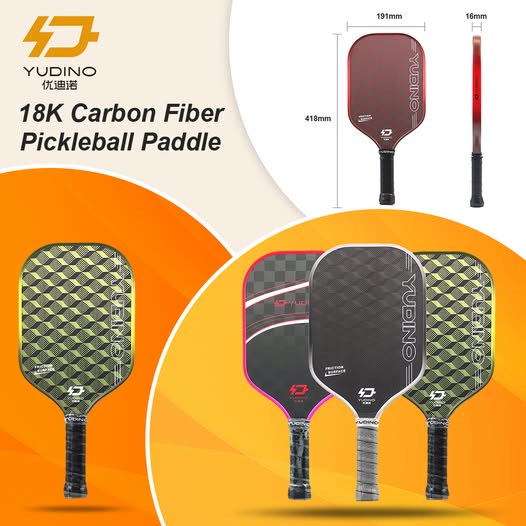
YUDINO offers carbon fiber paddle options including 3K, 12K, and 18K carbon fiber, as well as other composite constructions for different product requirements.
Fiberglass
Fiberglass is generally more flexible than carbon fiber.
This characteristic can contribute to:
A softer impact feel
Strong rebound
Good power
Forgiving response
Cost-effective production
Fiberglass paddles are therefore often suitable for beginners, recreational players, entry-level products, and brands looking to offer a more accessible price point.
The key point is that neither material is automatically better.
They are optimized for different performance and market requirements.
2. Carbon Fiber vs Fiberglass: Quick Comparison
| Feature | Carbon Fiber | Fiberglass |
| Stiffness | Higher | Lower |
| Impact feel | More precise and controlled | Softer and more flexible |
| Power | Strong, depending on construction | Often strong rebound |
| Control | Generally favored | Good |
| Weight potential | Lightweight | Lightweight to moderate |
| Consistency | High | High when properly manufactured |
| Durability | High | High |
| Material cost | Generally higher | Generally lower |
| Typical positioning | Mid-range to premium | Entry-level to mid-range |
| Suitable for OEM | Yes | Yes |
| Suitable for beginners | Yes | Especially suitable |
| Suitable for competitive products | Yes | Depends on construction |
These are general characteristics. Actual paddle performance also depends on the core, thickness, surface treatment, construction method, shape, weight, and manufacturing quality.
3. Which Paddle Has More Power?
Power is one of the most misunderstood differences between carbon fiber and fiberglass.
It is not accurate to say that one material always produces more power.
Fiberglass is more flexible than carbon fiber. When the paddle face deforms slightly during impact, it can contribute to a lively rebound and strong power response.
This is one reason fiberglass paddles can feel powerful even when they are positioned as entry-level products.
Carbon fiber, on the other hand, is stiffer and can provide efficient energy transfer with a more controlled response.
For players who want a combination of power and control, the complete paddle construction matters more than the face material alone.
The following specifications should also be considered:
Core material
Core thickness
Paddle weight
Paddle shape
Surface texture
Construction method
Balance point
Therefore:
Fiberglass ≠ automatically more powerful
and
Carbon fiber ≠ automatically less powerful
The final performance depends on the complete paddle design.
4. Which Material Provides Better Control?
For players who prioritize precision and control, carbon fiber is often the preferred choice.
The relatively high stiffness of carbon fiber can provide a more predictable response when the ball contacts the paddle.
This can be useful for players who rely on:
Dinking
Placement
Soft shots
Reset shots
Consistent contact
Controlled drives
However, control is not determined by carbon fiber alone.
A 16mm carbon fiber paddle with a particular core construction can feel very different from a thinner carbon fiber paddle.
For this reason, buyers should evaluate:
Face Material + Core + Thickness + Weight + Shape
rather than selecting a paddle based only on the material name.
5. Which Paddle Feels Softer?
If you prefer a softer impact sensation, fiberglass is generally worth considering.
Fiberglass has greater flexibility than carbon fiber, which can create a more cushioned or lively feeling at impact.
This can be attractive to:
Beginners
Recreational players
Players who prefer a softer feel
Players who want easy power
Carbon fiber generally provides more direct and structured feedback.
For advanced players, this direct response can make it easier to feel the ball and control placement.
The preferred feel is ultimately subjective.
A player who enjoys a softer, more forgiving response may prefer fiberglass, while a player who wants precise feedback may prefer carbon fiber.
6. Which Material Is Better for Beginners?
For beginners, fiberglass can be an attractive option because it combines accessible pricing with a forgiving playing experience.
A beginner typically does not need the most expensive paddle construction.
Instead, the important factors are:
Comfortable weight
Suitable grip
Forgiving response
Appropriate thickness
Reasonable durability
Affordable price
Fiberglass can therefore work well for an entry-level product line.
However, carbon fiber is not unsuitable for beginners.
A beginner who wants to invest in a paddle for longer-term use may prefer a carbon fiber model because it can provide a more controlled response and allow the player to continue using the paddle as their skills improve.
For brands, this creates an opportunity to develop different product levels:
Entry Level → Fiberglass
Mid-Range → 3K / 12K Carbon Fiber
Premium → 18K / T700 or advanced carbon fiber construction
YUDINO supports different materials and configurations, allowing brands to build a multi-level paddle portfolio rather than relying on a single construction.
7. Which Is Better for Advanced Players?
Advanced players usually have more specific requirements.
They may care about:
Ball placement
Spin
Touch
Feedback
Balance
Weight distribution
Paddle stability
Consistency
For these players, carbon fiber is often an attractive option because its stiffness and responsive characteristics can support a more precise playing experience.
However, an advanced player may still prefer fiberglass depending on their playing style.
The important consideration is not simply:Carbon fiber or fiberglass?
Instead, ask:What combination of material, core, thickness, weight, shape, and surface provides the desired performance?
That is a much more useful approach.
8. Carbon Fiber vs Fiberglass for Spin
Surface texture has a major influence on spin.
It is therefore misleading to assume that carbon fiber automatically produces more spin than fiberglass.
Spin performance can be affected by:
Surface texture
Surface coating
Face construction
Friction characteristics
Paddle shape
Player technique
Ball contact
A carbon fiber paddle with a suitable textured surface may provide strong spin performance.
A fiberglass paddle can also be designed with surface characteristics that support spin.
For brands developing paddles for performance-oriented players, surface design should therefore be evaluated together with the face material.
9. Which Material Is More Durable?
Both carbon fiber and fiberglass can be durable when the paddle is properly designed and manufactured.
Durability depends on much more than the face material.
Important factors include:
Composite quality
Core construction
Bonding
Edge protection
Manufacturing process
Impact conditions
Storage
Player usage
A poorly manufactured carbon fiber paddle may not necessarily outlast a well-manufactured fiberglass paddle.
For this reason, buyers should evaluate the manufacturer's production quality and product construction rather than assuming that a more expensive material automatically means better durability.
10. Carbon Fiber vs Fiberglass: Which Is More Expensive?
In general, carbon fiber paddles have a higher material and product cost than fiberglass paddles.
This is partly because carbon fiber is a higher-value composite reinforcement material and is commonly used in performance-oriented paddle construction.
However, the final paddle cost depends on the complete product specification.
For example:
Carbon Fiber + Premium Core + Thermoformed Construction + Custom Mold + Premium Packaging
will have a very different cost from:
Fiberglass + Standard Core + Existing Mold + Basic Packaging
This is why B2B buyers should not compare quotations based only on the words "carbon fiber" or "fiberglass."
A proper quotation should specify:
Face material
Carbon fiber type
Core material
Thickness
Shape
Weight
Construction method
Surface treatment
Logo
Packaging
Quantity
11. Which Material Is Better for a Pickleball Paddle Brand?
For a brand, the decision is not simply about performance.
It is also about product positioning.
Fiberglass Product Line
Fiberglass can be suitable for:
Beginner paddles
Recreational paddles
Entry-level products
Promotional products
Value-focused retail products
The relatively accessible material cost makes it easier to create products for price-sensitive customers.
Carbon Fiber Product Line
Carbon fiber can be suitable for:
Performance paddles
Intermediate-level products
Advanced paddles
Premium product lines
Competition-oriented products
YUDINO supports several carbon fiber options, including 3K, 12K, and 18K, allowing brands to develop products with different material positioning.
A brand does not necessarily have to choose one material for its entire product range.
A more effective strategy can be:
Entry → Fiberglass
Performance → 3K / 12K Carbon Fiber
Premium → 18K / T700 Carbon Fiber
This creates a clear product ladder and gives customers more purchasing options.
12. Which Material Is Better for OEM and Private-Label Paddles?
Both materials can be used for OEM and private-label production.
The better choice depends on the brand's target customer and retail price.
Choose Fiberglass If:
You are targeting beginners.
Your target retail price is relatively accessible.
You want a value-focused product.
You need a lower-cost entry product.
You are launching a large-volume recreational line.
Choose Carbon Fiber If:
Your brand focuses on performance.
You target intermediate or advanced players.
You want a premium product position.
You want to emphasize control and responsive feel.
You plan to develop a higher-value product line.
YUDINO can customize paddle specifications for both fiberglass and carbon fiber products, including material, thickness, shape, weight, graphics, logo, and packaging.
For brands developing their first paddle collection, this makes it possible to create multiple products around different target price points.
13. What Should Buyers Specify When Ordering Custom Paddles?
If you are purchasing paddles in bulk, simply telling the manufacturer:"I need carbon fiber paddles."
is not enough.
A complete product specification should include:
Face
Fiberglass
3K carbon fiber
12K carbon fiber
18K carbon fiber
T700
Other composite material
Core
Core material
Core thickness
Density requirements
Dimensions
Paddle length
Paddle width
Handle length
Grip circumference
Weight
Specify the target weight and acceptable tolerance.
YUDINO supports different paddle weight categories, including lightweight products below approximately 220g, mid-weight products around 230g ± 5g, and heavier products above approximately 240g.
Surface
Specify whether you need:
Smooth surface
Textured surface
Custom graphic
Performance-oriented surface treatment
Branding
Logo
Artwork
Colors
Grip branding
Packaging
Paddle bag
Retail box
Custom printed packaging
Accessories
The more specific the requirements, the more accurately a manufacturer can quote and produce the product.
14. How YUDINO Supports Carbon Fiber and Fiberglass Paddle Development
YUDINO provides both carbon fiber and fiberglass paddle solutions for brands, distributors, retailers, and other B2B buyers.
The available customization can cover:
Face material
Carbon fiber type
Paddle thickness
Shape
Weight
Handle configuration
Surface treatment
Logo
Graphics
Colors
Packaging
YUDINO operates an approximately 3,000 m² production facility, with more than 20 hot-press machines and an annual production capacity of approximately 50,000 paddles across its product categories.
For buyers testing a new product, standard models can support smaller trial orders. For customized OEM projects, MOQ is determined according to the product specification and production requirements.
Typical lead times are:
Stocked products: approximately 3 business days
Custom production: approximately 15–25 business days
The actual schedule for a new OEM development project should be confirmed after specifications and samples are approved.
YUDINO also supports sample development, product customization, quality inspection, packaging, and bulk-order production.
15. Carbon Fiber or Fiberglass: Which One Should You Choose?
The answer depends on what you want from the paddle.
| Your Priority | Recommended Material |
| Lower product cost | Fiberglass |
| Beginner-friendly product | Fiberglass |
| Recreational use | Fiberglass |
| Soft impact feel | Fiberglass |
| Premium positioning | Carbon Fiber |
| Precise feedback | Carbon Fiber |
| Control-oriented performance | Carbon Fiber |
| Advanced players | Carbon Fiber |
| Multi-level product range | Both |
| Private-label product line | Both |
| Performance-oriented OEM | Carbon Fiber |
| Entry-level OEM | Fiberglass |
But remember that this table is only a starting point.
A paddle's actual performance depends on the entire construction.
FAQ
Is carbon fiber better than fiberglass for pickleball paddles?
Not universally. Carbon fiber is generally favored for control, stiffness, and precise feedback, while fiberglass can provide a softer feel and strong rebound at a more accessible product cost.
Do carbon fiber paddles have more power?
Not necessarily. Power depends on the complete paddle construction, including the face material, core, thickness, weight, shape, and construction method.
Are fiberglass paddles good for beginners?
Yes. Fiberglass can be a practical choice for beginners because of its accessible price and forgiving playing characteristics.
Are carbon fiber paddles good for advanced players?
Yes. Carbon fiber is commonly used in performance-oriented paddles because it can provide a responsive and controlled feel.
Which is cheaper, carbon fiber or fiberglass?
Fiberglass paddles are generally less expensive to manufacture than comparable carbon fiber paddles, although the final price depends on the complete product specification and order quantity.
Can I customize both carbon fiber and fiberglass paddles?
Yes. YUDINO supports OEM/ODM customization for both material types, including paddle specifications, branding, graphics, weight, shape, and packaging.
What carbon fiber options does YUDINO offer?
YUDINO offers carbon fiber options including 3K, 12K, and 18K, along with other composite constructions depending on the product requirements.
What is the MOQ for customized paddles?
MOQ depends on the product and customization requirements. Standard models can support smaller trial orders, while fully customized OEM projects are evaluated according to specifications and production requirements.
How long does custom paddle production take?
Custom production typically takes approximately 15–25 business days. Stocked products can generally be shipped within approximately 3 business days. The final schedule should be confirmed for each project.
Conclusion
Carbon fiber and fiberglass are not competing materials where one is always better than the other.
They serve different product strategies.
Fiberglass is a strong option for beginners, recreational players, and brands looking for an accessible product with good rebound and a softer feel.
Carbon fiber is generally more suitable for performance-oriented products where control, responsiveness, and precise feedback are important.
For brands, the best solution may be to use both.
A well-structured product portfolio can use fiberglass for entry-level products and different carbon fiber constructions for mid-range and premium products.
YUDINO supports both fiberglass and carbon fiber pickleball paddle development, with options including 3K, 12K, and 18K carbon fiber, different thicknesses, shapes, weights, branding, and packaging.
With an approximately 3,000 m² production facility, 20+ hot-press machines, and an annual production capacity of approximately 50,000 paddles, YUDINO can support both standard products and customized OEM/ODM projects.
Looking for a carbon fiber or fiberglass pickleball paddle for your brand?
Send YUDINO your target material, paddle thickness, weight, shape, quantity, logo, and packaging requirements to discuss the right product configuration and request a quotation.