T300 vs T700 Carbon Fiber Paddle: Complete Buyer’s Guide for Performance & Durability
While the T300 and T700 may appear to differ only by a number, they yield distinct differences in a player's on-court feel, power, and ball-handling performance. This article will break down the distinctions between these two carbon fiber materials to help you make a more informed purchasing decision.
I. Basic Overview: What Exactly Do T300 and T700 Represent?
T300 and T700 are material grade standards established by Toray Industries, a world-leading manufacturer of carbon fiber.
T300: Classified as "Standard Modulus" carbon fiber; it is a widely utilized and mature foundational material.
T700: Classified as "High Tensile Strength" carbon fiber; it outperforms T300 in terms of both strength and stiffness.
According to publicly available material data, T700 demonstrates a significant improvement in tensile strength compared to T300 (though specific performance ultimately depends on the actual structural design and layup method).
In the realm of pickleball paddles, T700 is typically utilized in mid-to-high-end products, whereas T300 is more commonly found in entry-level and value-oriented models.
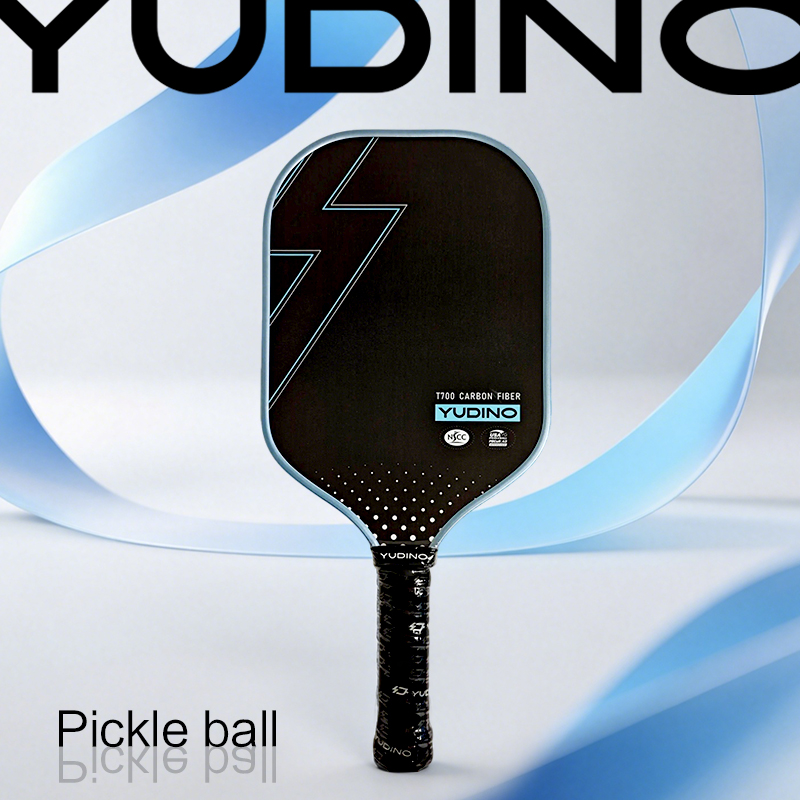
II. T300 vs. T700: A Comparison of Four Core Differences
1. Power & Explosiveness
T700: Due to its superior material strength and stiffness, it incurs relatively less energy loss during the ball-striking process, thereby providing more direct power feedback. In actual gameplay, this difference typically manifests as faster ball speeds and a crisper feel upon contact.
T300: The material is relatively softer and slightly more elastic; upon impact, it more readily creates a distinct "ball-holding" sensation (or dwell time), which aids in controlling the pace of the game.
2. Control & Touch
T300: In practical use, it offers a softer feel and provides more pronounced vibration absorption. This makes it more user-friendly for executing delicate shots at the net (such as "dinks") and for precise shot placement.
T700: It delivers clearer and more direct feedback upon impact, offering greater stability during rapid-fire exchanges. However, it demands superior power control from the player; without such control, shots may tend to fly too deep.
3. Durability & Texture Retention
T700: Under conditions of high-intensity use, it typically maintains its structural integrity for a longer duration. Furthermore, within a "Raw Carbon Fiber" surface structure, T700 material is more effective at preserving surface friction characteristics, thereby extending the period during which spin performance remains consistent and effective. T300: After prolonged use, the rate of performance degradation may be relatively faster—particularly in high-intensity, competitive scenarios.
4. Price
T300: Features lower production costs, making it better suited for beginners or casual players with limited budgets.
T700: Involves higher manufacturing costs and is typically positioned as a mid-to-high-end product, targeting advanced and competitive players.
III Quick Comparison Table:
| Performance Metric | T300 Carbon Fiber | T700 Carbon Fiber |
| Tensile Strength | Standard | Higher (depends on construction design) |
| Feel on Impact | Soft, shock-absorbing, comfortable | Crisp, firm, and direct |
| Key Advantages | Control, cost-effective | Power, spin potential, durability |
| Suitable Players | Beginners, control-oriented players | Intermediate to advanced, power-oriented players |
| Price Range | Budget-friendly | Mid-to-high range |
IV. Advanced Insights: The Importance of Raw Carbon Fiber
Many paddles currently on the market are labeled "T700," yet their actual performance depends significantly on the surface finishing method employed.
If you are seeking more consistent spin performance, consider looking for a **"T700 Raw Carbon Fiber"** construction. Unlike paddles with sprayed-on textured surfaces, this design typically relies on the inherent textural properties of the material itself, offering greater stability over the long term.
In professional and high-level competitive play, many high-performance paddles utilize similar high-strength carbon fiber face structures (with specific materials and designs determined by the individual brand).
V. Summary & Recommendations: How Should You Choose?
Reasons to Choose T300:
If you are new to pickleball, have a limited budget, and prioritize control, touch at the net, and stability, the T300 offers shot feedback that is easier to adapt to.
Reasons to Choose T700:
If you already possess a solid foundation in the sport and wish to enhance your shot speed and spin performance—while also demanding greater durability—then a T700-style paddle is typically the more suitable choice.
Additional Notes
As a pickleball paddle manufacturer, our practical production and testing processes have revealed the following:
The material (T300 / T700) constitutes only one part of a paddle's overall performance.
A paddle's performance also relies heavily on:
Structural Design (e.g., thermoforming)
Core Material (honeycomb/foam)
Weight and Balance Distribution
Therefore, when selecting a T700 Carbon Fiber paddle, we recommend evaluating the paddle based on its overall structural design rather than focusing solely on the material designation itself.