What Is the Best Pickleball Paddle Thickness for Different Players?
Pickleball paddle thickness is more than a number on a product specification sheet. The thickness of the paddle core affects how the paddle feels in the hand, how quickly the ball leaves the face, how much vibration is absorbed, and how forgiving the paddle is on off-center contact.
For most modern pickleball paddles, 13mm, 14mm, and 16mm are the most relevant thickness options. Each configuration creates a different balance between power, control, stability, feedback, and maneuverability.
So, what is the best pickleball paddle thickness?
The answer depends on who is using the paddle and how they play.
A beginner who is still developing consistent contact may benefit from the forgiveness of a thicker paddle. An aggressive player may prefer the faster response of a thinner core. An all-court player may want a middle ground.
For brands and distributors, the same principle applies. Choosing the right thickness allows a manufacturer to build different products for different customer groups instead of offering one paddle specification for every player.
1. Quick Answer: Which Pickleball Paddle Thickness Should You Choose?
As a general starting point:
| Player Type | Recommended Thickness | Main Reason |
|---|---|---|
| Beginner | 16mm | Forgiveness and control |
| Recreational player | 14–16mm | Balanced performance |
| All-court player | 14–16mm | Balance of power and control |
| Control-oriented player | 16mm | Touch and stability |
| Aggressive player | 13–14mm | Faster response and power |
| Singles player | 13–14mm | Speed and offensive response |
| Advanced player | 14–16mm | Depends on playing style |
| Competitive player | 14–16mm | Performance-specific selection |
| Brand developing a product range | 13/14/16mm | Different player segments |
These are starting recommendations rather than strict rules.
The same thickness can feel different depending on the paddle's face material, core construction, weight, shape, and manufacturing process.
2. What Does Pickleball Paddle Thickness Actually Mean?
When manufacturers describe a paddle as 13mm, 14mm, or 16mm, they are generally referring to the thickness of the internal paddle core and overall paddle construction.
Modern paddles commonly use a polypropylene honeycomb core.
The core sits between the paddle's face layers and plays a major role in how the paddle responds when the ball makes contact.
In general:
Thinner core → faster and more direct response
Thicker core → greater stability, control, and forgiveness
The difference may appear small on paper, but even a few millimeters can noticeably change the playing characteristics.
YUDINO currently supports 13mm, 14mm, and 16mm paddle configurations, allowing brands to develop different products for different playing styles.
3. How Does Thickness Affect Power?
One of the first questions players ask is: Does a thinner pickleball paddle have more power?
Generally, a thinner core produces a more direct and energetic response.
Because the thinner structure tends to flex and respond more quickly, the ball can leave the paddle face rapidly.
This can be useful for:
Drives
Smashes
Aggressive returns
Fast volleys
Baseline attacks
A 13mm paddle is therefore often attractive to players who want a crisp, fast response.
A 14mm paddle provides a middle ground.
A 16mm paddle generally emphasizes control and stability rather than maximum pop.
However, thickness is only one part of power.
A paddle's actual power also depends on:
Face material
Core density
Paddle weight
Paddle shape
Balance point
Construction method
Surface characteristics
Therefore, it would be inaccurate to say that every 13mm paddle is more powerful than every 16mm paddle.
4. How Does Thickness Affect Control?
Control is where thicker paddles generally have an advantage.
A thicker core can absorb more impact and increase the amount of time the ball interacts with the paddle.
This can make it easier to control:
Dinks
Drops
Resets
Blocks
Soft returns
Placement shots
For players who spend a lot of time at the kitchen line, this additional stability can be valuable.
A 16mm paddle can provide a more controlled response when the player needs to take pace off the ball.
This is one reason 16mm paddles are widely used in control-oriented and competitive paddle designs. YUDINO's own competition paddle uses a 16mm PP honeycomb core with a 230g ± 5g target weight, combining stability with a relatively balanced overall specification.
5. What Thickness Is Best for Beginners?
For most beginners, 16mm is a strong starting point.
A new player is still developing:
Contact consistency
Paddle positioning
Swing timing
Ball placement
Reaction speed
A forgiving paddle can make the learning process easier.
The advantages of a thicker paddle for beginners include:
Larger Forgiving Area
Off-center contact is less punishing.
More Stable Response
The paddle is less likely to feel unstable when the ball hits away from the center.
Better Soft-Shot Control
Beginners can practice dinks, drops, and controlled returns without relying entirely on precise timing.
More Comfortable Learning Curve
The paddle can provide a more predictable response while the player develops technique.
YUDINO's beginner fiberglass paddle, for example, uses a 16mm PP honeycomb core and a 230g ± 5g weight specification.
That combination illustrates how thickness should be considered together with weight and core construction rather than independently.
6. What Thickness Is Best for Recreational Players?
For recreational players, 14mm or 16mm is usually a practical choice.
Recreational players often want a paddle that can handle different types of shots without being designed around one highly specialized playing style.
Choose 14mm If You Want:
Faster response
More pop
Easier drives
Faster hand battles
A more energetic feel
Choose 16mm If You Want:
More control
Softer touch
Greater forgiveness
Better stability
Easier resets
If you are unsure which direction to choose, 16mm is generally the safer starting point for an all-around recreational paddle.
7. What Thickness Is Best for Aggressive Players?
Aggressive players often benefit from 13mm or 14mm.
An attacking player may prioritize:
Ball speed
Fast hands
Powerful drives
Quick volleys
Aggressive returns
Fast transitions
A thinner core can provide a sharper and more immediate response.
13mm
Best suited to players who want maximum responsiveness and a more direct feel.
14mm
Useful for players who want aggressive performance without moving completely toward a power-focused configuration.
For example, a player who frequently attacks from the baseline may prefer 13mm, while an all-court attacker may prefer 14mm.
8. What Thickness Is Best for Control-Oriented Players?
For players who build their game around placement rather than raw power, 16mm is usually the strongest option.
Control-oriented players may spend significant time performing:
Dinks
Resets
Drops
Soft volleys
Third-shot drops
Defensive blocks
These shots require the player to reduce pace and control where the ball lands.
A thicker core can help create a more stable and forgiving contact.
This is particularly valuable at the kitchen line, where small differences in paddle response can affect whether a soft shot lands correctly.
9. What Thickness Is Best for Singles Players?
Singles pickleball places different demands on equipment than doubles.
Singles players generally cover more court and often rely more heavily on:
Groundstrokes
Drives
Deep returns
Passing shots
Movement
Offensive pressure
For this reason, 13mm or 14mm can be attractive to singles players who prioritize speed and power.
A thinner paddle can provide a quick response for aggressive baseline play.
However, players who prefer a more controlled singles strategy may still choose 16mm.
The correct choice depends on whether the player wants:
Maximum offensive response
or
More balanced control and stability.
10. What Thickness Is Best for Doubles Players?
Doubles play involves more rapid exchanges at the kitchen.
Players need to react quickly to:
Speed-ups
Counterattacks
Blocks
Dinks
Resets
Fast hand battles
For control-focused doubles players, 16mm is often a practical choice.
For aggressive doubles players who prioritize hand speed and counterattacking, 14mm can provide a better balance.
Therefore:
Control-oriented doubles → 16mm
Aggressive doubles → 14mm
Maximum speed/power preference → 13mm
11. What Thickness Is Best for Advanced Players?
Advanced players generally should not choose thickness based solely on skill level.
At this stage, playing style matters more.
Two advanced players may have completely different requirements.
Advanced Control Player
Recommended starting point:
16mm
Focus:
Dinks
Resets
Touch
Stability
Placement
Advanced All-Court Player
Recommended starting point:
14–16mm
Focus:
Balanced power
Control
Versatility
Advanced Power Player
Recommended starting point:
13–14mm
Focus:
Drives
Speed
Aggressive returns
Fast hands
Therefore, "advanced player" does not automatically mean "16mm."
12. Does a Thicker Paddle Have a Larger Sweet Spot?
Generally, thicker-core paddles can provide a more forgiving response across a larger effective hitting area.
This matters when the ball does not hit the exact center.
A stable paddle can help maintain:
Ball direction
Paddle stability
Consistent rebound
Control on off-center contact
For beginners and recreational players, this forgiveness can be particularly useful.
For experienced players with highly consistent contact, the benefit may be less important than the additional speed and responsiveness of a thinner paddle.
13. Does Paddle Thickness Affect Vibration?
Yes.
A thicker core generally provides greater impact absorption and can produce a softer-feeling response.
A thinner core usually transmits more direct feedback.
This creates two different experiences.
13mm
More direct
Sharper feedback
Faster response
14mm
Balanced response
Moderate feedback
Combination of speed and control
16mm
Softer feel
More impact absorption
Greater stability
Players who prefer a crisp, immediate feel may enjoy thinner paddles.
Players who prefer a softer and more controlled feel may prefer thicker paddles.
14. Thickness Should Not Be Selected Alone
One of the biggest mistakes when choosing a paddle is treating thickness as an independent specification.
It is not.
The final playing experience is determined by the combination of:
Face Material + Core + Thickness + Weight + Shape + Surface + Construction
For example, consider two 16mm paddles.
Paddle A
16mm core
Fiberglass face
230g
Standard shape
Paddle B
16mm core
18K carbon fiber face
245g
Elongated shape
Both are 16mm.
But they will not feel or perform the same.
This is why product developers and B2B buyers should define the complete specification rather than simply requesting a "16mm carbon fiber paddle."
15. How Carbon Fiber Changes the Thickness Choice
The face material can change how a particular thickness performs.
For example, a 16mm carbon fiber paddle can provide a combination of:
Controlled response
Stable contact
Surface feedback
Consistent performance
A thinner carbon fiber paddle can shift the product toward:
Faster response
Stronger pop
More direct feedback
Aggressive performance
YUDINO supports 3K, 12K, 18K, and T700 carbon fiber options, allowing the face material to be combined with different core thicknesses.
This means a brand can develop different performance categories without changing only the surface material.
For example:
Entry Performance → 14mm fiberglass
Balanced Performance → 16mm 12K carbon fiber
Premium Control → 16mm 18K/T700 carbon fiber
Aggressive Performance → 14mm carbon fiber
The final specification should be selected according to the intended player profile.
16. How YUDINO Uses Thickness to Build Different Paddle Products
YUDINO supports 13mm, 14mm, and 16mm configurations for different playing styles.
This allows OEM customers to develop different product lines around specific player needs.
Power-Focused Product
13mm core
Designed around:
Faster response
Aggressive drives
Quick hand speed
All-Around Product
14mm core
Designed around:
Balanced power
Control
Versatility
Control-Focused Product
16mm core
Designed around:
Stability
Soft touch
Larger forgiving area
Controlled response
This approach is useful for brands that want to create a complete product portfolio rather than selling one paddle to every customer
17. Can Brands Customize Paddle Thickness With YUDINO?
Yes.
YUDINO supports different core thickness configurations, including:
13mm
14mm
16mm
OEM/ODM customers can also discuss related specifications such as:
Face material
Core construction
Paddle shape
Weight
Handle length
Grip
Surface treatment
Logo
Graphics
Packaging
YUDINO's competition paddle specifications include a 16mm PP honeycomb core, while its customization program supports multiple thicknesses for different playing styles.
This gives brands the flexibility to create separate products for beginners, recreational players, all-court players, and competitive users.
18. What Is the MOQ for Custom Thickness?
There is no single MOQ that applies to every customized thickness.
For standard in-stock products, YUDINO supports smaller trial orders.
For OEM projects involving customized:
Thickness
Materials
Shape
Graphics
Weight
Packaging
MOQ is determined according to the specific production requirements.
This is particularly useful for new brands that want to test a product before moving into larger-volume production. YUDINO's current OEM information states that MOQ varies according to customization scope, while standard in-stock configurations can support small trial orders.
19. How Long Does It Take to Produce a Custom Paddle?
The lead time depends on whether the buyer chooses a standard product or develops a customized configuration.
Standard In-Stock Models
Selected standard products can generally be shipped within approximately 3 business days.
Custom OEM Production
Customized projects generally require additional time for:
Specification confirmation
Artwork
Sample development
Production preparation
Manufacturing
Inspection
Packaging
The typical custom production lead time should be confirmed according to the specific project and production schedule.
For a new product, buyers should therefore plan the complete process rather than counting only factory production days.
20. YUDINO Manufacturing and Service Support
Thickness selection is only one part of developing a commercial paddle.
For brands, the manufacturer must also be able to produce the selected specification consistently.
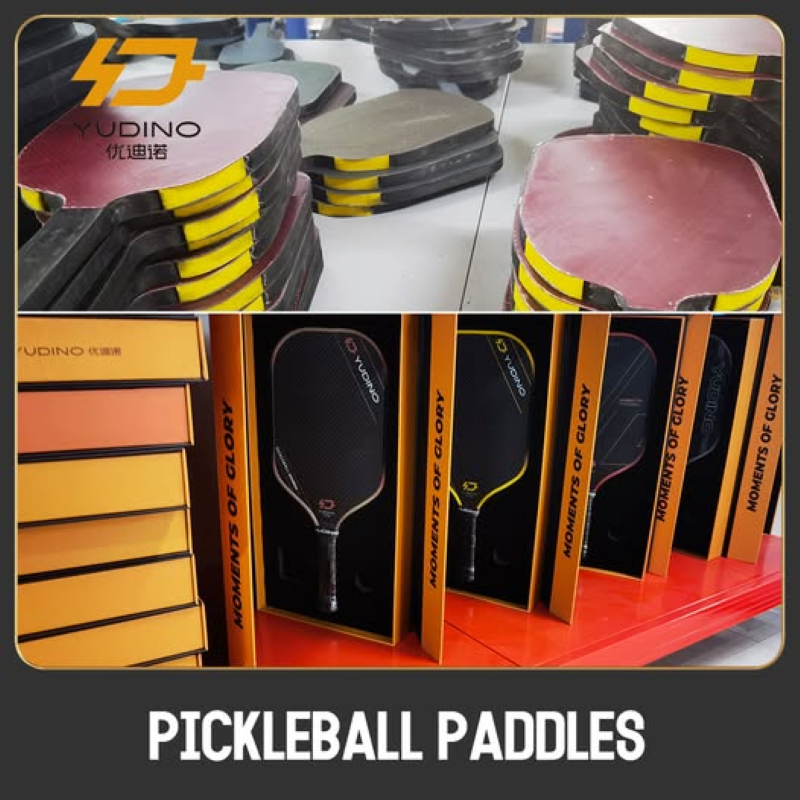
YUDINO operates an approximately 3,000 m² production facility equipped with more than 20 hot-press machines, with an annual production capacity of up to approximately 50,000 paddles.
The company also has an independent R&D center and laboratory and provides ODM support for international sports brands.
For customized paddle projects, YUDINO can support:
Material selection
Core thickness
Paddle shape
Weight specification
Handle configuration
Surface design
Logo and graphics
Packaging
Sample development
Bulk production
Quality inspection
This allows the thickness specification to be developed as part of the complete paddle rather than treated as an isolated parameter.
21. Recommended Paddle Thickness by Player Profile
For quick reference:
| Player Profile | Recommended Thickness | Why |
| New beginner | 16mm | More forgiving and stable |
| Recreational beginner | 14–16mm | Balanced performance |
| All-court player | 14–16mm | Flexible performance |
| Kitchen/control player | 16mm | Better touch and stability |
| Aggressive baseline player | 13–14mm | Faster response |
| Singles attacker | 13–14mm | Power and maneuverability |
| Doubles control player | 16mm | Stability during soft play |
| Fast-handed doubles player | 14mm | Speed and balanced response |
| Advanced control player | 16mm | Precision and forgiveness |
| Advanced power player | 13–14mm | Direct and explosive response |
| Competitive all-court player | 14–16mm | Depends on playing style |
Frequently Asked Questions
Is 16mm better than 14mm?
Not for every player. A 16mm paddle generally favors control, stability, and forgiveness, while a 14mm paddle offers a faster and more responsive feel. The better choice depends on playing style.
Is 13mm good for beginners?
It can be used by beginners, but it is generally less forgiving than a thicker paddle. Players who are still developing consistent contact may find 14mm or 16mm easier to control.
Is 16mm good for power?
Yes, but it is not normally selected when maximum pop is the only priority. A 16mm paddle can still generate substantial power when combined with the appropriate face material, weight, and construction.
What thickness is best for dinking?
A 16mm paddle is generally a strong choice for players who prioritize dinking, resets, and soft-game control because the thicker core can provide a more stable and controlled response.
What thickness is best for singles?
Many aggressive singles players may prefer 13mm or 14mm because of the faster response and power potential. However, a control-oriented singles player may still prefer 16mm.
What thickness do professional players use?
There is no single thickness used by every professional player. 16mm remains a major choice for control-oriented competitive play, while 14mm has become increasingly relevant for players prioritizing speed and power.
Does thicker always mean heavier?
No. Paddle thickness and total paddle weight are separate specifications. A manufacturer can use different materials, shapes, and weight configurations to produce paddles with different overall weights.
Can YUDINO customize paddle thickness?
Yes. YUDINO supports 13mm, 14mm, and 16mm core configurations as part of its OEM/ODM customization options.
Conclusion
There is no single "best" pickleball paddle thickness for every player.
Instead, thickness should be selected according to the player's skill level, playing style, preferred feel, and performance priorities.
As a general guide:
13mm → Power, speed, and direct response
14mm → Balance between power and control
16mm → Stability, touch, control, and forgiveness
For beginners and control-oriented players, 16mm is often the safest starting point.
For aggressive players and fast-paced competitors, 13mm or 14mm may provide a more suitable response.
For all-court players, 14mm or 16mm can offer a balanced combination of performance characteristics.
For brands, the choice is broader. Instead of asking which thickness is universally best, manufacturers can develop a product range around different player profiles.
YUDINO supports 13mm, 14mm, and 16mm paddle constructions, combined with carbon fiber, fiberglass, different paddle shapes, weight configurations, grips, graphics, and packaging.
With an approximately 3,000 m² production facility, 20+ hot-press machines, and annual capacity of approximately 50,000 paddles, YUDINO can support both standard paddle supply and customized OEM/ODM development.
For standard in-stock products, small trial orders can be supported with selected models available for approximately 3-business-day shipment. For customized projects, MOQ and production schedules are confirmed according to the required specifications.
Developing a pickleball paddle for a specific player group?
Send YUDINO your target player profile, preferred thickness, face material, weight, shape, quantity, logo, and packaging requirements to develop a customized paddle specification.