What Paddle Weight Is Best for Beginner Pickleball?
What Paddle Weight Is Best for Beginner Pickleball?
Many beginners spend hours comparing paddle materials like fiberglass, carbon fiber, and graphite, but overlook one of the most important factors affecting performance: paddle weight.
The weight of a pickleball paddle directly influences swing speed, shot control, power generation, reaction time, and even long-term comfort. Choosing a paddle that is too heavy may lead to arm fatigue, while one that is too light can reduce stability and make it harder to hit consistent shots.
For new players, selecting the right weight is often more important than choosing the most expensive paddle.
Whether you're buying your first paddle, sourcing products for a retail brand, or developing a private-label pickleball collection, understanding paddle weight will help you make a smarter decision.
In this guide, we'll explain how paddle weight affects performance, compare different weight ranges, and recommend which paddle weights are best suited for beginners.
Why Paddle Weight Matters More Than Most Beginners Think
Many people assume that a difference of 10 or 15 grams isn't significant.
In reality, even small weight differences can noticeably change how a paddle feels during play.
A paddle's weight influences nearly every aspect of your game, including:
Swing speed
Ball control
Shot consistency
Power generation
Reaction speed at the net
Arm and wrist fatigue
Overall playing comfort
For beginners who are still developing proper technique, these factors can dramatically affect the learning experience.
Instead of compensating for poor technique with excessive force, the right paddle weight allows players to build consistent mechanics and confidence from the very beginning.
Simply put, choosing the correct paddle weight makes learning easier.
How Paddle Weight Affects Your Game
Different paddle weights create different playing characteristics.
Understanding these differences helps beginners select equipment that matches their physical strength and playing style.
1. Swing Speed
Lighter paddles move through the air faster.
This allows players to react more quickly during fast exchanges, especially in doubles play where quick volleys at the kitchen line are common.
Beginners often find lightweight paddles easier to maneuver because they require less effort to accelerate.
However, paddles that are too light may feel unstable when blocking powerful shots.
2. Power
Heavier paddles naturally generate more momentum during the swing.
As a result, players can produce deeper shots and stronger drives without swinging significantly harder.
This is particularly helpful for players with tennis or badminton experience who already possess good swing mechanics.
However, beginners who rely solely on paddle weight to generate power often sacrifice shot control.
The goal isn't to use the heaviest paddle possible—it's to find a balanced weight that complements your skill level.
3. Control
Control is often overlooked when discussing paddle weight.
A paddle that feels stable through contact generally produces more predictable shots.
Medium-weight paddles usually provide the best balance between stability and maneuverability, making them ideal for most recreational beginners.
Players can place the ball more accurately while maintaining enough swing speed for defensive and offensive shots.
4. Comfort During Long Matches
One of the biggest mistakes beginners make is choosing a paddle that's too heavy simply because it feels powerful during a short demonstration.
After thirty or forty minutes of continuous play, that same paddle may become noticeably more difficult to swing.
Excessive weight increases stress on the wrist, forearm, elbow, and shoulder.
For players still building strength and endurance, this can reduce enjoyment and even increase the risk of overuse injuries such as tennis elbow.
A comfortable paddle encourages longer practice sessions and faster improvement.
5. Learning Curve
The right paddle weight doesn't just improve performance—it accelerates learning.
When players aren't fighting against equipment that's too heavy or too unstable, they can focus on:
Footwork
Paddle positioning
Shot placement
Soft game development
Consistent contact
These are the skills that determine long-term improvement.
For this reason, coaches often recommend balanced, forgiving paddles rather than the heaviest or lightest models available.
What Is the Standard Weight of a Pickleball Paddle?
Although there is no universal standard, most pickleball paddles fall into three general categories.
| Weight Category | Approximate Weight | Typical Characteristics |
| Lightweight | 200–220 g | Fast swing speed, quick reactions, less fatigue |
| Midweight | 220–230 g | Balanced control and power, ideal for most beginners |
| Heavyweight | 230–245 g | Greater power and stability, requires more strength |
Among these categories, 220–230 grams has become the most popular choice for beginner fiberglass pickleball paddles.
This range provides an excellent balance between maneuverability, stability, and comfort.
It is also the weight range adopted by many manufacturers for entry-level and recreational paddle series.
Editor's Tip
If you're purchasing paddles for a club, sports retailer, or private-label brand, offering multiple weight options (220 g, 225 g, and 230 g) can appeal to a broader range of players without significantly increasing inventory complexity.
Yudino manufactures fiberglass pickleball paddles in multiple weight configurations and supports OEM customization for brands looking to meet different market preferences.
What Paddle Weight Is Best for Beginner Pickleball?
If you're looking for a quick answer, a pickleball paddle weighing between 220 and 230 grams is the best choice for most beginners.
This weight range provides the ideal balance between control, maneuverability, stability, and power. It allows new players to develop proper technique without placing excessive strain on the wrist or forearm.
However, the "best" weight also depends on factors such as age, physical strength, previous racket sports experience, and playing style.
The table below can help you identify the most suitable weight range.
| Player Type | Recommended Weight | Why It Works |
| Junior Players | 210–220 g | Easier to swing and less tiring during practice. |
| Women Beginners | 220–225 g | Offers quick handling while maintaining good control. |
| Most Adult Beginners | 220–230 g | Best balance of power, comfort, and forgiveness. |
| Tennis or Badminton Players | 225–235 g | Additional stability supports stronger swings. |
| Advanced Players | 230 g+ | More power and solid feel but requires better technique. |
For manufacturers and sporting goods brands, 220–230 g has become the most widely accepted weight range for entry-level fiberglass pickleball paddles because it suits the largest percentage of recreational players.
Lightweight vs. Heavy Pickleball Paddles: Which Is Better?
One of the most common questions from new players is whether they should choose a lightweight or heavyweight paddle.
The answer isn't about which one is "better"—it's about which one matches the player's needs.
Lightweight Paddles (200–220 g)
Lightweight paddles are designed for speed and maneuverability.
Because they require less effort to swing, they help beginners react faster during quick exchanges and reduce fatigue over long practice sessions.
Advantages
Faster swing speed
Quicker reactions at the kitchen line
Reduced wrist and shoulder fatigue
Easier to control during extended play
Potential Drawbacks
Slightly less power on drives
Reduced stability against hard-hit balls
Smaller margin for timing errors
These paddles are particularly suitable for:
Junior players
Women
Seniors
Recreational players
Clubs offering beginner training programs
Midweight Paddles (220–230 g)
Midweight paddles are considered the "sweet spot" for most beginners.
They combine the quick handling of lighter paddles with the stability of heavier models, making them highly versatile.
Advantages
Excellent balance of power and control
Stable feel during impact
Comfortable for both singles and doubles
Suitable for long-term skill development
For most first-time players, this category provides the easiest transition from learning basic strokes to playing competitive recreational matches.
Because of this balance, many manufacturers—including Yudino—recommend midweight fiberglass paddles as the standard option for beginner product lines.
Heavyweight Paddles (230–245 g)
Heavier paddles create greater momentum during the swing.
Players with strong upper-body strength or previous racket sports experience may appreciate the additional power and stability.
Advantages
More powerful drives
Better stability during hard exchanges
Increased momentum on serves
Solid feel at ball contact
Potential Drawbacks
Slower reaction speed
Increased arm fatigue
More difficult for beginners to maneuver
Higher risk of overuse injuries if technique is poor
Unless a beginner already has experience in sports such as tennis or squash, a heavyweight paddle is generally not the best starting point.
Which Paddle Weight Fits Your Playing Style?
Different playing styles place different demands on paddle weight.
Choosing a weight that matches how you play can improve both comfort and performance.
Control-Oriented Players
If you enjoy placing the ball accurately, hitting soft shots, and developing a consistent kitchen game, a paddle weighing 220–225 g is an excellent choice.
This range provides enough stability for controlled shots while remaining easy to maneuver during quick exchanges.
Power-Oriented Players
Players with a naturally aggressive style often prefer a slightly heavier paddle.
A weight of 225–235 g can generate more momentum, helping produce deeper drives and stronger serves without requiring excessive effort.
This option is particularly suitable for players transitioning from tennis or badminton.
Doubles Players
Doubles emphasizes quick reactions, fast volleys, and precise placement.
A paddle in the 220–225 g range offers excellent maneuverability, making it easier to defend at the kitchen line and react to fast-paced rallies.
Singles Players
Singles involves covering more court and hitting more powerful groundstrokes.
Many singles players prefer paddles between 225–230 g, which provide additional stability and power while still allowing effective control.
Does Paddle Weight Affect Injury Risk?
This is a question many new players overlook.
While paddle weight alone doesn't cause injuries, using a paddle that doesn't match your strength or technique can increase physical strain over time.
A paddle that's too heavy may lead to:
Wrist fatigue
Forearm soreness
Shoulder discomfort
Reduced swing consistency
Increased risk of tennis elbow
Conversely, an extremely light paddle may require players to swing harder to generate power, which can also place additional stress on the arm.
For most beginners, choosing a balanced paddle between 220 and 230 g is the safest and most comfortable option for regular play.
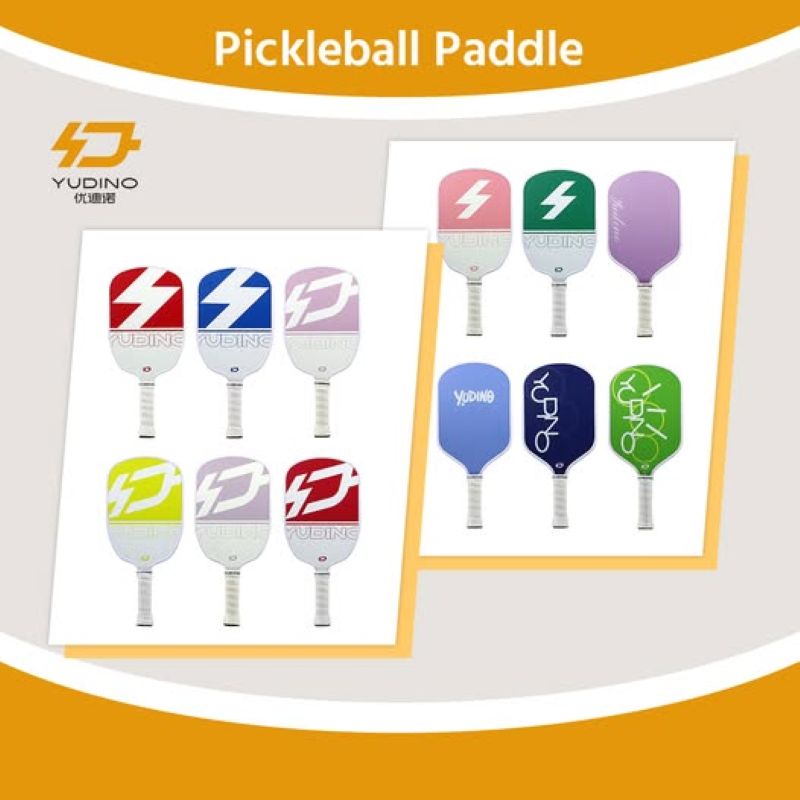
Editor's Recommendation
If you're developing a beginner paddle collection or sourcing products for your brand, it's worth offering three standard weight options—220 g, 225 g, and 230 g.
This approach allows retailers and distributors to meet the needs of a wider range of players without significantly increasing inventory complexity.
At Yudino, our fiberglass pickleball paddles can be manufactured in multiple weight configurations while maintaining consistent balance, quality, and performance. OEM and private-label customization are available to help brands tailor products for different market segments.
How Do Manufacturers Control Pickleball Paddle Weight?
Many buyers assume that paddle weight is determined simply by making the paddle heavier or lighter.
In reality, achieving a precise paddle weight requires careful engineering and strict manufacturing control. Even a difference of 5 grams can noticeably affect swing speed, balance, and overall playing feel.
For manufacturers, controlling paddle weight is not just about meeting a specification—it is about delivering consistent performance across every production batch.
This is especially important for distributors, sports brands, and OEM customers who expect every paddle in a shipment to perform the same way.
Several factors influence the final weight of a pickleball paddle.
1. Face Material
The paddle face contributes significantly to the overall weight and feel.
Fiberglass and carbon fiber have different densities and playing characteristics.
Fiberglass generally provides:
Easier power generation
More forgiving feel
Slightly softer ball impact
Excellent value for beginner paddles
Because of these characteristics, fiberglass remains one of the most popular materials for entry-level products.
Manufacturers can also adjust the thickness of the fiberglass layers to fine-tune the final paddle weight without sacrificing durability.
2. Honeycomb Core Thickness
The polypropylene honeycomb core is another key factor.
Although the material itself is lightweight, changing the core thickness directly affects paddle weight, stability, and playing characteristics.
For example:
| Core Thickness | Playing Characteristics |
| 14 mm | Faster swing, more power, quicker reactions |
| 16 mm | Balanced control and comfort |
| 18 mm | Greater stability, softer feel, maximum control |
Among these options, 16 mm has become the preferred choice for beginner fiberglass paddles, offering the best combination of comfort, forgiveness, and shot consistency.
3. Edge Guard Design
Many players underestimate the impact of the edge guard.
A wider edge guard improves durability but also increases overall weight.
Manufacturers must carefully balance protection and performance to ensure the paddle remains comfortable to use.
Premium manufacturers optimize edge guard materials rather than simply adding more plastic.
This approach keeps the paddle lightweight while maintaining durability.
4. Handle Construction
The handle influences not only grip comfort but also weight distribution.
Factors include:
Handle length
Wood insert design
Foam filling
Grip material
Grip wrapping
These details determine the paddle's balance point and overall swing feel.
Two paddles with the same total weight may feel completely different because their weight is distributed differently.
This is why experienced manufacturers focus on balance, not just total weight.
5. Manufacturing Tolerances
Weight consistency is often overlooked when comparing suppliers.
Some factories only guarantee an approximate weight, while others implement strict quality control to keep variations within a narrow tolerance.
For retailers and private-label brands, this consistency is essential.
Customers expect every paddle to feel the same, regardless of when or where it was produced.
Reliable manufacturing minimizes complaints, improves customer satisfaction, and strengthens brand reputation.
Why Weight Consistency Matters for OEM Buyers
If you're sourcing pickleball paddles for your own brand, consistency is just as important as performance.
Imagine receiving an order labeled 225 g, only to discover that some paddles weigh 217 g while others exceed 235 g.
Even though these differences seem small, players will immediately notice changes in balance, swing speed, and shot feel.
Inconsistent products can result in:
Increased customer complaints
Higher return rates
Negative online reviews
Reduced brand credibility
This is why experienced manufacturers establish strict production standards and quality inspections for every batch.
At Yudino, each production run is carefully monitored to ensure that paddle weight, balance, and construction remain consistent from sample approval through mass production.
Editor's Recommendation: Beginner Fiberglass Paddles by Weight
Rather than offering one universal paddle, we recommend selecting products based on the player's needs.
Option 1 – 220 g Lightweight Fiberglass Paddle
Best For
Junior players
Women
Recreational beginners
Clubs and training programs
Advantages
Faster swing speed
Excellent maneuverability
Reduced arm fatigue
Comfortable for long practice sessions
For brands targeting entry-level players, this weight offers broad market appeal.
Option 2 – 225 g Standard Beginner Paddle ⭐ Recommended
This is the weight we recommend for most beginner players.
It provides an excellent balance between:
Control
Power
Stability
Comfort
Whether the player is learning basic strokes or participating in recreational doubles matches, a 225 g paddle delivers consistent all-around performance.
For this reason, it has become one of the most popular specifications among sports retailers and private-label brands.
Option 3 – 230 g Stability Series
Players who already have experience in tennis, badminton, or squash often prefer a slightly heavier paddle.
The additional weight provides:
Greater hitting stability
Stronger serves
More powerful drives
Better resistance against fast shots
Although it requires slightly more strength, many athletic beginners quickly adapt to this weight.
OEM Customization Available
Every market has different customer preferences.
Some regions favor lightweight paddles for recreational players, while others prefer slightly heavier models for competitive performance.
Yudino supports flexible OEM production, allowing customers to customize:
Paddle weight
Balance point
Face material
Core thickness
Surface graphics
Grip color
Packaging design
Private label branding
Whether you're launching a new sports brand or expanding an existing product line, our engineering team can help develop paddle specifications tailored to your target market.
Need Multiple Weight Options for Your Brand?
Many distributors choose to launch 220 g, 225 g, and 230 g versions simultaneously to meet different customer preferences.
By offering multiple weight options under the same product series, brands can increase market coverage while maintaining a consistent product identity.
Yudino manufactures fiberglass pickleball paddles directly from our factory in Dandong, Liaoning, China, with OEM and private-label services available for global customers.
Why Choose Yudino for Beginner Fiberglass Pickleball Paddles?
Selecting the right paddle weight is only one part of building a successful pickleball product line.
Choosing the right manufacturing partner is equally important.
Whether you're an importer, sporting goods distributor, retail chain, or private-label brand, your supplier should provide more than just competitive pricing. Consistent quality, reliable production, and flexible customization are essential for long-term business growth.
At Yudino (Liaoning) Sports Goods Co., Ltd., we specialize in manufacturing high-quality fiberglass and carbon fiber pickleball paddles for customers around the world.
With years of production experience and a dedicated engineering team, we help brands develop paddles that combine performance, durability, and market appeal.
Why Global Buyers Work with Yudino
Factory-Direct Manufacturing
Unlike trading companies, Yudino operates its own manufacturing facility in Dandong, Liaoning, China.
Factory-direct production provides better quality control, more competitive pricing, and faster communication throughout the entire project.
Multiple Weight Options
We manufacture beginner fiberglass paddles in several popular weight ranges, including:
220 g
225 g
230 g
Custom weight specifications can also be developed according to your product requirements.
OEM & Private Label Services
Our engineering and production teams support complete OEM solutions, including:
Custom logo printing
Paddle graphics
Surface finish
Grip color
Edge guard color
Retail packaging
Gift boxes
Barcode labels
User manuals
Whether you're launching a new brand or expanding an existing product line, we can help bring your ideas to market.
USA Pickleball Certified Products
Quality and compliance are increasingly important in today's pickleball market.
Our certified product lines help brands meet the expectations of retailers, distributors, and players while strengthening market credibility.
Stable Production Capacity
Yudino has an annual production capacity of more than 50,000 pickleball paddles, enabling us to support both small OEM projects and large-volume wholesale orders.
Our manufacturing process focuses on maintaining consistent paddle weight, balance, and product quality across every production batch.
Get Wholesale Pricing on Fiberglass Pickleball Paddles
If you're looking for a reliable manufacturer of beginner fiberglass pickleball paddles, we'd be happy to discuss your project.
Whether you need standard products, private-label manufacturing, or fully customized paddle designs, our team can recommend the most suitable solution based on your target market and business goals.
Contact Information
Yudino (Liaoning) Sports Goods Co., Ltd.
Factory Location: Dandong, Liaoning, China
Product Range
Fiberglass Pickleball Paddles
Carbon Fiber Pickleball Paddles
Thermoformed Pickleball Paddles
OEM & Private Label Solutions
+86 150 0404 8823
Phone
+86 186 0415 1313
FAQ
What is the best pickleball paddle weight for beginners?
For most beginners, a paddle weighing 220–230 grams offers the best balance of power, control, comfort, and maneuverability. This range is suitable for recreational players and is widely recommended by manufacturers and coaches.
Is a lighter pickleball paddle better for beginners?
A lighter paddle is easier to swing and reduces fatigue, making it a good choice for juniors, women, seniors, and players with slower swing speeds.
However, paddles that are too light may provide less stability during powerful shots.
Is a heavier paddle more powerful?
Generally, yes.
A heavier paddle carries greater momentum, which can help generate stronger drives and serves.
However, beginners should avoid choosing a heavy paddle solely for power, as it may reduce reaction speed and increase arm fatigue.
Can paddle weight be customized?
Yes.
Professional manufacturers like Yudino can customize paddle weight by adjusting factors such as the face material, core thickness, edge guard design, handle construction, and balance point.
OEM customization allows brands to create products tailored to different player preferences and market demands.
Does paddle weight affect paddle balance?
Absolutely.
Two paddles may have the same total weight but feel completely different depending on how the weight is distributed.
Balance point plays a major role in swing speed, stability, and overall playing comfort.
For this reason, experienced manufacturers focus on both weight and balance during product development.
Which weight is best for women's beginner paddles?
Most women beginners prefer paddles in the 220–225 gram range because they offer quick handling without sacrificing stability.
However, the ideal weight always depends on individual strength and playing style.
Should beginner brands offer multiple paddle weights?Yes.
Offering 220 g, 225 g, and 230 g versions allows brands to serve a broader customer base while maintaining a consistent product series.
Many successful sporting goods brands use this strategy to meet the needs of different player groups.
Final Thoughts
Choosing the right pickleball paddle weight isn't about selecting the lightest or heaviest option—it's about finding the best balance between comfort, control, and performance.
For most beginners, a fiberglass paddle weighing 220–230 grams provides the confidence needed to develop proper technique while enjoying a more comfortable playing experience.
For sporting goods brands, distributors, and private-label buyers, offering multiple weight options can expand your product range and better meet the needs of different customer groups.
At Yudino, we combine manufacturing expertise with flexible OEM capabilities to help our partners develop beginner-friendly pickleball paddles that are built for both performance and commercial success.
If you're planning your next pickleball paddle project, our team is ready to help you find the right weight, materials, and customization options for your market.
Contact us today to request samples, discuss OEM requirements, or receive a wholesale quotation.