Why Pickleball Paddle Materials Matter and How to Choose the Right One
When choosing a pickleball paddle, players often focus on weight, shape, thickness, or appearance. However, one of the most important factors is the material used in the paddle face and core.
Different materials can significantly affect power, control, spin, durability, vibration feedback, and overall playing feel. For this reason, understanding paddle materials is essential for both individual players and brands looking to develop the right pickleball paddle product line.
Today, modern pickleball paddles are available with carbon fiber, fiberglass, composite, and other hybrid constructions. The paddle core also plays an important role, with polypropylene honeycomb becoming one of the most widely used core structures.
At YUDINO, we work with different paddle materials and constructions to meet the needs of recreational players, competitive athletes, clubs, distributors, and OEM/ODM customers.
This guide explains the major pickleball paddle materialshttps://www.ydnlntuyp.com/products and how to choose the right combination for different playing styles.
Why Does Pickleball Paddle Material Matter?
The material of a pickleball paddle is closely related to how the paddle performs during contact with the ball.
A paddle face can influence:
Power
Ball control
Spin generation
Touch and feel
Vibration feedback
Durability
Overall paddle weight
However, the surface material is only one part of the paddle. The core material, core thickness, construction method, paddle shape, weight, and surface texture all work together to determine the final performance.
For example, a carbon fiber face combined with a 16 mm polypropylene honeycomb core can provide a very different playing experience from a fiberglass face combined with a thinner core.
Therefore, there is no single material that is automatically "best" for every player.
The right choice depends on the performance characteristics you need.
Common Pickleball Paddle Face Materials
1. Carbon Fiber Pickleball Paddle
Carbon fiber has become one of the most popular materials for performance-oriented pickleball paddles.
It offers an excellent strength-to-weight ratio and provides a relatively stiff and responsive paddle surface. Depending on the carbon fiber grade, weave, surface treatment, and construction method, carbon fiber paddles can deliver different combinations of power, control, spin, and feel.
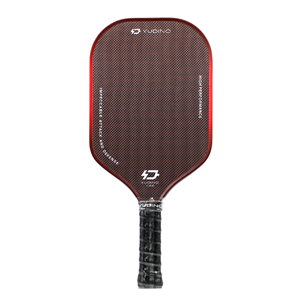
YUDINO offers several carbon fiber options, including 3K, 12K, 18K, and T700 carbon fiber constructions.
What Are the Advantages of Carbon Fiber?
Carbon fiber is particularly attractive to players who prioritize control, spin, and responsive feedback.
Its key advantages include:
Lightweight construction
High strength and stiffness
Excellent ball feedback
Strong spin potential
Good durability
Suitable for competitive play
The performance of carbon fiber is not identical across every paddle.
For example, 3K, 12K, 18K, and T700 carbon fiber can provide different performance characteristics depending on the construction and manufacturing process.
T700 carbon fiber is particularly popular in high-performance paddle construction because of its strength and stiffness characteristics.
For players who want a combination of control, spin, and responsive feel, carbon fiber is often a strong choice.
2. Fiberglass Pickleball Paddle
Fiberglass is another widely used material in pickleball paddle manufacturing.
Compared with carbon fiber, fiberglass is generally more flexible. This flexibility can contribute to a stronger rebound effect and a more powerful feel during ball contact.
Fiberglass paddles are therefore commonly selected by beginners, recreational players, and players who prefer a more power-oriented playing style.
What Are the Advantages of Fiberglass?
Fiberglass can offer:
Strong rebound power
A softer impact feel
Good durability
Competitive manufacturing cost
Beginner-friendly performance
For players who are still developing their technique, a fiberglass paddle can provide additional assistance when generating ball speed.
This is also why fiberglass is an important material for brands developing entry-level and mid-range pickleball paddle product lines.
YUDINO provides fiberglass paddle solutions for different market requirements, including OEM and customized applications.
3. Hybrid Pickleball Paddle Materials
Modern paddle manufacturing does not always rely on a single material.
Hybrid constructions can combine different materials to achieve a specific performance balance.
For example, a paddle may combine carbon fiber and fiberglass to balance control and power. Other advanced constructions may combine carbon fiber with structural reinforcement materials to improve stability and durability.
The advantage of hybrid construction is flexibility.
Instead of choosing between "maximum power" and "maximum control," manufacturers can adjust materials, thickness, surface construction, and core structure to create a more balanced paddle.
For brands and distributors, hybrid paddles can also help build different product tiers for different customer groups.
Pickleball Paddle Core Materials Matter Too
The paddle face is visible, but the core is equally important.
Modern pickleball paddle cores commonly use honeycomb structures because they provide structural stability while keeping the paddle relatively lightweight.
Polypropylene honeycomb is one of the most common core solutions used in modern pickleball paddles.
Polypropylene Honeycomb Core
Polypropylene, often referred to as PP, provides a good balance between power, control, durability, vibration absorption, and playing comfort.
The size and density of the honeycomb cells can also influence paddle performance.
A thicker core generally provides a softer and more controlled feel, while a thinner core can produce a more direct and powerful response.
YUDINO supports different core thickness options, including 13 mm, 14 mm, and 16 mm configurations, allowing paddle specifications to be matched with different playing styles.
Carbon Fiber vs. Fiberglass: Which Is Better?
There is no universal winner between carbon fiber and fiberglass.
The better material depends on what the player wants from the paddle.
| Performance | Carbon Fiber | Fiberglass |
| Power | Moderate to High | High |
| Control | Excellent | Good |
| Spin | Excellent | Good |
| Feel | Crisp and responsive | Softer and more flexible |
| Weight | Lightweight | Lightweight |
| Durability | Excellent | Good to Excellent |
| Best For | Intermediate & advanced players | Beginners & recreational players |
If your priority is control, spin, and precise feedback, carbon fiber is generally the better starting point.
If your priority is power, easier rebound, and value, fiberglass can be a practical choice.
The final performance, however, depends on the entire paddle construction rather than the face material alone.
Which Carbon Fiber Should You Choose?
Not all carbon fiber paddles are identical.
YUDINO's product range includes different carbon fiber specifications designed for different performance requirements.
3K Carbon Fiber
3K carbon fiber is a popular choice for players and brands looking for a balance between performance and cost.
It can be used for entry-level to intermediate performance paddle lines and is also suitable for brands developing cost-effective carbon fiber products.
12K Carbon Fiber
12K carbon fiber provides a higher-end positioning and can be used for intermediate and advanced paddle products.
It is suitable for brands that want to offer a stronger performance specification without moving directly into the highest-priced product category.
18K Carbon Fiber
18K carbon fiber is commonly used for premium performance paddle designs.
Its construction can provide high stiffness and responsive feedback, making it suitable for advanced players and competitive-oriented products.
T700 Carbon Fiber
T700 carbon fiber is widely used in high-performance paddle construction.
Its strength-to-weight characteristics make it suitable for lightweight performance paddles where manufacturers want to achieve a combination of stiffness, responsiveness, and durability.
For buyers who are evaluating carbon fiber paddles, it is important to look beyond the words "carbon fiber" and understand the actual fiber specification and construction method.
How Does Paddle Thickness Affect Material Performance?
Material selection should not be considered separately from paddle thickness.
For example, two paddles may both use carbon fiber but have very different playing characteristics because they use different core thicknesses.
A thicker paddle core can generally provide:
Better control
More stability
Softer impact feedback
Greater forgiveness
A thinner paddle can generally provide:
Faster response
More direct feedback
Stronger pop
A more aggressive playing feel
YUDINO supports 13 mm, 14 mm, and 16 mm paddle thickness options for different playing requirements.
How to Choose the Right Pickleball Paddle Material?
Instead of choosing a material simply because it is considered "premium," players should first identify their playing style.
If You Want More Control
Consider a carbon fiber paddle combined with a suitable thicker polypropylene honeycomb core.
This type of construction is particularly suitable for players who rely on placement, dinks, resets, and controlled shots.
If You Want More Power
Fiberglass can be a good starting point because its greater flexibility can help generate rebound power.
Players who prefer aggressive drives and powerful shots may also consider performance-oriented carbon fiber constructions designed for higher pop.
If You Want More Spin
Carbon fiber is generally the preferred material for players who prioritize spin.
However, surface texture is also important. Raw carbon fiber and textured carbon fiber constructions can provide additional friction between the paddle surface and ball.
Therefore, when evaluating a spin-oriented paddle, look at both the carbon fiber material and the surface construction.
If You Want a Lightweight Performance Paddle
Carbon fiber is an excellent option because of its high strength-to-weight ratio.
T700 carbon fiber and other advanced carbon fiber constructions can be used to develop lightweight paddles without sacrificing structural strength.
If You Are a Beginner
Beginners do not necessarily need the most expensive carbon fiber paddle.
A fiberglass paddle or balanced carbon fiber paddle can be a practical starting point.
More importantly, beginners should consider:
Comfortable paddle weight
Appropriate paddle thickness
Forgiving sweet spot
Comfortable grip
Good vibration control
Overall balance
Material Is Important, But Construction Is Even More Important
One common mistake is to judge a pickleball paddle only by its face material.
A "carbon fiber paddle" can perform very differently depending on how it is manufactured.
The final paddle performance depends on several factors:
Face material
Carbon fiber grade
Surface texture
Core material
Core thickness
Paddle shape
Weight
Construction technology
Edge reinforcement
Manufacturing consistency
For example, YUDINO's paddle solutions include thermoformed constructions, carbon fiber surfaces, polypropylene honeycomb cores, different thickness options, and multiple paddle shapes. These parameters can be combined to develop different performance profiles.
This is especially important for OEM and ODM buyers.
A successful paddle product is not simply about putting "carbon fiber" on the product specification sheet. The material, structure, production process, and performance target must work together.
Choosing Materials for Your Pickleball Paddle Product Line
For distributors, retailers, clubs, and pickleball brands, material selection is also a product-positioning decision.
A practical product portfolio may include:
Entry-Level:
Fiberglass + polypropylene honeycomb core
Intermediate:
3K / 12K carbon fiber + polypropylene honeycomb core
Advanced:
12K / 18K carbon fiber + thicker performance core
High-Performance:
T700 carbon fiber + thermoformed construction + performance polypropylene honeycomb core
This type of product structure allows brands to cover different price points and player requirements without relying on a single paddle specification.
YUDINO supports OEM and ODM customization for paddle materials, thickness, shapes, weights, designs, and other specifications, helping brands develop products for different markets and customer groups.
YUDINO: Pickleball Paddle Materials for Different Performance Needs
YUDINO is a professional pickleball equipment manufacturer integrating R&D, design, and production of pickleball paddles and balls.
Our product portfolio includes 3K, 12K, 18K, T700 carbon fiber, fiberglass, and other paddle constructions. We also provide different paddle thicknesses, shapes, weight categories, and customized OEM/ODM solutions.
For players, the right paddle is the one that matches their technique and playing style.
For brands and buyers, the right paddle is the one that combines the correct material, structure, performance, target market, and cost.
Understanding paddle materials is therefore the first step toward making a better equipment decision.
If you are developing a new pickleball paddle line or looking for a reliable pickleball paddle manufacturer, YUDINO can provide material selection, paddle specification development, OEM/ODM customization, and production support.
Contact YUDINO to discuss your pickleball paddle requirements and develop the right material and construction for your market.