Best Carbon Fiber Pickleball Paddle Surface: T700, 3K, or 18K?
Pickleball players often hear terms like T700 raw carbon fiber, 3K carbon weave, and 18K carbon fiber paddle faces. These materials are frequently promoted as premium features, but many players still wonder what they actually mean for performance.
In reality, the carbon fiber surface of a pickleball paddle directly affects power, spin, control, and feel. Understanding the difference between T300, T700, 3K, and 18K carbon fiber can help you choose the right paddle for your playing style.
In this guide, we’ll break down the science behind carbon fiber pickleball paddles and explain how each material impacts real on-court performance.
Quick Answer: Which Carbon Fiber Paddle Surface Is Best?
T700 raw carbon fiber is widely considered the best overall pickleball paddle surface, offering an excellent balance of spin, power, and control.
3K carbon fiber provides the best touch and control for finesse players
18K carbon fiber offers maximum stiffness and explosive power
3D 18K carbon fiber delivers enhanced spin thanks to its textured weave
Choosing the right surface ultimately depends on your skill level and playing style.
1. T300 vs T700 Carbon Fiber: Which Is Better?
The “T” rating refers to the tensile strength of carbon fiber filaments, which determines durability and stiffness.
T300 Carbon Fiber (Entry-Level Material)
T300 carbon fiber is a lower-cost material commonly used in budget pickleball paddles.
Characteristics:
Softer feel
Lower stiffness
Reduced durability under high-impact play
While it can be suitable for beginners, it typically lacks the responsiveness and strength required for competitive play.
T700 Raw Carbon Fiber (Industry Standard)
Toray T700 carbon fiber is widely recognized as the gold standard for raw carbon fiber pickleball paddles.
Why advanced players prefer T700:
Excellent strength-to-weight ratio
Minimal deformation during hard shots
Crisp and direct feedback
Because T700 maintains its structural integrity during high-speed impact, it transfers energy efficiently to the paddle core, producing the clean and controlled contact experienced players prefer.
2. 3K vs 12K vs 18K Carbon Fiber: What Do These Numbers Mean?
The “K” value represents how many individual filaments are bundled together in a carbon fiber tow.
1K = 1,000 carbon filaments
Higher K values change the stiffness, vibration frequency, and overall feel of the paddle surface.
3K Carbon Fiber: Maximum Control and Touch
3K carbon fiber features tightly woven fibers, usually in plain or twill weave patterns.
Performance characteristics:
Greater flexibility
Longer ball dwell time
Excellent control on soft shots
Players who rely on dinks, drops, and resets at the kitchen line often prefer 3K paddles because they provide a softer and more responsive feel.
Best suited for:
Control-focused players
Technical players who prioritize touch and precision
12K / 18K Carbon Fiber: Maximum Power
As the K value increases, carbon fiber bundles become wider and intersections decrease. This results in a stiffer paddle face.
Performance characteristics:
Faster rebound speed
Less cushioning
Higher power output
An 18K carbon fiber pickleball paddle is ideal for players who prefer aggressive baseline drives and fast attacking shots.
However, beginners may find 18K paddles too reactive, which can lead to over-hitting.
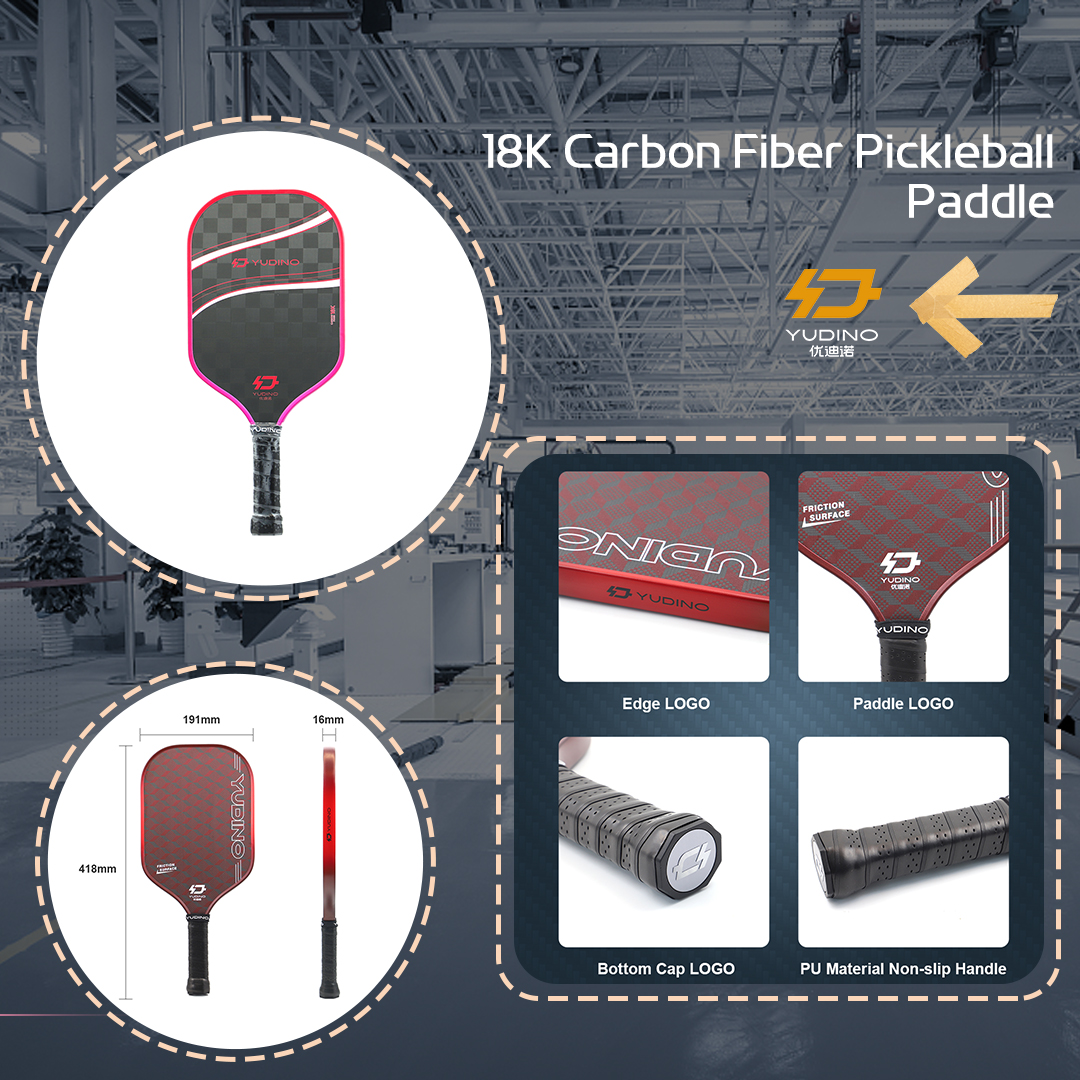
3. 3D 18K Carbon Fiber vs Traditional Grit Surfaces
Modern pickleball emphasizes spin generation, making paddle surface texture increasingly important.
Traditional Carbon Fiber Surfaces
Most paddles rely on sprayed grit coatings to create friction.
The downside:
The coating typically wears down after 3–6 months of heavy play.
3D 18K Carbon Fiber Technology
3D carbon fiber technology creates a physical three-dimensional weave structure within the paddle face.
Key advantage:
The spin texture comes from the carbon fiber itself rather than an external coating.
Even after surface wear, the woven structure continues to grip the ball and generate spin.
With proper technique, this design can produce over 2000 RPM of topspin.
4. Carbon Fiber Paddle Surface Comparison
| Surface Material | Power | Control | Spin | Feel | Best For |
|---|---|---|---|---|---|
| T300 | ★★☆☆☆ | ★★★☆☆ | ★★☆☆☆ | Soft but muted | Beginners |
| T700 Raw Carbon | ★★★★☆ | ★★★★☆ | ★★★★★ | Crisp and responsive | Intermediate players |
| 3K Carbon Fiber | ★★★☆☆ | ★★★★★ | ★★★☆☆ | Smooth and controlled | Control specialists |
| 18K Carbon Fiber | ★★★★★ | ★★☆☆☆ | ★★★★☆ | Stiff and explosive | Power hitters |
| 3D 18K Carbon | ★★★★★ | ★★★☆☆ | ★★★★★+ | Aggressive ball bite | Competitive spin players |
5. How to Choose the Best Carbon Fiber Pickleball Paddle
When selecting a carbon fiber pickleball paddle, it’s important to consider both the surface material and core thickness.
Best Paddle for Beginners
A 3K carbon fiber paddle with a 16mm core offers the best control and forgiveness for developing players.
Best Paddle for Spin
Players who rely on heavy topspin should look for paddles with:
Raw T700 carbon fiber surfaces
3D carbon weave textures
These materials provide longer-lasting grip on the ball.
Best Paddle for Power
Aggressive players often choose:
18K carbon fiber paddles with thinner cores (around 13mm)
This setup maximizes speed, pop, and attacking potential.
FAQ: Carbon Fiber Pickleball Paddle Questions
Why are some T700 pickleball paddles cheap while others are expensive?
The difference usually comes from construction quality.
Premium paddles often feature:
Multiple layers of T700 carbon fiber
Advanced thermoforming manufacturing processes
Reinforced edge structures
Budget paddles may simply apply a thin carbon layer over fiberglass, which reduces performance and durability.
Is raw carbon fiber better than fiberglass paddles?
In most cases, yes.
Raw carbon fiber paddles provide better spin, durability, and responsiveness compared to fiberglass surfaces, which tend to feel softer but generate less spin.
Do 18K carbon fiber paddles create more spin?
Not necessarily.
Spin is influenced more by surface texture and dwell time than fiber bundle size. Many players find raw T700 or textured carbon paddles generate the most spin.
Final Thoughts
Choosing a pickleball paddle surface is ultimately about finding the right balance between power, control, and spin.
3K carbon fiber excels at control
T700 raw carbon fiber offers the best overall performance
18K carbon fiber delivers explosive power for aggressive players
Understanding these materials will help you select a paddle that truly matches your playing style.
Looking for the right paddle for your game?
Explore our professional carbon fiber pickleball paddles designed with T700 raw carbon fiber and advanced carbon weave technology, and find the perfect match for your performance goals.