product-news
-
If a pickleball brand plans to enter the U.S. competitive market and wants its paddles to be eligible for USA Pickleball sanctioned tournament play, approval should not be treated as something to handle only after the product is finished.
-
When sourcing Spin pickleball paddles, one should not focus solely on 18K carbon fiber; it is essential to comprehensively evaluate factors such as face texture, surface finish, core material, thickness, weight, and overall construction. Before placing bulk orders, it is advisable to use samples to verify appearance, specifications, actual performance, and manufacturing standards to ensure the product meets target market needs, while also assessing the supplier's consistency in mass production and their OEM/ODM capabilities.
-
For brands developing private-label pickleball paddles, cold-pressed and thermoformed constructions should not be viewed simply as “traditional” versus “advanced.” A cold-pressed construction can be a practical choice when the project requires a mature structure, easier specification changes, and tighter cost control.
-
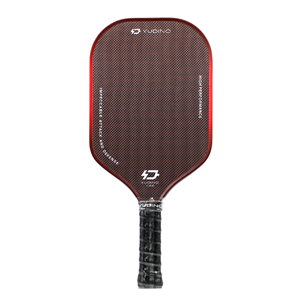
When selecting high-performance pickleball paddles, professional players consider a range of factors, including surface material, core structure, weight, dimensions, handle design, and manufacturing craftsmanship. Brands and buyers should determine product specifications based on the target users' playing styles and market positioning. YUDINO’s high-performance paddles—featuring 18K carbon fiber, a 16mm PP honeycomb core, and thermoforming technology—serve as a valuable reference for the development of competitive-grade products.
-
The primary differences between 3K and 12K carbon fiber pickleball paddles lie in the carbon fiber tow specifications and weave patterns; however, these factors alone do not determine product performance or market positioning. When making a purchasing decision, buyers should evaluate the product holistically, considering factors such as structure, weight, dimensions, price point, and the target market.
-
For pickleball brands, the choice between an edgeless paddle and an edge guard paddle is not simply a question of appearance. An edge guard paddle is usually the more practical option when edge protection, everyday durability, and a familiar retail structure are important. An edgeless paddle can be a better fit when the brand wants a cleaner visual profile, a different perimeter construction, or a product that stands apart from conventional paddle designs.
-
2409-2026
Titanium Carbon Fiber vs T700 Carbon Fiber Pickleball Paddle: What Should Brands Consider?
For brands developing a private-label pickleball paddle, a T700 Carbon Fiber Pickleball Paddle is often a practical choice for a mature mid-to-premium product line, while a Titanium Carbon Fiber Pickleball Paddle can make more sense when the goal is to create stronger material differentiation, visual identity, or a higher-positioned model.
-
This article explains what a training pickleball paddle is and what buyers should consider when purchasing one, including thickness, weight, size, shape, appearance, packaging, and batch consistency. Using the YUDINO paddle as an example, it also discusses how different buyers can select suitable configurations for training, clubs, and retail markets.
-
2209-2026
12k Carbon Fiber Pickleball Paddle Guide
This article focuses on 12K carbon fiber pickleball paddles, explaining the meaning of "12K carbon fiber" and its function in paddle construction, while clarifying that the 12K designation does not automatically equate to a tournament-grade product. Drawing on the specifications of the Udino 12K paddle as an example, the article outlines the key factors—such as carbon fiber type, core material, thickness, weight, and batch consistency—that buyers should consider, and details the specific product and quality information that must be verified during procurement.