Titanium Carbon Fiber vs T700 Carbon Fiber Pickleball Paddle: What Should Brands Consider?
For brands developing a private-label pickleball paddle, a T700 Carbon Fiber Pickleball Paddle is often a practical choice for a mature mid-to-premium product line, while a Titanium Carbon Fiber Pickleball Paddle can make more sense when the goal is to create stronger material differentiation, visual identity, or a higher-positioned model.
That does not mean a titanium carbon fiber paddle will automatically outperform a T700 paddle.
In an OEM project, face material is only one part of the construction. Core material, core thickness, paddle shape, weight, balance, surface treatment, and manufacturing method can all change how the finished paddle performs.
For that reason, the more useful question is not:
“Is titanium carbon fiber better than T700 carbon fiber?”
It is:
“Which construction fits the product position we are trying to build?”
That is the approach we use when comparing paddle options during product development and sampling.
1. What Is the Difference Between a Titanium Carbon Fiber Pickleball Paddle and a T700 Carbon Fiber Pickleball Paddle?
One point should be clarified first.
Titanium carbon fiber and T700 carbon fiber are not necessarily two completely separate carbon fiber grades.
T700 refers to a grade of carbon fiber.
A Titanium Carbon Fiber Pickleball Paddle, on the other hand, may use titanium filaments, titanium fibers, mesh, or another titanium-related structure together with carbon fiber.
In some YUDINO paddle configurations, for example, titanium filaments are combined with T700 raw carbon fiber.
This means the actual comparison may be closer to:
T700 Carbon Fiber Pickleball Paddle
versus
Titanium-enhanced carbon fiber construction based on T700 carbon fiber.
That distinction matters when sourcing.
Before comparing samples, a buyer should know:
Which carbon fiber grade is being used?
How is the titanium component incorporated?
Is T700 still the base carbon fiber?
What core material is used?
What is the core thickness?
Is the paddle thermoformed?
What is the target weight and allowed weight tolerance?
These details tell you much more than the word “Titanium” printed in a product description.
2. Why Is T700 Carbon Fiber Common in OEM Pickleball Paddle Projects?
T700 carbon fiber is already widely used in performance-oriented pickleball paddles.
For OEM buyers, one of its main advantages is that it can be combined with a wide range of established paddle specifications.
A T700 Carbon Fiber Pickleball Paddle can be developed with:
T700 raw carbon fiber face
PP honeycomb core
13 mm, 14 mm, or 16 mm core thickness
Standard, widebody, or elongated shape
Defined target weight
Weight tolerance
Different handle lengths
Customized grip size
Surface treatment options
Thermoformed or other construction methods
Custom logo and packaging
In other words, T700 is only one part of the specification.
Two paddles can both use T700 carbon fiber and still be positioned very differently.
A 14 mm elongated paddle may be designed around a different playing feel and market position than a 16 mm widebody paddle, even when the face material is the same.
For a brand building its first serious carbon fiber range, this flexibility is useful. Product differentiation does not always require a completely different face material.
Sometimes the more meaningful differences come from thickness, shape, balance, handle design, and construction.
3. When Does a Titanium Carbon Fiber Pickleball Paddle Make Sense?
The question often changes once a brand already has a T700 Carbon Fiber Pickleball Paddle in its range.
At that stage, the challenge is no longer: Should we offer a carbon fiber paddle?
It becomes: How do we make the next model clearly different from the one we already sell?
If the next paddle uses a similar face, similar thickness, similar shape, and similar weight, changing the artwork alone may not give customers a strong reason to see it as a new product.
This is where a titanium carbon fiber construction can become relevant.
It may give a brand another way to create:
A premium series
A flagship model
A performance-focused line
A material-driven product story
A visually differentiated model
But material differentiation should not be confused with guaranteed performance improvement.
Adding titanium does not automatically mean more power, more spin, better control, or longer life.
Those claims need to be supported by the complete paddle construction and actual sample testing.
It is better to treat titanium carbon fiber as a product-development option, not as a shortcut to a performance claim.
4. Compare Complete Paddle Specifications, Not Just Material Names
This is one of the most important points when comparing the two constructions.
Imagine two samples:
Sample A
T700 Carbon Fiber
16 mm PP Honeycomb Core
Thermoformed Construction
230 g
Sample B
Titanium Carbon Fiber
13 mm PP Honeycomb Core
Different Shape
Different Weight
Different Manufacturing Process
If the two paddles feel different during testing, it would be difficult to say that the difference came from the face material alone.
Too many variables have changed at the same time.
For a meaningful OEM comparison, try to keep the main specifications as close as possible.
| Sample Parameter | T700 Sample | Titanium Carbon Fiber Sample |
| Paddle Shape | Same | Same |
| Core Material | PP Honeycomb | PP Honeycomb |
| Core Thickness | 16 mm | 16 mm |
| Target Weight | Similar | Similar |
| Handle Length | Same | Same |
| Manufacturing Process | Same | Same |
| Main Variable | T700 Carbon Fiber Face | Titanium Carbon Fiber Face |
This gives the brand a much cleaner basis for evaluation.
Instead of relying on a generic “Titanium vs T700” performance chart, the buyer can see how the face construction behaves within a comparable paddle design.
5. How Should Brands Compare T700 and Titanium Carbon Fiber Samples?
For most OEM projects, the sample stage is more useful than trying to make the decision from material descriptions alone.
A good comparison starts with the physical specifications.
Check the Basic Specifications First
Record the following for both samples:
Paddle length
Paddle width
Core thickness
Handle length
Grip circumference
Total weight
Weight tolerance
Balance
Surface finish
If the basic specifications are significantly different, the playing comparison becomes less useful.
Inspect the Face and Finish
The next step is to look at manufacturing consistency.
Check:
Whether the carbon fiber surface is even
Whether the titanium structure matches the approved sample
Whether the surface texture is consistent
Logo and graphic quality
Edge finishing
Bonding condition between the face and the core
For an OEM buyer, this is not only about how the first sample looks.
The more important question is whether the same construction can be reproduced consistently in bulk production.
Then Compare Playing Characteristics
If the brand has an internal test group, retailer partners, or players who can evaluate samples, the two paddles can be compared under similar conditions.
Useful observations may include:
Impact feel
Ball response
Control
Power
Spin response
Vibration feedback
Perceived sweet spot
These results are best treated as sample-specific evaluation data.
They should not automatically be generalized into statements such as “all titanium paddles have more power” or “all T700 paddles offer better control.”
The full paddle construction still matters.
6. When Is a T700 Carbon Fiber Pickleball Paddle the Better Starting Point?
A T700 Carbon Fiber Pickleball Paddle is often worth considering first in several situations.
You Are Building Your First Mid-to-Premium Carbon Fiber Paddle
If your current line is mainly fiberglass or entry-level paddles, T700 offers a clear route into a more performance-oriented carbon fiber range.
The material is already familiar to many buyers and players, and the rest of the paddle can be differentiated through shape, thickness, weight, and construction.
You Need a Core Product for Long-Term Sales
A main product line has different requirements from a short-term experimental model.
For repeat orders, buyers usually care about:
Specification stability
Batch consistency
Cost control
Supply continuity
Repeatability
These factors can matter more than adding another material name to the product.
You Want Several SKUs Built Around One Face Material
A single T700 carbon fiber platform can support several models.
For example:
Model A
T700 Carbon Fiber
14 mm PP Honeycomb Core
Responsive positioning
Model B
T700 Carbon Fiber
16 mm PP Honeycomb Core
Control-oriented positioning
Model C
T700 Carbon Fiber
Elongated Shape
Different handle configuration
This approach lets a brand create a structured product family without changing the face material on every SKU.
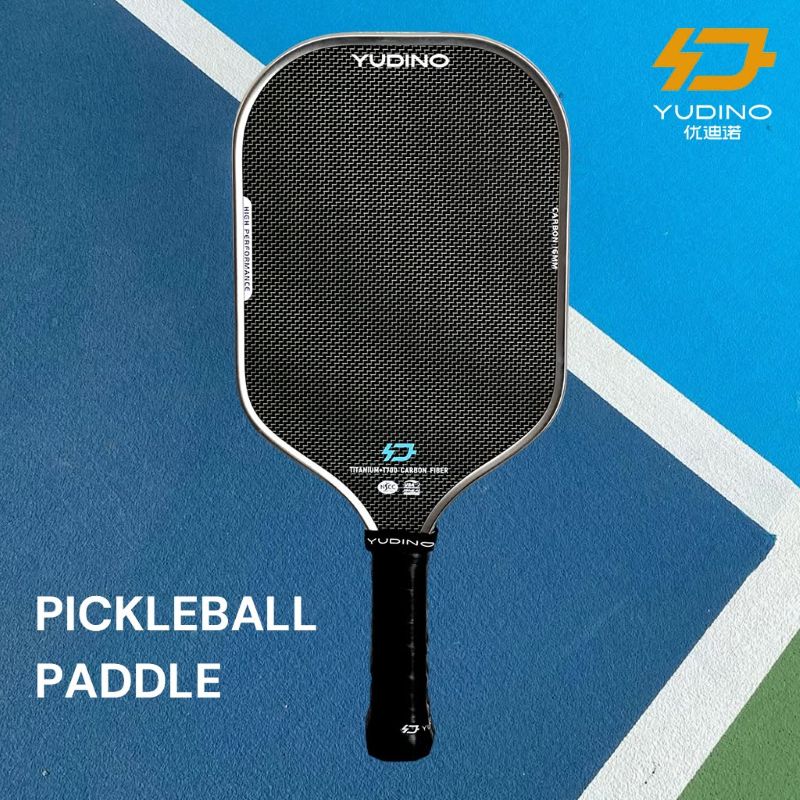
7. When Should a Brand Consider a Titanium Carbon Fiber Pickleball Paddle?
Titanium carbon fiber becomes more relevant when a brand has a specific reason to add another construction.
The Brand Already Has a T700 Product
If a T700 Carbon Fiber Pickleball Paddle is already selling well, a second paddle with almost the same specification may create unnecessary overlap.
A titanium carbon fiber model can give the new product a clearer material identity.
The Brand Wants More Visible Product Differentiation
Material appearance can also be part of product design.
A titanium-related surface or structure may help distinguish one model from another before the customer even compares technical specifications.
The Brand Is Developing a Premium or Flagship Series
Some brands use material differences to separate product tiers:
Entry Level
Mid-Range
Performance
Premium
Titanium carbon fiber can be one option for the upper end of that structure.
However, the decision should still be based on the entire project:
Target retail price
OEM cost
Sample results
Target players
Existing product range
Product story
Expected order volume
A more complex material is only useful if it gives the product a clear reason to exist.
8. Is a Titanium Carbon Fiber Pickleball Paddle Always More Expensive?
Not necessarily.
OEM pricing depends on much more than the material name.
The final cost can be affected by:
Face construction
Carbon fiber specification
Core thickness
Thermoforming process
Paddle shape
Mold requirements
Surface treatment
Logo process
Order quantity
Packaging
Inspection requirements
This is why a buyer should avoid asking only:“How much is a titanium paddle?”
A useful RFQ should define the complete product.
At minimum, include:
Dimensions
Core thickness
Target weight
Shape
Handle specification
Surface requirement
Logo process
Packaging
Expected quantity
Only then does a cost comparison between a Titanium Carbon Fiber Pickleball Paddle and a T700 Carbon Fiber Pickleball Paddle become meaningful.
9. What Should Buyers Confirm Before Ordering a Titanium Carbon Fiber Pickleball Paddle?
“Titanium Carbon Fiber Pickleball Paddle” is not a complete purchasing specification.
Before approving a sample, ask the supplier to clarify the following.
Material
What form of titanium is used?
What carbon fiber is used underneath or together with it?
Is T700 carbon fiber part of the construction?
How is the face structure built?
Core
What core material is used?
What is the core thickness?
Can the core specification or density be confirmed?
Construction
Is the paddle thermoformed?
How is the edge constructed?
How is the handle integrated with the paddle body?
Weight
What is the target weight?
What weight tolerance is allowed?
How will weight consistency be controlled during production?
Surface
How is the surface texture created?
How is surface consistency checked during mass production?
Customization
What logo processes are available?
Can colors be customized?
Can the grip be customized?
Is retail packaging available?
These questions turn a vague request such as:
“We want a titanium paddle.”
into a much more useful development specification.
10. What Matters Most for Repeat Orders?
A sample can look good. The bigger test is whether the second, third, and later production runs remain consistent.
For both T700 Carbon Fiber Pickleball Paddles and Titanium Carbon Fiber Pickleball Paddles, repeat orders should be checked against the approved specifications.
Key items include:
Face material
Core specification
Weight range
Surface finish
Bonding quality
Graphic consistency
Grip specification
Packaging
Approved sample reference
Special attention should be paid to any paddle using a more complex composite face.
The material and construction used for later production should remain consistent with the approved sample.
For long-term OEM cooperation, it is useful to keep three references together:
Approved Sample + Product Specification Sheet + Quality Standard
That gives both the brand and the manufacturer a clearer basis for future production.
In many cases, repeatability across multiple orders is more important than a small performance difference observed in one prototype.
11. Can T700 Carbon Fiber and Titanium Carbon Fiber Paddles Exist in the Same Product Line?
Yes.
For a brand with several product tiers, using both can be more practical than choosing only one.
A product line might look like this:
Core Carbon Fiber Series
T700 Carbon Fiber Pickleball Paddle
14 mm / 16 mm Options
Designed for the main mid-to-premium range
Premium Carbon Fiber Series
Titanium Carbon Fiber Pickleball Paddle
Different face construction
Thermoformed option
Designed for additional material and visual differentiation
The goal is not to tell the customer that titanium is automatically “better.”
The goal is to give each series a clear:
Target customer
Price position
Construction
Design language
Reason to buy
If two models are almost identical apart from the material name, the brand should consider whether both SKUs are really necessary.
12. What Can YUDINO Support for OEM Paddle Development?
YUDINO works with several carbon fiber paddle configurations, including:
T700 Carbon Fiber
3K Carbon Fiber
12K Carbon Fiber
18K Carbon Fiber
Titanium-carbon-fiber hybrid constructions
PP honeycomb cores can also be developed in different thicknesses, including:
13 mm
14 mm
16 mm
Depending on the project, other specifications can be adjusted as well:
Paddle shape
Handle length
Weight
Surface construction
Branding
Graphic design
Grip
Packaging
A practical development process usually starts with the target market and product position rather than the material name.
Before choosing the face material, brands should first define:
Target Market + Product Position + Target Price + Playing Direction + Basic Specifications
The face material, core, thickness, shape, weight, and manufacturing process can then be selected around that product brief.
Titanium Carbon Fiber or T700 Carbon Fiber: Which Should Your Brand Choose?
For a brand developing its first established mid-to-premium carbon fiber model, or a core product intended for stable repeat orders, a T700 Carbon Fiber Pickleball Paddle is often the more practical place to start.
For brands that already have a T700 model and want to introduce a more differentiated material story, stronger visual distinction, or a separate premium tier, a Titanium Carbon Fiber Pickleball Paddle may be worth developing and testing.
The final decision should not be based on the words “Titanium” and “T700” alone.
A better approach is to build comparable samples with similar core material, thickness, shape, weight, and manufacturing process, then evaluate whether the change in face construction actually supports the intended product position.
For an OEM project, the real question is not:
“Which material sounds more premium?”
It is:
“Which paddle construction gives this product a clear position in our range and can be reproduced consistently in mass production?”