USA Pickleball Paddle Approval: What Should Brands Prepare Before Submission?
If a pickleball brand plans to enter the U.S. competitive market and wants its paddles to be eligible for USA Pickleball sanctioned tournament play, approval should not be treated as something to handle only after the product is finished.
A better sequence is:
define the product first, lock the submission version, then move into certification.
USA Pickleball is not approving a general product concept or a broad category such as “a T700 paddle.” It is evaluating a specific paddle model. The materials, construction, surface finish, final graphics, and model information all need to correspond to the product being submitted.
Approval also does not end with laboratory testing. The manufacturer is expected to keep production units consistent with the certified version, and products sold in the market may continue to be checked for compliance.
For brands, the real question is therefore not:“How do we get a USA Pickleball logo on the paddle?”
It is:“How complete should the product be before submission so that the tested paddle, the approved paddle, and the production paddle remain the same product?”
That is where certification starts to become part of OEM product development rather than a separate administrative task.
1. Does Every Paddle Need USA Pickleball Approval?
No.
A paddle does not need USA Pickleball approval simply because it will be sold in the United States.
The approval is most relevant when a model is intended for USA Pickleball sanctioned tournament play and needs to appear on the official Approved Paddle List.
For a recreational model aimed mainly at:
Beginners
Schools
Promotional programs
General leisure play
Entry-level retail
the brand can decide whether certification is necessary based on the target market and sales channel.
The situation changes if the paddle is intended for:
Competitive players
Tournament-focused retail
Performance-oriented product lines
or if a distributor specifically requires an approved model.
In those cases, certification should be considered much earlier in the development process.
Approval should follow the market strategy. It does not need to be applied mechanically to every SKU.
2. When Is a Paddle Actually Ready for Submission?
Submitting too early can create as many problems as submitting too late.
If the brand is still changing:
Face material
Core
Core thickness
Surface
Shape
Construction
the product is usually not ready for formal submission.
At the other extreme, waiting until mass production is complete can create unnecessary rework if the brand then discovers that the model name, graphics, construction, or official markings still need adjustment.
A more practical submission point is:
after the final product definition is largely locked, but before full-scale market launch.
By then, the brand should already know:
Which model is being submitted
Which materials it uses
How it is constructed
What surface finish is final
Which artwork version will be used
From YUDINO’s experience with USA Pickleball certification testing projects, one practical lesson is clear:
the closer a product gets to submission, the less room there is for uncontrolled version changes.
At this point, the issue is no longer whether the sample looks good.
The question is whether the sample being submitted is the same product the brand intends to sell.
3. USA Pickleball Approval Starts With Model Control
Many brands initially focus on questions such as:
Will the dimensions pass?
Will the surface pass?
Will the PBCoR result pass?
Those are important, but there is an earlier question:
Which exact model is being certified?
Before submission, the brand should have a clear record of:
| Submission Item | What Should Be Confirmed |
| Brand | Final brand name |
| Model Name / Number | Final model identity |
| Face Material | Actual production material |
| Core | Material + thickness |
| Construction | Final production construction |
| Surface Finish | Same as production version |
| Paddle Shape | Final dimensions and profile |
| Artwork | Final version |
| Manufacturer / Model Marking | Consistent with submission information |
The point is not simply to complete a table.
The point is to make clear that these details should not be changed later without considering whether the change affects the approved model.
Certification is partly a testing process, but it is also a product-version control process.
4. Confirm the Manufacturer Account Early
Under the current USA Pickleball process, the manufacturer needs an approved manufacturer account before a paddle can be formally submitted for certification.
For an in-house brand, this is usually straightforward.
For OEM and private-label projects, it can become more complicated.
The brand and manufacturer should agree early on:
Which company will hold the manufacturer account
How the brand and manufacturer will be identified
Who will submit the paddle
Who will receive testing communication
Who will manage testing and submission costs
These may sound like administrative details, but they can delay a project if they are left unresolved until the final sample is ready.
For private-label projects in particular, the certification owner and product identity should be clear before submission begins.
5. Formal Submission Is More Than Sending One Sample
As of September 2026, the current USA Pickleball equipment submission process requires nine paddles to be sent to six locations for a new paddle submission.
Submitted products are not returned. Some testing may be destructive, and some samples are retained for future reference.
For an overseas brand or a China-based OEM project, this means certification planning should account for more than the test fee.
The project may also need to budget for:
Paddle samples
Multi-address shipping
Documentation
Possible pre-production testing
Possible re-submission
Additional development time
Certification should therefore be treated as part of the development budget rather than as a small last-minute expense before launch.
Submission requirements can change, so the latest official submission form and instructions should always be checked before shipping samples.
6. Why Final Graphics Matter Before Submission
In many OEM projects, graphics are treated as something that can be finalized after the construction is complete.
For USA Pickleball submission, that approach can create problems.
The current process requires the submitted paddle to use final graphics, with the manufacturer name and model name shown on the paddle face, together with the required USA Pickleball licensed logo or text treatment.
Before submission, brands should therefore lock:
Model Name
Do not submit under a temporary name that may change later.
Brand / Manufacturer Identification
The marking on the paddle should match the submission information.
Final Artwork
Certification samples should not use temporary graphics.
USA Pickleball Marking
Use the required licensed treatment rather than adding a logo informally.
This means certification planning and graphic development should move together.
For private-label buyers, the structural sample and the final certification sample may be different development stages.
7. USA Pickleball Testing Goes Beyond Paddle Dimensions
A common misunderstanding is that approval mainly depends on staying within the size limits.
Current paddle testing covers a broader range of requirements.
These may include areas such as:
Dimensions
Surface characteristics
Construction
Materials
Deflection
Surface roughness and friction-related testing
Power-related compliance
One of the most important recent areas is:
PBCoR — Paddle/Ball Coefficient of Restitution.
The current not-to-exceed PBCoR limit is 0.43.
For product developers, this matters because a paddle designed for greater power cannot be judged only by how powerful it feels during play.
If a brand is developing:
Foam core paddles
High-power thermoformed constructions
New perimeter systems
High-response material combinations
the development team also needs to consider whether the resulting product remains within the permitted performance range.
Product design and certification are no longer completely separate discussions.
8. Why Pre-Production Testing Can Be Worthwhile
For a mature construction, a manufacturer may already have a good understanding of the product.
For a new:
Foam core
Surface system
High-power construction
Thermoformed structure
waiting until formal certification to identify a compliance problem can be expensive.
USA Pickleball currently allows manufacturers to conduct compatible internal pre-production testing or use available prototype and pre-production testing services.
The purpose is not to guarantee approval.
It is to identify obvious risks before:
Final artwork
Packaging
Launch schedules
Mass production
are fully locked.
For more experimental paddle constructions, the development sequence may look like:
Prototype → Pre-Production Testing → Structural Adjustment → Final Sample → Official Submission
That is usually safer than:
Prototype → Production Ready → Official Test → Failure → Redesign
Pre-production testing is essentially a way to find problems earlier, when they are still cheaper to fix.
9. Certification Timing Needs to Be Part of the Launch Plan
The current USA Pickleball guidance indicates approximately:
Standard Testing: 4–6 weeks
Expedited Testing: 3–8 business days
Actual timing can still vary depending on submission volume.
That means certification should not be scheduled one week before a planned launch.
A realistic timeline should account for:
International shipping
Submission review
Testing
Follow-up questions
Possible design changes
Possible re-submission
This becomes especially important if the product is planned around:
Tournament season
Distributor launches
Trade shows
Major DTC or retail launches
Certification timing is part of the product launch calendar, not just a purchasing task.
10. The Most Important Practical Point: The Submitted Paddle and Production Paddle Must Remain the Same Product
This is one of the most useful lessons from actual certification-related projects.
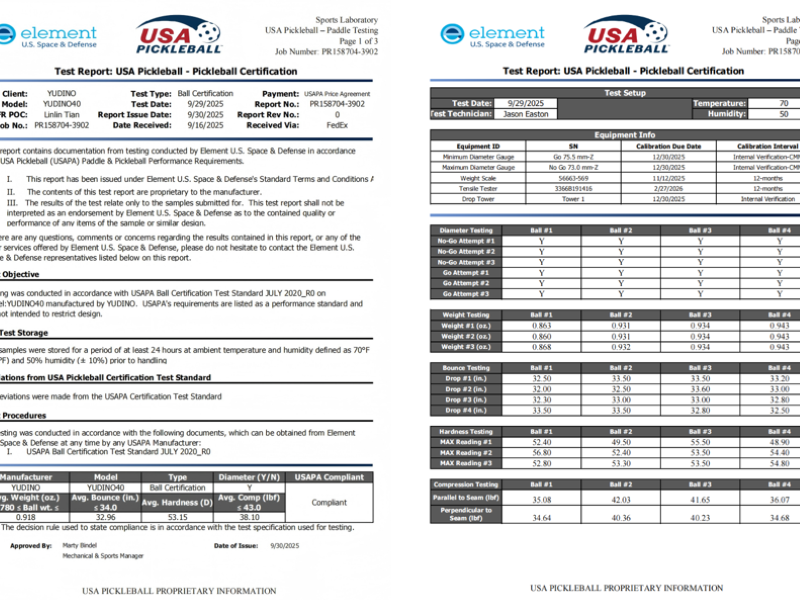
Based on the test documentation provided by YUDINO, selected YUDINO paddle models have undergone USA Pickleball Paddle Certification testing and received Compliant results.
The most valuable takeaway is not simply:“YUDINO has certification experience.”
The more practical lesson is:
the certification sample and the later production paddle should not gradually become two different products.
If the submitted version uses a specific:
Face material
Core
Surface
Construction
and the brand later changes those items to reduce cost or adapt the supply chain, the production paddle may no longer represent the product that was tested.
That is why certified products need stronger change control.
Certification does not only affect the submission stage.
It also changes how later production modifications should be managed.
11. Similarity Submission Does Not Mean “Change the Logo and Reuse the Approval”
This is particularly important for private-label projects.
USA Pickleball currently allows qualified Similarity Submissions, but the similar model must use the same materials, manufacturing methods, and surface finishing processes as the approved base paddle.
The new model must also use a distinct model name.
So the following do not automatically prove similarity:
Same factory
Same shape
Similar appearance
Same general carbon fiber description
A private-label paddle cannot simply assume that changing the logo allows it to inherit an existing approval.
The manufacturer still needs to evaluate:
Materials
Manufacturing
Surface finishing
Base model status
against the current Similarity Submission requirements.
12. Approval Is Followed by Ongoing Compliance
This is one of the most important points for brands to understand:
USA Pickleball Approval is not a one-time event with no future obligations.
Manufacturers are expected to keep production units consistent with the certified samples.
The official compliance system also includes statuses such as:
Under Investigation
Compliance Issue Resolved
Removed from USAP Approved List
That means approval confirms that a model met the relevant requirements under the certification conditions.
Production still needs to control:
Materials
Construction
Surface
Performance
Batch consistency
For a brand, certification management therefore becomes part of supplier quality management.
13. Why “Break-In” Matters More Than It Used To
Modern high-performance paddles have created another compliance question:
Does the paddle change significantly after repeated use?
Some materials and constructions can behave differently after a break-in period.
USA Pickleball currently expects paddles to remain compliant throughout their product life cycle, not only when they are brand new.
This is especially relevant for products using:
Foam cores
Compressible materials
New perimeter systems
High-power constructions
Brands should not only ask:“Can the new paddle pass?”
They should also consider:“Could the structure change enough during use to affect compliance later?”
That question can influence:
Material selection
Product testing
Repeat production
QC
After-sales management
For next-generation paddle development, this is becoming a product-development issue, not just a certification issue.
14. What Does YUDINO’s Certification Experience Mean for OEM Buyers?
Based on the testing documentation provided, selected YUDINO paddle models have participated in USA Pickleball Paddle Certification testing and received Compliant results.
For a brand customer, the value of this experience is not simply that:“The factory has submitted paddles before.”
The more useful value is that the manufacturer has already worked through parts of the process involving:
Product version confirmation
Certification sample preparation
Testing requirements
Model and graphic confirmation
Production consistency after certification
For brands developing paddles for the U.S. competitive market, that experience can help identify important questions earlier in the OEM process.
For example:
Which product details need to be locked before submission?
Which construction changes may need further review?
How should the final sample, certification sample, and mass-production version be aligned?
That is more meaningful than simply placing a USA Pickleball logo on a product page.
15. A More Practical Certification Development Path
For a brand preparing for USA Pickleball Approval, a useful development sequence is:
Market Position → Product Definition → Final Sample → Certification Readiness → Submission → Testing → Approval → Production Consistency
The two ends of this process are often where problems occur.
At the beginning:
Do not rush into submission while the product is still changing.
At the end:
Do not assume that approval allows unlimited production changes.
The product definition should remain continuous:
The product developed = the product submitted = the product approved = the product mass-produced and sold.
USA Pickleball Approval Is More Than a One-Time Test
For brands entering the U.S. competitive pickleball market, approval is not only about answering:“Can this paddle appear on the Approved Paddle List?”
It also forces the brand to define:
Which model is being launched?
Which materials and construction belong to that model?
Which specifications should not change without review?
How will future production remain consistent with the certified version?
From actual certification-related projects, the more mature approach is not to finish a product and then send a few samples out to “see if it passes.”
A better approach is to bring certification requirements into:
Product development
Sample approval
Artwork
Production planning
before the product reaches full-scale production.
For an OEM manufacturer such as YUDINO, the value of having selected models complete USA Pickleball certification testing is not simply a marketing claim.
The more useful value is applying that experience to new brand projects:
helping buyers define the correct product version earlier, reduce unnecessary changes around submission, and keep the approved sample aligned with mass production.
Note: USA Pickleball submission quantities, testing fees, timelines, and technical requirements may change. Brands should always confirm the latest requirements on the official USA Pickleball Approved Equipment website and current submission form before submitting a paddle.