Carbon Fiber Pickleball Paddle Lifespan Tips
Introduction: How Long Should a Paddle Actually Last?
Ask ten pickleball players how long a paddle should last, and you will get ten different answers. "Mine lasted two years." "I've had mine for four seasons, and it's still perfect." "My last one was dead in eight months." The range is real, and the variance is not random — it is the direct result of how paddles are built, how they are used, and critically, how they are cared for between sessions.
A carbon fiber pickleball paddle sits at a price point where the durability question carries genuine financial weight. Entry-level composite paddles can be replaced without much deliberation. But a quality carbon fiber paddle — with a precisely engineered surface texture, a polymer honeycomb core, and a carefully constructed frame — represents a meaningful investment in your game. Understanding what determines its lifespan, what shortens it unnecessarily, and what extends it significantly is not just maintenance advice. It is how you protect the equipment performance you paid for.
This guide covers the full lifespan picture for carbon fiber paddles: the materials science behind how carbon fiber ages, the specific threats that kill paddles faster than they should, the storage and handling practices that add years to a paddle's service life, how to recognize when performance has genuinely degraded (versus normal break-in), and the selection criteria that predict longevity before you buy.
It draws on real patterns observed across Quora and Reddit discussions where competitive players and serious recreationalists compare paddle experiences — and on the manufacturing expertise of YUDINO (Liaoning) Sports Goods Co., Ltd., a purpose-built pickleball paddle manufacturer producing over 50,000 units per year with USAPA-certified products and a full range from titanium carbon fiber to fiberglass. Manufacturers who understand how paddles fail are uniquely positioned to advise on how to make them last.
What Actually Determines a Carbon Fiber Pickleball Paddle's Lifespan
Paddle lifespan is not a single variable. It is the intersection of three factors: construction quality, usage intensity, and maintenance behavior. Understanding each helps you make better purchasing decisions and better care decisions simultaneously.
Construction Quality: The Foundation Everything Else Builds On
The most important determinant of lifespan is how well the paddle was built. This encompasses:
Core integrity: The polymer honeycomb core — typically polypropylene — is what gives a pickleball paddle its characteristic feel and pop. This core is bonded to the face material under heat and pressure during manufacturing. If that bond is imperfect — air pockets, insufficient adhesive coverage, uneven pressure during curing — the core will begin to delaminate from the face earlier and more severely than a properly bonded paddle. Core delamination is the most common form of terminal paddle failure, and it is almost entirely a manufacturing quality issue.
Face material adhesion: On a carbon fiber pickleball paddle, the face material — whether 3K, 12K, 18K, or T700 carbon fiber, or a titanium-carbon composite — must be bonded to the core with precision. The bond must withstand thousands of repeated impact events with minimal thermal and mechanical stress accumulation. Manufacturers who cure their laminates at the correct temperature and pressure, with correctly formulated epoxy resin systems, produce faces that maintain their bond integrity for years. Manufacturers who cut corners in the curing process produce faces that begin to separate within months.
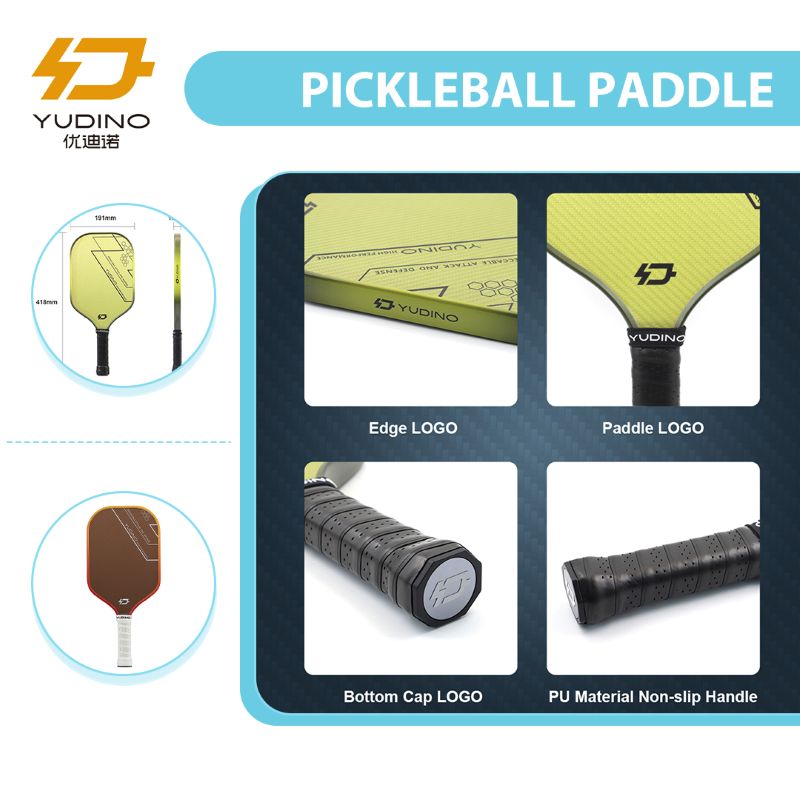
Edge guard quality: The edge guard — the plastic or composite band that protects the perimeter of the paddle — is the primary mechanical barrier between the playing surface and the court surface during drops and drags. Edge guards that are properly fitted and fully bonded to the face stay put. Poorly fitted edge guards separate at their junction with the face, allowing moisture and debris to enter the paddle interior and attack the core and adhesive from the inside.
Handle construction: The handle must maintain its structural connection to the paddle body across years of torque load, vibration, and the occasional dramatic drop. Handles that rely on mechanical fastening alone — versus those that are integrated into the paddle's structural laminate — are more vulnerable to loosening over time.
YUDINO's titanium carbon fiber pickleball paddle line addresses each of these construction points through the aerospace-grade titanium alloy wire composite structure: the titanium wire mesh distributes mechanical stress across a wider matrix area, reducing concentrated fatigue at any single bond point. The result is a paddle structure that maintains its integrity under sustained high-frequency impact — not just in the first month, but across the competitive season and beyond.
Usage Intensity: How Much Stress the Paddle Accumulates
A paddle used three times per week by a competitive tournament player accumulates more mechanical stress in one year than a paddle used twice weekly by a recreational player in three years. This is simply physics — carbon fiber composite materials have a fatigue life that is expressed in load cycles, not calendar time.
Two usage factors are most significant:
Ball impact energy: The kinetic energy transferred to the paddle face at ball contact depends on swing speed and ball mass. Harder, faster swings — characteristic of power-oriented players and aggressive competitive play — generate more impact energy per stroke than soft-game dinking. Players who generate significant pace are loading their paddle faces more intensely per hour of play.
Edge and frame contact events: Every time a paddle frame contacts the court — a drag shot, a sudden drop, a miss-hit where the frame strikes the court surface — it creates a localized impact event on the edge guard and frame material. These events are distinct from the fatigue load of ball impacts and can cause immediate structural damage if severe, or cumulative weakening if repeated. Players who drag their paddles frequently (a technique used for certain spin shots) accumulate edge wear faster than players who avoid court contact.
Maintenance Behavior: The Most Controllable Variable
Given identical construction quality and identical playing intensity, paddle lifespan varies by a factor of two or more based on maintenance behavior alone. This is where player decisions have the most leverage — and where the most common, entirely avoidable lifespan-shortening mistakes occur.
How Different Carbon Fiber Materials Age: What Your Face Material Means for Longevity
Not all carbon fiber pickleball paddle face materials age in the same way or at the same rate. Understanding the aging characteristics of the material in your paddle helps you calibrate your care practices and lifespan expectations.
3K Carbon Fiber
3K carbon fiber — with 3,000 individual filaments per bundle — produces a relatively tight, dense weave with a surface texture that is finely grained and slightly rough. This surface texture is both a performance asset (spin generation, friction at ball contact) and a durability consideration.
The surface texture of 3K carbon is created by the weave pattern itself, not by post-processing or coating. This means the tactile roughness that generates spin is integral to the fiber matrix. As the paddle ages, this texture naturally smooths with use — ball contact gradually polishes the highest surface points. In most cases, this is a slow process that occurs over many months of regular play. But aggressive play against harder balls (particularly outdoor balls, which are harder than indoor balls) accelerates surface smoothing.
For longevity of 3K surface performance, avoid aggressive cleaning with abrasive materials, which mimics and accelerates the natural smoothing process. Clean with soft materials only.
12K and 18K Carbon Fiber
Denser carbon fiber weaves — 12,000 or 18,000 filaments per bundle — produce finer, more tightly packed surface structures. The higher fiber density means more fiber-to-matrix bonding area per unit surface, which increases resistance to surface delamination and edge chipping. 18K weaves, in particular, have a surface that is noticeably more dense and consistent than 3K, which contributes to both a different aesthetic appearance and a moderately different durability profile.
The trade-off: denser weaves are marginally more brittle in extreme impact scenarios (such as a hard frame strike on a court surface) because the fibers are more tightly constrained and have less capacity to distribute a localized impact load laterally. For players who frequently drop paddles or play aggressively near court surfaces, this is worth noting.
T700 Carbon Fiber
T700 is a specific aerospace-grade carbon fiber designation from Toray (and equivalent grades from other manufacturers) representing a particular combination of tensile strength and modulus. T700 carbon is widely used in the pickleball industry and is significantly stronger in tension than standard carbon fiber — a property that contributes directly to durability under the repeated tensile loads of ball impact.
YUDINO's T700 carbon fiber pickleball paddle line draws on the same material specification used in aircraft structural components. The tensile strength advantage of T700 means the fiber-matrix bond has more reserve capacity before accumulating fatigue damage — which translates to a longer period before performance degradation becomes noticeable. For buyers prioritizing longevity as a selection criterion, T700 specifications represent a meaningful advantage over commodity carbon grades.
Titanium Carbon Fiber Composite
The titanium wire woven into YUDINO's flagship titanium carbon fiber line introduces metal fatigue characteristics that differ from pure carbon. Titanium alloy has a high fatigue endurance limit — meaning there is a stress level below which it can be cycled essentially indefinitely without progressive damage. By introducing this element into the carbon composite, the frame structure gains a fatigue resistance profile that pure carbon (which does not have a fatigue endurance limit in the same sense) lacks.
For practical paddle lifespan, this means: the titanium-carbon frame is less prone to the gradual accumulation of micro-crack damage that eventually causes pure carbon frames to lose stiffness and structural integrity. Under equivalent usage conditions, a titanium carbon composite frame maintains its structural stiffness for longer than a pure carbon equivalent. This is not a marginal difference — aerospace engineers use titanium reinforcement precisely because of this fatigue characteristic.
Fiberglass
YUDINO's fiberglass paddles occupy the entry-level segment and have a different aging profile. Fiberglass is less stiff than carbon, which means it deforms more at impact — absorbing energy rather than reflecting it. This lower stiffness is why fiberglass paddles feel softer and have a different pop characteristic than carbon. For longevity, fiberglass faces are less sensitive to edge chipping and point impacts than carbon fiber, but they are more sensitive to creasing damage from lateral impacts (such as a frame catching the court during a slide). They also smooth faster at the surface, losing their textured grip characteristics more quickly than carbon fiber faces under equivalent conditions.
The Five Biggest Paddle Lifespan Killers
Based on player experience shared across competitive forums and YUDINO's manufacturing perspective on how paddles fail in service, five factors account for the vast majority of premature paddle deaths:
1. Extreme Temperature Exposure
Heat is the most underestimated threat to paddle longevity. The epoxy resin systems that bond carbon fiber laminates to honeycomb cores have a glass transition temperature (Tg) — a point at which the resin softens from a rigid solid to a more compliant state. Below Tg, the bond is rigid and stable. At or above Tg, the bond softens, allowing micro-movement between the face and core that, when it recurs repeatedly, accumulates as delamination damage.
The most common way this happens: leaving a paddle in a car in summer sun. On a hot day with ambient temperature of 35°C (95°F), the interior of a parked car can reach 70–80°C (158–176°F) within 30 minutes. The Tg of typical pickleball paddle epoxy systems is in the range of 60–80°C (140–176°F). A paddle left in a car for an afternoon in summer sun may be spending hours at or above its resin's glass transition temperature — repeatedly. Each such event accumulates damage.
Players on Reddit's r/Pickleball community repeatedly describe the same scenario: "My paddle felt completely different after I left it in my car during a road trip." The feeling they are describing is early delamination — the face and core have separated microscopically, changing the feel and eventually the performance of the paddle.
Rule: Never leave a carbon fiber pickleball paddle in a hot car. Store it in a temperature-controlled environment.
Cold is also damaging, but in a different way. Carbon fiber composites contract in extreme cold, and epoxy resin becomes more brittle. Paddles exposed to very cold temperatures (below -10°C / 14°F) before play are more susceptible to edge chipping on early impacts before the material warms. Allow cold paddles to reach ambient temperature before playing.
2. Moisture Infiltration
Carbon fiber itself does not absorb moisture. Epoxy resin systems are also largely moisture-resistant. But the honeycomb core material — polypropylene — can be compromised if moisture enters through a compromised edge guard or a crack in the face.
Water entering the paddle interior does not immediately destroy it. But moisture-saturated honeycomb becomes heavier, changes the paddle's weight distribution and feel, and creates a medium for expansion and contraction cycling that accelerates delamination. Paddles that have been wet internally — from rain exposure, repeated outdoor play in humid conditions with a compromised edge guard, or storage in a damp bag — develop a dull, dead feel that does not recover.
Edge guard condition is the primary moisture barrier. Inspect edge guards regularly for separation, cracks, or sections that have lifted from the face. A small section of separated edge guard — seemingly cosmetic — is an open pathway for moisture. Seal it immediately with appropriate adhesive or replace the edge guard rather than allowing moisture exposure to continue.
3. Hard Surface Impacts to the Frame
The edge guard protects against minor contact with court surfaces, but it is not engineered for repeated hard impacts. A frame strike on a hard court surface — when a player drops their paddle, or when the frame drags aggressively on a concrete surface during a defensive shot — can cause localized delamination of the face from the core, cracking of the carbon fiber face at the edge, or fracture of the edge guard.
Each of these damage types can be progressive: a small delamination creates a weak point where the next impact causes a larger separation; a small crack grows into a delamination under subsequent ball impacts. The damage from a single bad drop is not always visible or immediately apparent in performance — but it sets a failure process in motion.
Practical protection: Use a paddle bag or sleeve whenever the paddle is not in your hand. Do not rest paddles face-down on court surfaces. Develop the habit of placing paddles face-up or hanging them from a bag, not setting them flat on hard surfaces with the face down.
4. Improper Cleaning
A carbon fiber pickleball paddle face accumulates ball residue (from the outdoor ball's rubber material), court dust, and sweat from grip transfer during play. This residue fills the surface texture grooves of the carbon face and reduces spin generation — one of the earliest performance degradation signals players notice.
The temptation is to scrub the face aggressively to restore texture. This is counterproductive. Abrasive cleaning mimics and accelerates the natural smoothing process that wear produces over time. Using metal scourers, stiff brushes, or abrasive cleaning compounds removes not just the residue but the surface fiber material itself — permanently reducing texture and shortening the performance lifespan of the face.
Proper face cleaning uses a damp soft cloth or specialized paddle eraser (designed to lift ball residue without abrading the surface). A slightly damp microfiber cloth applied with gentle circular motion removes most residue. For stubborn deposits, a small amount of isopropyl alcohol on a soft cloth dissolves rubber residue without damaging the carbon or epoxy — but apply it sparingly and do not allow it to contact edge guard adhesive areas repeatedly.
5. Storing with Pressure or in Tight Spaces
Paddle bags that compress the face under another paddle's edge, equipment stored under heavy gym bags, or paddles wedged into tight spaces with lateral pressure are all gradually deforming the honeycomb core through sustained compression loads that the paddle is not designed to carry. Unlike the brief compression of ball impact — which the core is engineered to absorb and recover from — sustained static compression causes permanent core deformation over days or weeks.
The result: the paddle develops soft spots or areas of reduced stiffness where the core has been permanently compressed. These areas feel different at ball contact and produce inconsistent pop across the face.
Store paddles in a bag where they lie flat without heavy objects on top, or hang vertically in a way that does not put edge pressure on the face.
Storage and Care Best Practices: The Year-Round Maintenance Routine
After Every Session
Wipe the face: Use a clean, soft microfiber cloth to remove ball residue, sweat, and court dust. Do this while the residue is fresh — dried rubber residue is harder to remove without increased friction.
Wipe the grip: Grip tape absorbs sweat and degrades faster when saturated. A quick wipe of the handle after play extends overgrip life and prevents salt accumulation that can harden and crack grip materials.
Inspect the edge guard: Run a finger around the perimeter of the edge guard. Any section that has separated slightly from the face should be noted. Address separations immediately rather than allowing them to grow.
Allow to air dry: If the paddle was used in humid or rain-adjacent conditions, allow it to air dry in a cool, ventilated space before returning it to a bag.
Weekly (for Regular Players)
Deeper face inspection: Hold the paddle face at an angle to a light source. Delamination often becomes visible as slight bubbling or rippling of the surface that is not visible straight-on. Run your finger across the face — any soft areas, or areas that sound different when tapped (a hollow versus solid sound), indicate core delamination.
Check the grip: Press the grip area and assess its resilience. Old, compressed overgrip has lost its protective thickness and should be replaced. If the grip material is glazed (smooth and slippery), replace immediately — playing with a glazed grip causes over-gripping that stresses the wrist and elbow.
Check handle integrity: Grasp the handle and apply lateral torque while holding the paddle face still. Any movement between handle and paddle body indicates a loosening connection that should be addressed before it becomes a complete failure.
Seasonal (Every 3–6 Months)
Full edge guard replacement: If the edge guard shows any sections that have separated, cracked, or show significant wear, replace the full edge guard rather than patching individual sections. Partial patches create differential stiffness at the patch boundary that can generate a new crack point.
Base grip replacement: Even if the base grip under your overgrip feels acceptable, inspect its condition. A degraded base grip provides less impact cushioning and can make the handle feel stiffer than it should — affecting comfort during extended sessions.
Structural assessment: Apply firm but not aggressive pressure across the entire paddle face. A well-maintained paddle should feel uniformly stiff across its entire face. Any soft spot, flexure, or area that produces a sound different from the rest of the face is a sign of localized delamination.
How to Tell When Your Carbon Fiber Pickleball Paddle Is Actually Dead
This is one of the most frequently debated questions on pickleball forums because the performance degradation of a paddle is gradual and subjective. Players often do not notice the slow changes in their equipment — they attribute inconsistent shots to technique fluctuation rather than paddle deterioration.
Here are the specific, objective signs that indicate genuine end-of-life performance degradation in a carbon fiber pickleball paddle:
The Trampoline Effect Has Disappeared
A well-maintained carbon fiber paddle with an intact core produces a consistent "pop" at ball contact — a brief, springlike energy return that is characteristic of the polymer honeycomb core's designed function. When the core begins to delaminate from the face, this energy return becomes inconsistent and ultimately disappears. The paddle begins to feel "dead" — shots require more effort to generate the same pace, and the characteristic crispness of carbon fiber feedback is replaced by a dull, flat sensation.
This is the most reliable indicator of core failure. If your paddle feels dramatically less lively than it did when new, and that change has not been explained by a specific impact event, core delamination is the most likely cause.
Audible Change at Ball Contact
Tap the face of your paddle with a knuckle in multiple locations — center, mid-face, edges. A healthy paddle produces a consistent tone across the face. A delaminated paddle produces a noticeably hollow or drum-like sound in the affected area, because the face is vibrating freely rather than in contact with the core beneath it.
This test is simple, reliable, and takes ten seconds. Make it a routine part of your pre-session paddle check.
Visible Surface Changes
Bubbling, rippling, or visible separation at the face-edge junction all indicate active delamination. Small bubbles on the face surface are delamination between the carbon fiber face and the core — once started, they grow under continued use. These are visible in raking light and, once you know what to look for, easy to identify.
On Reddit's r/Pickleball, the question "how do I know if my paddle is dead?" reliably attracts responses pointing to the hollow-tap test and the face bubble inspection as the two most reliable diagnostics. The consensus: if you hear hollow sounds or see bubbles, it is time to replace regardless of how the paddle still feels in play — because the failure is progressive and will accelerate.
Loss of Surface Texture
For a carbon fiber pickleball paddle whose spin generation is part of your game strategy, a face that has smoothed to a slick finish has lost a core performance attribute even if the core is structurally intact. This is not a structural failure but a functional one: the paddle can no longer perform the role you bought it to perform.
Surface smoothing is slower on higher-quality carbon with better weave density (18K ages more slowly than 3K in this respect) and faster under aggressive use with hard outdoor balls.
Grip Has Compressed to Nothing
A grip-related change is not the paddle dying — it is a maintenance failure that is entirely fixable with grip replacement. But it is frequently mistaken for paddle failure because it dramatically changes how the paddle feels and behaves. Before concluding that your paddle is dead, replace the overgrip and assess whether performance returns.
Buying for Longevity: Selection Criteria That Predict Paddle Lifespan
If you want a carbon fiber pickleball paddle that will genuinely last two to four years under regular competitive use, these selection criteria predict longevity before you buy:
Material Specification: Does the Manufacturer Tell You Exactly What They Used?
Manufacturers who specify the exact carbon fiber grade (3K, 12K, 18K, T700), core material (polypropylene honeycomb, thickness, cell density), and epoxy system in their product descriptions are manufacturers who have engineered their paddle with explicit material selections — not whoever is cheapest this quarter.
Manufacturers who describe their paddle as "carbon fiber" without further specification, or use vague terms like "high-performance composite" without material specifics, are manufacturers whose product quality may vary without disclosure. Exact material specification is a transparency signal that correlates with manufacturing consistency.
YUDINO's product descriptions specify the carbon fiber construction explicitly: titanium alloy wire integration for the titanium carbon line, T700 specification for the aerospace carbon line, 3K/12K/18K weave density for surface material. This level of specificity reflects manufacturing process control — you cannot specify a material you are not consistently sourcing and verifying.
USAPA Certification: Quality Verification Through Testing
USAPA paddle certification requires paddles to pass physical testing for dimensions, surface roughness, deflection, and power characteristics. While certification primarily assesses compliance with competition rules rather than durability, the testing process provides an independent verification that the paddle was built to a consistent specification.
Paddles that are USAPA certified have been physically examined by a standards body. This is not a guarantee of exceptional durability, but it is evidence of consistent manufacturing process — the quality discipline required to produce paddles that reliably pass a standardized test is the same discipline that produces consistent construction quality.
Three YUDINO paddle models carry USAPA approval. For buyers who want an independent quality signal beyond manufacturer claims, USAPA certification is a meaningful filter.
Manufacturing Scale and Process Maturity
A manufacturer producing 50,000 paddles per year has operated its production processes, identified its failure modes, and refined its quality controls at a scale that a low-volume producer cannot match. High production volume with consistent quality requires — not just benefits from — rigorous process control at every manufacturing stage. Manufacturers at this scale have seen how their paddles fail in service and have had the opportunity and the incentive to address those failure modes in future production.
This is directly relevant to lifespan prediction: YUDINO's 50,000-unit production volume, combined with USAPA certification across multiple models, is a proxy for the manufacturing process maturity that produces structurally reliable paddles across a full production run, not just in the samples submitted for certification.
OEM Customization Depth as a Durability Signal
A manufacturer offering genuine OEM and ODM customization — where B2B buyers can specify core type, face material, and construction parameters — is a manufacturer with complete command of their production process. A factory that can produce a paddle to arbitrary specification on demand understands every variable of the construction. This depth of manufacturing competence is the same competence that produces consistent quality in standard production.
For end-users evaluating manufacturer quality through indirect signals, the breadth of genuine customization capability is a useful indicator of manufacturing sophistication.
Common Mistakes That Shorten Paddle Life Unnecessarily
Hitting Paddles Together at the Net
The "paddle tap" — touching paddles at the net after a point as a sportsmanship gesture — is ubiquitous in recreational pickleball. It is also slowly killing many paddles. Carbon fiber faces are vulnerable to edge-on and localized point impact from hard materials. Repeated paddle taps create exactly these conditions: carbon against carbon, edge-on, at variable angles and forces.
Professional players have largely shifted to touching paddles at the grip or handle rather than face-to-face or edge-to-edge for this reason. For recreational players, developing the habit of a gentle handle-tap rather than a face-tap is a small change that meaningfully reduces accumulated edge damage over a paddle's service life. Quora discussions about paddle wear frequently identify paddle tapping as an underacknowledged lifespan factor — one that many players have never considered.
Playing Through Obvious Damage
When a paddle shows early signs of delamination — soft spots, hollow sounds, visible bubbles — continuing to play through the damage accelerates its progression significantly. A small delamination under continued ball impact loading grows faster than it would if the paddle were rested, because each impact event stresses the delamination boundary and causes further separation.
Players who notice early damage and replace the paddle promptly have protected their investment in the sense that the paddle served its full expected performance life. Players who continue through early damage until total failure extract more calendar time from the paddle but fewer quality sessions — because the performance degradation is progressive, and the sessions played on a damaged paddle are lower quality than those played on a paddle caught at the same delamination stage but replaced immediately.
Using Alcohol-Based Cleaning Products Directly on Edge Guards
Isopropyl alcohol is effective for removing ball residue from carbon fiber faces. It is harmful to many edge guard adhesive systems if applied directly to the face-edge junction repeatedly. The solvent properties that make it useful for residue removal are the same properties that can soften edge guard adhesive, causing premature separation.
Apply any cleaning solution to a cloth first — never apply directly to the paddle — and avoid the edge guard junction area. If you need to clean residue from the edge guard itself, use plain water on a soft cloth.
Sharing Paddles Without Adjusting Grip
Allowing other players to use your paddle — a common social occurrence in recreational sessions — is not itself damaging. But when players with different hand sizes and grip preferences use a paddle repeatedly without appropriate overgrip adjustment, the existing overgrip accumulates different moisture patterns, different compression loading, and potentially different grip positions that affect how the handle wears. For a high-investment paddle, limiting shared use — or ensuring shared users add their own overgrip layer — is a reasonable practice.
Neglecting the Handle-Body Joint
The junction between the paddle handle and the paddle body is a mechanical stress concentration point. Every swing generates torque at this junction; every vibration event stresses it. In paddles where the handle is attached mechanically (rather than being integral to the laminate structure), this joint can loosen over time.
The failure mode: a slightly loose handle introduces micro-movement at the junction, which both feels wrong and accelerates fatigue damage at the joint area. Test your handle quarterly by applying deliberate torsion — any detectable looseness should be addressed with the appropriate repair or replacement before it progresses to total handle failure during play.
YUDINO's Construction Advantage: Built to Last from the Manufacturing Stage
What a paddle is capable of in terms of lifespan is determined before the player ever touches it — in the manufacturing process. YUDINO's production approach reflects several choices that directly affect longevity:
Titanium wire reinforcement at the structural level: The integration of aviation-grade titanium alloy wire into the carbon composite frame is not a surface feature or marketing enhancement. Titanium has a genuine fatigue endurance limit — a stress amplitude below which it can be cycled without progressive damage. In the titanium carbon fiber pickleball paddle construction, this property extends to the composite frame, reducing the fatigue damage accumulation rate that is inevitable in pure carbon fiber under repeated impact loading. Players who keep their titanium carbon paddles well-maintained consistently describe them as "still feeling live" well into their second competitive season.
High-modulus carbon and frame integrity: The high-modulus carbon used in YUDINO's construction maintains its stiffness under repeated loading more effectively than standard modulus carbon. Modulus degradation — the gradual softening of carbon fiber composites under cyclic loading — is real, but it occurs faster in lower-modulus materials and slower in high-modulus materials under equivalent conditions.
Precision manufacturing at 50,000 units per year: Consistent quality at this scale requires automated process controls, consistent incoming material verification, and active quality management across the production run. Each paddle produced is a product of the same validated process — not a hand-built prototype subject to individual craftsperson variability. For buyers, this means the paddle you receive performs to the specification that was validated, not to the performance of whatever materials happened to be in stock the day your paddle was assembled.
USAPA certification as quality floor: The certified models in YUDINO's range have been externally validated against a standardized testing protocol. This establishes a minimum construction standard for the certified products that provides assurance beyond self-reported quality claims.
Conclusion
A carbon fiber pickleball paddle is not a consumable — it is a performance tool with a service life that responds directly to how it is used, stored, and maintained. Players who treat their paddles as consumables, accepting that they will wear out quickly, are often the players inadvertently causing that rapid wear through avoidable mistakes: leaving paddles in hot cars, storing them with surface pressure, cleaning with abrasives, and playing through early damage signals.
The principles of paddle longevity are straightforward: protect the face from abrasion and impact, protect the core from temperature extremes and moisture, inspect regularly for early delamination signals, maintain the grip and edge guard proactively, and replace at the first reliable sign of core failure rather than playing through degrading performance.
When it comes to selecting a paddle for longevity, the material specification matters — T700 carbon and titanium carbon fiber composite constructions age more gracefully under competitive conditions than commodity carbon alternatives — and manufacturer transparency about construction details, USAPA certification, and production process maturity are all meaningful indicators of the structural reliability you will experience over a paddle's full service life.
YUDINO's range of carbon fiber pickleball paddle products — from the titanium composite flagship to the T700 competition line — are built for players who expect their equipment to perform consistently across competitive seasons, not just the first few months. The engineering decisions made at the manufacturing stage, including titanium wire integration for frame fatigue resistance and aerospace-grade carbon specifications for face durability, are the foundation of real-world lifespan advantage.
Take care of the right paddle, and it will take care of your game.
FAQ
Q1: How long should a quality carbon fiber pickleball paddle realistically last?
For a well-constructed carbon fiber pickleball paddle used by a regular recreational player (2–3 sessions per week), with proper storage, maintenance, and careful handling, a realistic service life is 2–4 years before performance degradation becomes noticeable. Competitive tournament players who drill extensively and play multiple events per month will experience faster core fatigue and surface wear — typically 12–24 months before the hollow-tap test reveals delamination. The most important variables under the player's control are temperature storage (never hot cars), moisture protection (intact edge guards), and cleaning method (soft cloth only, never abrasive). Players who follow these practices consistently fall toward the higher end of the lifespan range; players who routinely leave paddles in cars and clean faces with abrasive materials fall toward the lower end, regardless of paddle quality. YUDINO's titanium carbon fiber construction provides inherent structural advantages that extend the upper end of this range — but those advantages are best realized in combination with good maintenance practice, not as a substitute for it.
Q2: How do I know if my carbon fiber paddle's core is damaged, and can it be repaired?
The most reliable diagnostic for core damage is the tap test: use a knuckle to tap the face in multiple locations — center, mid-face, upper face, near the edges — and listen for tonal consistency. A healthy, fully bonded core produces a firm, relatively consistent sound across the face. A delaminated area produces a hollow, drum-like sound that is distinctly different from the healthy areas. The transition between healthy and damaged areas can often be mapped precisely by moving the tapping location around the face. Visually, delamination appears as slight bubbling or rippling of the face surface, visible in raking light. Core damage in pickleball paddles is not repairable in any meaningful sense — the bond between face and core, once compromised, cannot be restored to its original integrity through adhesive injection or surface treatment. The structural failure is internal and progressive. Once the hollow tap test reveals delamination, the correct action is replacement, not repair.
Q3: Does outdoor versus indoor play affect how quickly my carbon fiber paddle wears out?
Yes — significantly. Outdoor play accelerates paddle wear through two primary mechanisms. First, outdoor pickleballs are harder and heavier than indoor balls — they generate more impact energy per shot, loading the core and face adhesive more intensely per session. Second, outdoor courts (concrete or asphalt) are harder and more abrasive than indoor wood surfaces. Frame contact on an outdoor court removes more edge guard material per contact event and is more likely to cause localized face damage. Outdoor play also exposes paddles to more temperature variation, UV radiation (which gradually degrades epoxy resin systems), and dust infiltration through any edge guard gap. Players who use their carbon fiber pickleball paddle exclusively outdoors should plan for the shorter end of the lifespan range and inspect their edge guards more frequently. If you play both indoors and outdoors, using a dedicated outdoor paddle for court surface contact events and preserving your higher-end paddle for indoor or controlled surfaces is a practice that many serious competitors adopt.