Carbon Fiber vs. Graphene: Why Carbon Fiber Pickleball Paddles Perform Bett
Carbon Fiber vs. Graphene
Why Carbon Fiber Pickleball Paddles Still Lead the Game
By 2026, the pickleball equipment market has definitely gone beyond the simple "spec comparison" era. Players nowadays are much more concerned about control and spin rather than the flashy names of materials.
As a manufacturer with an integrated operation, a 3,000㎡ modern factory, and long-term OEM/ODM experience with global brands Franklin and JOOLA, we are frequently asked one key question:
Graphene or carbon fiber—what's really better for a pickleball paddle?
We make it simple; on-court performance, manufacturing stability, and real market recognition being taken into consideration, carbon fiber—particularly high-performance raw carbon fiber—is still the best overall choice. What follows is a no-nonsense breakdown based on material physics, production reality, and competition feedback.
1. Material Basics: Structural Core vs. Performance Additive
Carbon Fiber
What is it:
Carbon fiber (such as T700 or T800) has very high strength-to-weight ratio and stiffness-to-weight ratio. In a carbon fiber pickleball paddle, carbon fiber is more than just a decorative layer—it is the structural backbone that provides energy transfer every shot.
Impact on the court:
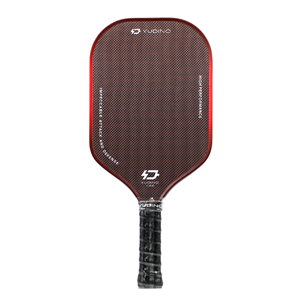
Since the surface of woven raw carbon fiber is uneven, players can get superb spin potential and really precise control without the need for extra coatings.
Graphene
What it is:
Graphene is noted for its outstanding theoretical strength and thermal conductivity. Nevertheless, in pickleball paddles, it cannot be woven into standalone fabric unlike carbon fiber.
Limitation in practice:
Market's majority of so-called “graphene paddles” are actually products where only a very small amount of graphene powder is mixed in the resin layer.The performance enhancement is hardly noticeable whereas the price increase is usually significant—just a marketing exercise, not a significant improvement.
2. The Real Question: Why Carbon Fiber Fits Pickleball Better
After 3 years of exclusive paddle:
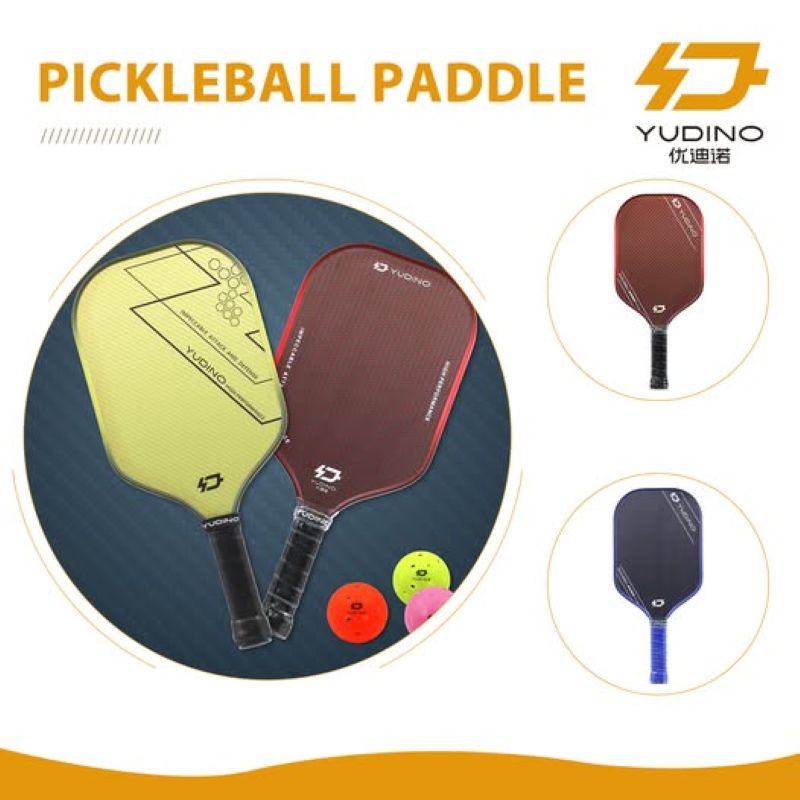
R&D and continuous input from PPA Tour level competition, we have pinpointed four benefits that put the carbon fiber pickleball paddleahead: Superior Vibration Control
Pickleball demands delicacy in execution, especially when close to the net. High-quality carbon fiber, along with a good PP honeycomb core, operates as a filter for unwanted vibration. Thus, the muscles in the elbow and wrist get less strained. A carbon fiber-graphene mixture tends to be perceived as too stiff. The resulting vibration is so harsh that it can cause tiredness of the muscles if it continues over time.
Controlled Surface Friction for Spin Article of USAPA standards specifies paddle surface texture as a major performance factor.
We don't even have to go for an additional layer of coating because our raw carbon fiber pickleball paddle surfaces are made of carbon weave that is capable of generating strong spin directly through. So that means:
The spin level is the same from one time to another.
The wear resistance is top-notch.
There is no drastic decay of performance even after a long period of use.
Worth mentioning, graphene surfaces tend to be overly smooth and rely on the wear-prone surface coatings for spin.
Manufacturing Precision and Consistency:
Having a group of 50 highly skilled workers, the operation of carbon fiber processing has been taken to the very advanced level. The angles at which layers are laid, temperature, and pressure can be closely monitored, thus guaranteeing that the amount of weight and balance fluctuations from one paddle to another in the case of a large order are kept to an absolute minimum.
Graphene-resin mixtures are significantly less stable in the production of large quantities, and the resulting products are often performance-wise inconsistent.
3. From a Business Standpoint: Expenses vs. Conversions
Carbon fiber pickleball paddles are probably the safest choice and most likely to attract the attention of users for international buyers and brand owners.
Strong Value for Money:
Supply chain of carbon fiber material especially of T700 grade has been very well established globally. Our facility in Dandong, made the front and center, our massive production is keeping the cost down and at the same time we are able to produce high-performance products.
Low Market Education Cost:
Players are already aware of and have confidence in carbon fiber paddles due to the extensive promotion of such materials by the leading brands like JOOLA and Selkirk for the past years. As such, conversion will be quicker with fewer objections as the customers do not really need to be re-educated with the “breaking concepts”.
4. About Yudino
More then just a paddle manufacturer, we are also performance standard setter.
Global experience:
3 years of OEM/ODM production for top international brands, with every design is USAPA compliant.
Full-process control:
Our 3,000㎡ factory is equipped to produce every part of a carbon fiber pickleball paddle and it is also subjected to 32 quality-controlled steps during production, starting from the selection of fibres to the final quality inspection—no low-level fillers, no shortcuts.
Export-ready supply chain:
We take advantage of Dandong's transportation and trade facilities to provide global sports retailers and cross-border e-commerce companies with a reliable supply and also support complicated exporting operations.
Final Takeaway
Graphene might be a good option to consider in the long run in the field of material science. However, in the present day pickleball industry, carbon fiber is still the uncontested leader.
In case you are thinking of making a high-performance Carbon Fiber Pickleball Paddle that is a good compromise between control, spin, durability, and market acceptance, we offer our assistance right from choosing the materials to global delivery.
Let's create paddles that truly give players the feeling of being on the court.