Fiberglass vs Carbon Fiber Pickleball Paddle: Who Wins?
Introduction
Every serious buyer in the pickleball supply chain eventually faces the same decision: carbon fiber or fiberglass?
It sounds simple. In practice, it is one of the most commercially consequential choices you will make when building or expanding a pickleball product line. Get it right and you have a product that sells through, generates repeat orders, and builds brand equity. Get it wrong and you end up with a warehouse full of paddles that don't match your market's performance expectations — or worse, paddles that come back as returns because they don't hold up in sustained play.
This article is a comprehensive, technical, and commercially grounded comparison of carbon fiber and fiberglass pickleball paddles — written specifically for B2B buyers: importers, wholesale distributors, brand owners, and OEM customers who need to understand what these materials actually do, how they differ in real manufacturing terms, and what the right choice is for their specific market segment.
We will not give you a vague answer. By the end of this guide, you will know exactly which material to specify for which channel, what technical parameters to include in your product brief, and what to look for in a manufacturing partner who can deliver either or both.
What's Actually Inside a Pickleball Paddle? The Anatomy You Need to Know
Before we compare carbon fiber and fiberglass, let us establish a shared technical baseline. Both materials serve the same structural function in a paddle — they form the face (the hitting surface on both sides of the paddle). What changes is the material's mechanical properties, and those properties ripple through every aspect of how the paddle performs and how it sells.
The Three-Layer Paddle Construction
Every modern performance pickleball paddle — regardless of face material — is built around the same fundamental architecture:
Layer 1: Face Surface (Carbon Fiber or Fiberglass)
This is the outermost layer on both sides of the paddle. It is the first thing that contacts the ball and the primary determinant of spin, power, ball feedback, and surface durability. The face material is where the carbon fiber vs. fiberglass debate lives.
Layer 2: Core (PP Honeycomb)
The internal structure of nearly all performance paddles is a polypropylene (PP) honeycomb — a hexagonal cell lattice running through the paddle body. The core governs energy return, vibration damping, sound, and the "feel" of the paddle at contact. Core thickness (13mm, 14mm, or 16mm) interacts with the face material to produce the overall performance profile.
Layer 3: Edge Guard and Handle
The edge guard protects the paddle perimeter from court impact damage. The handle determines grip comfort, leverage, and player control. Both components are specified independently of the face material.
Understanding this architecture matters for B2B buyers because it clarifies where material choice has the most impact: the face. A fiberglass paddle and a carbon fiber paddle with identical cores, identical edge guards, and identical handles will perform very differently — because of the face alone.
What Is a Fiberglass Paddle Face?
Fiberglass (also called glass fiber or E-glass) is a composite material made from fine glass filaments woven into a fabric and laminated with resin. In pickleball paddle production, fiberglass faces are manufactured using similar hot-press processes to carbon fiber but with glass fiber fabric instead of carbon fiber fabric.
Key characteristics of fiberglass as a paddle face material:
Flexibility: Fiberglass is more flexible than carbon fiber. When the ball contacts a fiberglass face, the surface deflects slightly before returning to shape. This "trampoline effect" creates a sensation of power — the ball bounces off with more force than a stiffer surface would deliver.
Surface texture: Fiberglass has a smoother surface than carbon fiber. The texture is less pronounced, which means lower friction at contact and less spin generation capability.
Weight: Fiberglass is slightly heavier than carbon fiber for equivalent surface area and thickness, but the difference in a finished paddle is minimal — the core material dominates the overall weight profile.
Cost: Fiberglass raw material is significantly less expensive than carbon fiber at the manufacturing level. This cost advantage flows directly into FOB pricing and end retail price points.
Durability under normal use: Fiberglass is resilient and holds up well under recreational use. It is less resistant than carbon fiber to surface abrasion over intensive play but durable enough for its target use case.
What Is a Carbon Fiber Paddle Face?
Carbon fiber is a composite material made from thin filaments of carbon atoms woven into fabric and laminated with high-performance resin. The carbon fiber used in pickleball paddles comes in several grades, distinguished by weave count and fiber grade.
Weave count grades (by filament count per tow):
3K: 3,000 filaments per tow — finer weave, strong visual texture, moderate friction coefficient
12K: 12,000 filaments per tow — coarser weave, higher surface density, excellent spin and control performance
18K: 18,000 filaments per tow — maximum density of standard weave grades, highest spin generation capability in the carbon fiber family
T700: Grade designation based on tensile strength (4,900 MPa) and tensile modulus (230 GPa) — lightweight, high stiffness, used in aerospace applications and premium paddle construction
Hybrid grades:
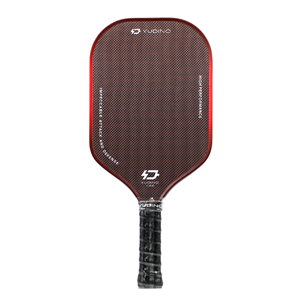
Titanium Carbon Fiber (Titanium Wire Carbon Fiber): A proprietary hybrid construction in which titanium wire filaments are integrated into the carbon fiber layup during the hot-press forming process. The titanium reinforcement adds tensile resilience — the face resists micro-deformation under sustained high-impact play — while preserving the surface texture and spin characteristics of pure carbon fiber. This is the flagship face material in YUDINO's competition and professional paddle lines.
Key characteristics of carbon fiber as a paddle face material:
Stiffness: Carbon fiber is significantly stiffer than fiberglass. Higher stiffness means more direct energy transfer from swing to ball, producing more precise and consistent ball feedback.
Surface texture: Carbon fiber's woven structure creates a naturally textured surface with a higher friction coefficient than fiberglass. This texture is the mechanical basis for superior spin generation.
Weight-to-strength ratio: Carbon fiber is approximately five times stronger than steel by weight. This allows manufacturers to build lighter paddles with higher structural integrity than fiberglass alternatives.
Dimensional stability: Carbon fiber resists deformation and maintains its mechanical properties across temperature and humidity ranges — critical for players in outdoor environments and competitive settings.
Premium positioning: The visual appearance of carbon fiber — particularly the woven 3K pattern — communicates "performance technology" effectively to consumers, supporting premium retail pricing.
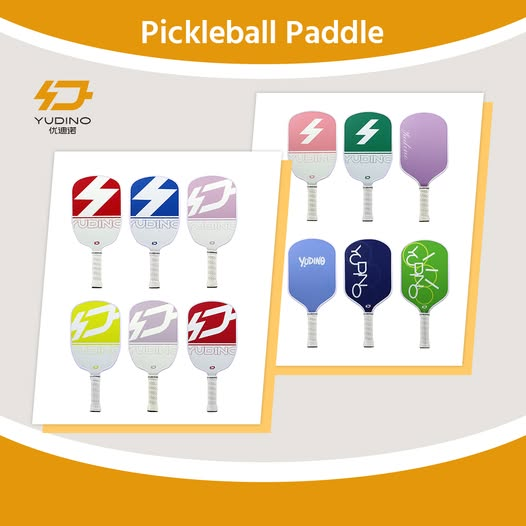
Head-to-Head Comparison: Carbon Fiber vs. Fiberglass Across Every Key Performance Dimension
Now that we have established the technical foundation, let us run a direct comparison across the dimensions that matter most to players — and by extension, to B2B buyers designing product lines for specific market segments.
Spin Generation
Winner: Carbon Fiber — by a significant margin
Spin in pickleball is generated by the friction between the paddle face and the ball surface at the moment of contact. Higher friction coefficient = more spin. Carbon fiber's textured woven surface consistently outperforms fiberglass in this dimension.
In practical terms, players using 18K carbon fiber paddles generate measurably higher spin RPM than equivalent players using fiberglass paddles under comparable swing conditions. The difference is not subtle — experienced players switching from fiberglass to carbon fiber typically report noticeable improvement in their ability to execute consistent topspin drives, heavy slice shots, and spin-heavy third-shot drops.
For B2B buyers: spin performance is an increasingly important marketing dimension in both the B2C retail and competitive wholesale channels. As the player base matures and average skill levels rise, demand for high-spin paddles is growing faster than the overall market. Carbon fiber positions your product line in this high-demand segment.
Fiberglass paddles, with their smoother surface, offer limited spin advantage. They are adequate for recreational players who rely more on power and placement than spin mechanics.
Ball Control and Precision Feedback
Winner: Carbon Fiber — for experienced players; Fiberglass — for beginners
This is a nuanced dimension. "Control" means different things to different players.
For experienced players, control means precise ball placement, predictable ball exit angle, and consistent feedback from every shot. Carbon fiber's stiffness delivers this: less face flex means more direct energy transfer, which means the ball goes where you aim it more consistently. The rigid face also provides clearer tactile feedback — players describe carbon fiber paddles as having more "feel" because the vibration from contact travels more directly through the handle.
For beginner players, the fiberglass "trampoline effect" can actually be beneficial. The face flex creates a slightly more forgiving impact window — the ball stays in contact with the surface longer, giving less precise swing mechanics a better chance of producing an acceptable shot. Beginners who switch to carbon fiber too early sometimes struggle because the higher feedback exposes swing inconsistencies more clearly.
B2B implication: If you are sourcing paddles for a beginner-oriented segment (introductory sets, physical education programs, community recreation clubs), fiberglass paddles may actually serve your customer better. If you are targeting intermediate-to-advanced players, competitive clubs, or performance-oriented retail, carbon fiber is the correct specification.
Power Transfer and Shot Speed
Winner: Fiberglass — for raw power feel; Carbon Fiber — for controlled power
This is where buyers get confused, so let us be precise.
Fiberglass paddles feel more "powerful" to many players because the face flex acts like a spring, storing and releasing energy at contact. The ball comes off a fiberglass paddle with a satisfying "pop" that many recreational players equate with power.
Carbon fiber paddles transfer power differently. The stiffer face delivers energy to the ball more directly, which produces shot velocity that is controlled and repeatable. For competitive players who want power and precision, carbon fiber wins. For players who prioritize the subjective feeling of power over precision, fiberglass may feel more impressive — at least initially.
In measurable terms: ball exit speed is comparable between high-quality fiberglass and carbon fiber paddles of the same weight. The differences in perceived power are largely about feel and consistency rather than raw ball velocity.
Durability and Lifespan
Winner: Carbon Fiber — clearly and consistently
This is perhaps the most commercially significant performance dimension for B2B buyers, particularly those supplying clubs, rental programs, or high-volume retail channels.
Carbon fiber faces are substantially more resistant to:
Surface abrasion: The harder carbon fiber surface resists the micro-abrasion from repeated ball contact and court impact that gradually degrades fiberglass texture
Delamination: Higher-grade carbon fiber faces bonded with quality resin systems maintain face-to-core adhesion over thousands of impact cycles; lower-quality fiberglass faces are more susceptible to progressive delamination
Edge damage: While edge guard quality matters for both, the stiffer carbon fiber face is less vulnerable to edge chipping from court and fence contact
Performance degradation over time: Fiberglass faces lose some of their surface texture and consequently some of their playability as the face wears; carbon fiber maintains more consistent surface properties over a longer service life
For club wholesale specifically: a carbon fiber paddle's longer service life means lower total cost of ownership even at a higher unit price. A carbon fiber paddle that lasts 18 months of club use versus a fiberglass paddle that needs replacement in 9 months is a better economic argument for many club buyers.
Weight
Winner: Comparable overall; Carbon Fiber wins in premium lightweight configurations
For standard paddle weights in the 220–245g range, the difference between carbon fiber and fiberglass faces at equivalent core thickness is minimal. Both materials can be used to produce paddles across the full weight spectrum.
Where carbon fiber demonstrates a clear advantage is in premium lightweight configurations (under 220g). T700 carbon fiber's exceptional stiffness-to-weight ratio allows manufacturers to build sub-220g paddles that maintain structural integrity and on-court performance — something that is very difficult to achieve with fiberglass without sacrificing durability.
Price Point and Margin Profile
Winner: Fiberglass — for accessible price points; Carbon Fiber — for margin and brand premium
This is the business dimension that ultimately drives B2B sourcing decisions, so let us be direct.
Fiberglass paddles carry a lower raw material cost at the manufacturing level. This produces:
Lower FOB cost per unit
More accessible retail pricing (strong for volume-driven, price-sensitive channels)
Thinner margins at retail unless positioned carefully
Limited premium story to support brand differentiation
Carbon fiber paddles carry a higher raw material cost but deliver:
Higher ASP (average selling price) at retail
Stronger margin profile for both manufacturer and retailer
A credible technology differentiation story that supports brand premium positioning
Repeat purchasing from performance-oriented players who become brand loyal
For brand owners building long-term portfolio strategy: the premium you can charge for carbon fiber paddles — particularly 18K and Titanium Carbon Fiber configurations — is proportionally higher than the material cost premium. The margin structure of the carbon fiber segment is more favorable.
Who Should Buy Which Paddle: Market Segment Mapping
The fiberglass vs. carbon fiber decision is not universal. The right answer depends entirely on who your end customer is and what they need from the product.
Fiberglass Paddle — The Right Choice For:
Entry-level recreational players
New players are still developing their fundamentals. They benefit from the forgiving "trampoline" feel of fiberglass and are not yet sensitive to the spin and control nuances where carbon fiber excels. They are also price-sensitive — a fiberglass paddle at an accessible price point reduces the barrier to adoption.
Budget-conscious retail channels
Mass-market sporting goods chains, online platforms competing primarily on price, and promotional or gift sets benefit from fiberglass paddles' lower cost structure. These channels optimize for volume and accessible price points over performance premium.
High-volume rental and introductory programs
Parks and recreation departments, resort amenity programs, and introductory clinic kits are contexts where the cost per unit matters more than peak performance. Fiberglass paddles serve these environments well, provided they are replaced on a regular maintenance schedule.
Young learners and school programs
Educational settings typically have strict budget constraints and require paddles that are accessible to a wide range of physical abilities. Fiberglass is the appropriate specification for these programs.
Carbon Fiber Paddle — The Right Choice For:
Intermediate to advanced competitive players
Players who have progressed past the beginner stage and are actively developing their spin game, kitchen control, and shot precision will immediately notice the difference carbon fiber makes. This is the segment driving the fastest growth in premium paddle demand.
Competitive club wholesale
Clubs with active competitive programs — leagues, ladders, tournaments — need USAPA-compliant equipment with the performance characteristics their members expect. 12K and 18K carbon fiber paddles are the standard specification for this channel.
Professional and semi-professional players
At the highest levels of play, Titanium Carbon Fiber paddles represent the benchmark. Their combination of surface texture for spin, stiffness for precision feedback, and titanium-reinforced resilience for performance consistency over extended play makes them the preferred choice of competitive players.
Brand owners building performance-oriented product lines
If your brand is positioned in the performance or premium segment, carbon fiber is the only credible face material choice. The technology narrative — particularly 18K weave or Titanium Carbon Fiber construction — is a fundamental component of your brand's market story.
OEM customers requiring USAPA-compliant products
For North American market access in sanctioned competitive environments, USAPA approval is required. YUDINO's carbon fiber paddle lines are USAPA approved across multiple configurations, providing OEM buyers with a compliant product foundation for private-label launches.
The Sourcing Decision: What B2B Buyers Are Actually Asking
When importers, distributors, and brand owners reach the sourcing decision stage, the fiberglass vs. carbon fiber question becomes a portfolio and margin question as much as a performance question. Here are the most common B2B sourcing considerations — and direct answers to each.
"Should I carry both fiberglass and carbon fiber in my product line?"
For most brand owners and distributors with meaningful market coverage, yes — a tiered portfolio that includes both is strategically sound. Here is why:
A fiberglass entry-level model serves as your acquisition product — accessible price point, broad appeal, converts new players into your brand ecosystem. A carbon fiber mid-line (12K or 18K) is your volume driver in the intermediate segment. A Titanium Carbon Fiber flagship is your brand equity product — the paddle that earns credibility with serious players and anchors your premium positioning.
This tiered structure mirrors how successful consumer sports brands operate: an accessible entry point, a performance mainstream, and a flagship that justifies the brand's technology credentials.
"Can I get OEM customization for both fiberglass and carbon fiber in the same order?"
Yes, at YUDINO. Our production facility handles both fiberglass and carbon fiber face materials on the same production infrastructure, which means brand owners can specify a full tiered product line — including both face material types — with a single manufacturing partner. This simplifies quality control, logistics coordination, and ongoing supplier relationship management considerably.
"What is the MOQ difference between fiberglass and carbon fiber paddles?"
Both face materials can be produced at comparable minimum order quantities for standard configurations. Custom OEM orders (unique graphics, specifications, non-standard shapes) carry production-dependent MOQs regardless of face material. For specific MOQ guidance based on your product brief, contact our sales team directly.
"How does pricing compare at the FOB level?"
As noted above, fiberglass paddles carry a lower raw material cost and consequently a lower FOB price than carbon fiber equivalents of the same core specification. The specific FOB differential depends on the carbon fiber grade: a 3K carbon fiber paddle is closer in cost to fiberglass than an 18K or Titanium Carbon Fiber configuration. For current pricing based on your specification and volume, request a quotation with your full product brief.
Common Mistakes When Choosing Between Carbon Fiber and Fiberglass
After working with importers and brand owners across North American, European, and Southeast Asian markets, we have seen the same sourcing errors appear repeatedly. Here are the ones that cost buyers the most money.
Mistake #1 — Defaulting to Carbon Fiber Without Segmentation Analysis
Carbon fiber is superior for performance segments. It is not the automatic correct answer for every buyer or every SKU. Buyers who specify carbon fiber paddles for channels that are primarily serving recreational beginners often discover that their price point is too high for the target consumer, or that the performance characteristics are wasted on — and sometimes confusing for — less experienced players.
Always start with the end consumer segment analysis before specifying the face material.
Mistake #2 — Assuming All Carbon Fiber Is Equivalent
"Carbon fiber paddle" describes a very wide range of products. A 3K carbon fiber paddle and a Titanium Carbon Fiber paddle are both technically "carbon fiber" but perform very differently and carry very different retail positioning opportunities. Buyers who specify "carbon fiber" without a weave count designation frequently receive 3K paddles when their market segment requires 18K performance.
Always specify the weave grade (3K, 12K, 18K), fiber grade (standard vs. T700), or construction type (titanium hybrid) explicitly in your product brief.
Mistake #3 — Choosing Fiberglass to Save Cost Without Calculating TCO
Fiberglass paddles have a lower unit cost. In club wholesale and high-turnover retail contexts, they also have a shorter replacement cycle. For buyers who have not run a total cost of ownership calculation across the full product lifespan, the apparent savings from fiberglass can evaporate — or become a net cost — when replacement frequency is factored in.
Before finalizing a fiberglass specification for high-use contexts (clubs, rentals, academies), compare the 3-year TCO of fiberglass against a comparable carbon fiber paddle at actual replacement intervals.
Mistake #4 — Overlooking Core Thickness When Comparing Materials
Face material comparisons are often made between paddles with different core thicknesses — which makes the comparison meaningless. A fiberglass paddle with a 16mm core and a carbon fiber paddle with a 13mm core are not testing the face material variable in isolation; they are testing a combination of face stiffness and core configuration.
For valid side-by-side performance comparison: always compare paddles with identical core thickness, weight, and handle configuration. The face material should be the only variable.
Mistake #5 — Ignoring the Retail Pricing Ceiling
Some markets have a price ceiling above which consumer adoption drops sharply. In these markets, the premium ASP that carbon fiber commands may exceed the threshold where your target consumer is willing to purchase. This is particularly relevant in emerging markets (early-stage Southeast Asian markets, for example) where pickleball is growing but the consumer base is still predominantly recreational.
Research the retail price tolerance in your target channel before specifying face material. In markets with lower price ceilings, a fiberglass paddle at an accessible price point may deliver better sell-through and margin than a carbon fiber paddle priced above market tolerance.
Inside the Factory: How Both Materials Are Produced at YUDINO
Understanding how each material is manufactured helps buyers appreciate where quality variation comes from — and what to verify during supplier qualification.
Fiberglass Paddle Production Process
Step 1 — Glass fiber fabric cutting: E-glass fabric is cut to paddle face dimensions using precision CNC cutting equipment. Fiber orientation is pre-determined by the weave structure.
Step 2 — Resin layup and pressing: Glass fiber sheets are layered with resin and hot-pressed in temperature-controlled molds. The pressing process determines the final surface texture and structural integrity of the face.
Step 3 — Core bonding: The cured fiberglass face is bonded to the PP honeycomb core using automated adhesive dispensing equipment.
Step 4 — Edge finishing and surface treatment: Edge guards are installed; the surface is finished and prepared for graphic application.
Step 5 — Quality verification: Weight, balance, surface consistency, and adhesion are verified at the production line.
Carbon Fiber Paddle Production Process
The carbon fiber production process shares the same fundamental architecture as fiberglass but with several additional process controls that reflect the higher material value and performance specifications involved.
Step 1 — Carbon fiber fabric preparation: Raw carbon fiber fabric (3K, 12K, 18K, T700, or titanium-hybrid layup) is cut to specifications using automated CNC cutting equipment. For Titanium Carbon Fiber paddles, titanium wire is integrated into the layup at this stage.
Step 2 — Hot press forming with calibrated parameters: Carbon fiber sheets are laminated with high-performance resin and pressed in precisely calibrated temperature-controlled molds. The pressing parameters — temperature, pressure, and dwell time — are more precisely controlled for carbon fiber than for fiberglass because carbon fiber's performance characteristics are more sensitive to these variables.
Step 3 — Core bonding using automated dispensing: The cured carbon fiber face is bonded to the PP honeycomb core using automated resin dispensing equipment that ensures uniform adhesive distribution across the full bond surface.
Step 4 — Edge burning and sealing: The paddle perimeter is sealed using an edge burning machine — a critical step for carbon fiber paddles that prevents moisture ingress and delamination at the face-to-core bond line.
Step 5 — Surface grinding and finishing: The paddle face is ground and polished to achieve the specified surface texture. For high-performance carbon fiber paddles, surface texture is a performance-critical specification that is verified against quantitative standards.
Step 6 — UV graphic application: Custom graphics are applied using UV inkjet printing systems.
Step 7 — Quality control and testing: Each finished paddle is verified against: weight (target ±5g), balance, surface texture uniformity, sweet-spot performance, edge guard adhesion, and graphic quality. YUDINO's testing center includes dedicated equipment for sweet-spot performance evaluation and surface hardness testing — parameters that directly determine whether a paddle performs to its specification.
YUDINO's Manufacturing Credentials
YUDINO operates a 3,000㎡ production facility in Dandong, Liaoning, staffed by a 50-person team with three years of dedicated pickleball paddle manufacturing experience. The facility holds ISO 9001 quality management system certification, providing a documented and auditable production framework.
Our carbon fiber paddle lines are USAPA approved, and we have established OEM manufacturing relationships with globally recognized brands including Franklin and JOOLA. Our products have been used in PPA Tour-related activities — a testament to their compliance with professional play standards.
The Dandong location provides a logistical advantage that directly benefits international buyers: proximity to cross-border transportation infrastructure supports efficient raw material procurement and export-oriented shipping through established logistics networks.
Sustainability: Material Responsibility in Paddle Production
Increasingly, B2B buyers — particularly those supplying European markets under growing ESG scrutiny — are evaluating manufacturing partners on environmental practices alongside product specifications.
Both carbon fiber and fiberglass paddle production involve composite materials that carry environmental considerations in their raw material production and end-of-life disposal. YUDINO addresses this proactively through:
Clean energy adoption in the production facility, reducing the carbon intensity of the manufacturing process relative to conventional grid-powered operations.
Certified sustainable raw material sourcing, covering wood-based inputs (used in packaging and some handle components) under sustainability certification programs.
Wastewater recycling and treatment systems that manage process water from surface treatment and cleaning operations in compliance with national environmental standards — and meeting the requirements of European import partners who conduct supply chain environmental audits.
For brand owners building sustainability messaging into their product lines, a manufacturing partner whose environmental practices are documented and verifiable provides a foundation for credible claims.
Frequently Asked Questions: Consumer Perspective
These are the questions players ask most frequently when evaluating carbon fiber vs. fiberglass paddles — and the answers that will help your sales team and retail partners communicate the differences effectively.
Yes, but with appropriate expectations. Beginners can use carbon fiber paddles, and many players benefit from starting with performance equipment. However, beginners should be aware that carbon fiber's higher feedback and stiffer response will expose swing inconsistencies more clearly than a forgiving fiberglass paddle. If you are a beginner focused on getting the ball over the net, a fiberglass paddle may be more immediately confidence-building. If you are committed to developing your game and plan to progress to competitive play, starting with a 3K or 12K carbon fiber paddle is a sound long-term investment.
Does carbon fiber make a pickleball paddle heavier?
No — if anything, carbon fiber enables lighter paddles. Carbon fiber is lighter and stronger than fiberglass per unit area, which is why it is used in aerospace applications. In pickleball paddles, the overall weight is primarily determined by core thickness and handle configuration rather than face material. T700 carbon fiber, in particular, enables the construction of sub-220g paddles that maintain excellent structural integrity — a weight class that is very difficult to achieve with fiberglass without sacrificing durability.
How long does a carbon fiber paddle last compared to fiberglass?
With regular play (3–5 sessions per week), a quality carbon fiber paddle typically maintains peak performance for 12–24 months or longer. A comparable quality fiberglass paddle may show performance degradation — particularly in surface texture and spin generation — within 6–12 months under the same usage conditions. In high-volume club use (multiple sessions per day), the durability difference is even more pronounced. Carbon fiber's harder, more abrasion-resistant surface simply outlasts fiberglass over sustained intensive use.
Is the spin difference between carbon fiber and fiberglass noticeable?
Yes — and the difference increases with player skill level. Beginners may not immediately perceive the spin difference because their stroke mechanics do not yet generate sufficient rotational force to maximize either surface's potential. Intermediate and advanced players, however, report a clear and meaningful difference in their ability to generate topspin drives, heavy slices, and spin-based third-shot drops with carbon fiber paddles. The 18K and Titanium Carbon Fiber surfaces — with their highest friction coefficients — produce the most noticeable spin advantage over fiberglass.
Are carbon fiber paddles worth the higher price?
For competitive players: unequivocally yes. The combination of superior spin, more precise ball control, better feedback, and longer durability delivers measurable value that justifies the premium. For recreational players playing twice a week for social enjoyment: the performance advantages are real but may matter less than other factors. For B2B buyers: the higher retail ASP of carbon fiber paddles produces better absolute margins per unit and supports brand premium positioning that creates long-term value beyond any single transaction.
Making the Final Decision: A Practical Decision Framework
Use this decision matrix to determine the correct face material for your specific sourcing context.
If your primary buyer is a beginner or recreational player → Fiberglass
If your primary channel is mass retail or price-sensitive online → Fiberglass (or 3K carbon fiber at a slight premium)
If your channel is club wholesale or performance retail → 12K or 18K carbon fiber
If your target consumer is a competitive or advanced player → 18K or Titanium Carbon Fiber
If you are building a tiered brand portfolio → Both: fiberglass entry, carbon fiber mid-line, Titanium Carbon Fiber flagship
If North American market and USAPA compliance required → Carbon fiber (USAPA-approved configurations)
If you require long-term OEM partnership with a single manufacturer for both → YUDINO handles both face materials under one roof
Conclusion: The Right Answer Depends on the Right Question
Carbon fiber vs. fiberglass is not a question with a universal answer — it is a question that requires you to specify what market you are serving, what performance your end consumer expects, what price point your channel supports, and what brand story you want to tell.
What we can say with confidence: for performance-oriented markets, competitive segments, and brand owners building lasting equity in the pickleball category, carbon fiber is the correct material. Its superiority in spin generation, ball control precision, and long-term durability is not marginal — it is substantial and commercially meaningful.
Fiberglass remains a valuable option for entry-level and budget-sensitive segments, and a thoughtfully designed product portfolio often includes both materials, tiers priced intelligently, and positioned for different buyer profiles along the player development journey.
At YUDINO, we manufacture both. Our fiberglass paddles serve the entry-level and volume channels. Our carbon fiber lines — from 3K through 18K to our flagship Titanium Carbon Fiber series — serve the performance, competitive, and premium segments. With ISO 9001 certification, USAPA-approved models, and established OEM relationships with brands including Franklin and JOOLA, we have built a manufacturing operation that can support your entire product portfolio from a single, reliable source.
If you are ready to discuss your specific requirements — face material, weave specification, core configuration, OEM customization, or sample evaluation — contact our team today. We respond within 12 hours.
Product FAQ
Q1: Does YUDINO produce both fiberglass and carbon fiber paddles?
Yes. YUDINO manufactures the full range of face materials: fiberglass (entry-level), 3K carbon fiber, 12K carbon fiber, 18K carbon fiber, T700 carbon fiber, and Titanium Carbon Fiber (titanium wire hybrid). Both fiberglass and carbon fiber paddles are produced on the same production infrastructure in our Dandong, Liaoning facility, enabling brand owners to source a complete tiered product line from a single manufacturing partner.
Q2: What is the performance difference between 12K and 18K carbon fiber in a pickleball paddle?
Both are carbon fiber, but 18K has a higher filament density per tow than 12K. In practical terms: 18K delivers higher surface friction, which means greater spin generation capability and slightly more ball "grab" at contact. 12K provides excellent spin and control performance at a more accessible price point. For competitive play and professional club environments, 18K is the preferred specification. For intermediate performance retail, 12K offers an excellent performance-to-value ratio.
Q3: Can I order a mixed product line with both fiberglass and carbon fiber paddles under my brand?
Yes. YUDINO supports OEM orders that span multiple face materials, core configurations, and paddle specifications under a single brand identity. We work with brand owners to design tiered product lines that cover multiple market segments — from entry-level fiberglass models to flagship Titanium Carbon Fiber paddles — with cohesive branding and packaging across the full range.
Q4: How do I know which paddle material is right for my target market?
We recommend sharing your target market profile — geography, player skill level distribution, primary sales channel (retail, club, online, specialty), and target retail price point — with our sales team. Based on this brief, we can recommend the optimal face material and core specification for your market, provide relevant samples for evaluation, and supply reference data from existing distribution partners in comparable markets.
Q5: Are YUDINO's carbon fiber paddles and fiberglass paddles both USAPA approved?
Our carbon fiber paddle lines are USAPA approved for use in sanctioned tournament play. Fiberglass paddle USAPA approval varies by specific model. Contact our sales team with your product specification to confirm current USAPA approval status for the models you are considering.
YUDINO (Liaoning) Sports Goods Co., Ltd. manufactures professional-grade carbon fiber and fiberglass pickleball paddles for brand owners, importers, and wholesale buyers worldwide. ISO 9001 certified. USAPA approved. OEM/ODM partnerships with Franklin, JOOLA, and PPA Tour affiliates. Contact us to request samples or discuss your sourcing requirements.