How to Choose a Pickleball Paddle Factory for a New Sports Brand
Choosing a pickleball paddle factory is one of the earliest and most important decisions for a new sports brand. The right factory should do more than manufacture paddles. It should be able to understand your product positioning, support prototype development, control production quality, handle branding and packaging requirements, and scale with your business as order volumes increase.
For a new brand, the lowest quotation is rarely the most important factor. A better approach is to evaluate the factory across product development capability, manufacturing process, customization, quality control, MOQ, communication, production scalability, and long-term cooperation.
This guide explains what new pickleball brands should check before choosing a manufacturing partner.
1. Start With Your Brand's Product Positioning
Before contacting a pickleball paddle factory, define what your brand is trying to sell.
A new brand may target:
Beginner and recreational players
Club players
Performance-oriented players
Premium customers
Online sports retailers
Pickleball clubs and distributors
Private-label customers
Your target customer affects almost every manufacturing decision, including:
Paddle construction
Carbon fiber or fiberglass options
Core material
Paddle thickness
Shape
Weight range
Handle specifications
Surface finish
Graphics and branding
Packaging
For example, a brand building a performance-oriented product line may require different materials and development support from a brand selling entry-level recreational paddles.
Do not choose a factory before defining the product you want the factory to manufacture.
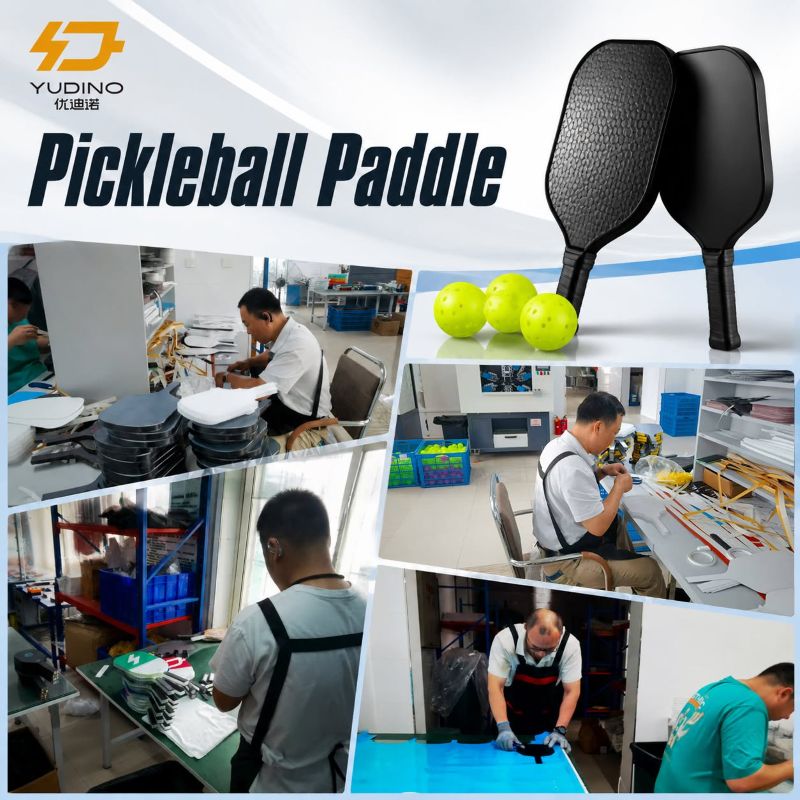
2. Check Whether the Factory Actually Manufactures Pickleball Paddles
One of the first questions should be: Is this company a pickleball paddle manufacturer, or is it primarily a trading company?
A supplier's website can provide useful clues.
Look for evidence such as:
Factory photographs
Production equipment
Paddle assembly processes
Quality-control procedures
Material processing
Product development capability
Testing equipment
Production workers
Factory address and company information
Product-specific manufacturing experience
A factory that actually controls production can generally provide more direct communication about materials, processes, quality issues, lead times, and product changes.
However, website claims should still be verified. A large factory description alone does not prove that the same facility manufactures the specific paddle you want.
3. Evaluate Product Development Capability
For a new sports brand, product development can be more important than production capacity.
You may start with an existing paddle platform and customize:
Logo
Colors
Graphics
Grip
Packaging
Or you may need more substantial development, such as:
A new paddle shape
Modified dimensions
Different core thickness
New surface construction
New edge design
Custom handle
Custom mold
New packaging structure
Ask the factory which level of customization it can support.
A useful way to classify your project is:
| Development Level | Typical Requirement |
| Existing product + branding | Logo, colors, packaging |
| Existing platform modification | Materials, dimensions, grip, graphics |
| Product customization | Construction, shape, thickness, balance |
| New product development | Mold, prototype, testing and production validation |
This helps you avoid choosing a supplier that can only print your logo on an existing paddle when your brand actually needs product differentiation.
4. Understand the Materials and Construction
Do not evaluate a paddle factory simply by asking whether it offers "carbon fiber."
Carbon fiber terminology can describe different aspects of a paddle.
For example:
T700 can refer to a carbon fiber grade.
3K, 12K and 18K can describe tow size.
Different weaves can affect the appearance and construction.
The core can use different materials and thicknesses.
Manufacturing methods can also differ.
This means terms such as T700, 12K or 18K should not be treated as simple quality rankings.
When comparing factories, ask them to clearly identify:
Face material
Carbon fiber specification
Weave or surface construction
Core material
Core thickness
Manufacturing process
Edge construction
Handle construction
Weight range
Paddle dimensions
The complete construction is more meaningful than a single material label.
5. Ask How Samples Are Developed
A sample is not just a product for taking photographs.
For a new brand, the sample should help answer an important question:Can this factory turn our product concept into a repeatable production specification?
Ask about:
Sample development time
Sample quantity
Prototype revisions
Mold requirements
Sample approval process
Specification confirmation
Weight tolerance
Graphic approval
Packaging samples
Final production reference sample
It is also important to understand what happens after sample approval.
The approved sample should become a clear reference for bulk production rather than simply being treated as a one-time prototype.
6. Compare MOQ With Your Actual Launch Strategy
MOQ is particularly important for new sports brands.
A factory may advertise a very low MOQ, but that does not necessarily mean every customization option is available at that quantity.
Ask whether MOQ applies to:
Each SKU
Each color
Each design
Each paddle construction
Packaging
Custom molds
Custom grips
For example, a factory may accept a small total order but require a larger quantity for a specific custom mold or packaging configuration.
A better question is not simply: What is your MOQ?
Instead ask: What is the minimum commercially practical order for the exact product configuration we want?
This gives you a more realistic picture of your launch cost.
7. Evaluate Quality Control Before Placing the First Bulk Order
A new brand's first production run can determine how customers perceive the brand.
Ask the factory how it controls consistency across bulk production.
Important areas include:
Paddle weight
Dimensions
Surface appearance
Graphic placement
Edge sealing
Handle assembly
Grip installation
Core construction
Packaging
Final inspection
You should also ask whether the factory has a defined inspection process and what happens when products fail inspection.
For a new brand, quality control should not depend entirely on visual inspection at the end of production.
The more important question is: At which stages of production are quality problems identified and controlled?
8. Check Certification and Testing Requirements
Not every paddle needs the same testing or certification requirements.
If your products are intended for organized competition or specific markets, clarify the applicable requirements before production.
Ask the factory:
Which certifications or approvals are currently available?
Which specific paddle models are covered?
Can the factory provide relevant documentation?
Can the same specification be maintained after certification or approval?
Who is responsible for testing and related costs?
Do not rely only on a factory-wide statement such as "certified manufacturer."
For procurement purposes, the important question is whether the specific product you plan to sell meets the requirements relevant to your market.
9. Look at Production Scalability
A new brand may start with a relatively small order, but a successful product can quickly require larger production volumes.
Therefore, evaluate both:
Current production capability
and
Future scalability.
Ask about:
Production lines
Equipment
Production capacity
Typical lead times
Peak-season capacity
Raw material availability
Repeat-order lead times
Quality consistency during larger production runs
A factory that works well for a 100-piece launch order may not necessarily be the best partner for a 10,000-piece order.
The goal is to find a manufacturing partner that can grow with your brand.
10. Review Branding and Packaging Capabilities
For a new sports brand, the paddle itself is only part of the product.
You may also need:
Custom logo
Paddle graphics
Grip branding
Protective film
Individual packaging
Retail boxes
Hang tags
User manuals
Barcode labels
Shipping cartons
Ask the factory which elements can be customized and whether packaging can be developed together with the paddle.
This is particularly important for private-label and e-commerce brands, where packaging contributes directly to the customer's first impression.
11. Pay Attention to Communication
Communication problems can create more costs than a slightly higher factory quotation.
During the initial discussion, evaluate whether the factory can clearly answer technical questions about:
Materials
Construction
Specifications
Samples
MOQ
Production
QC
Packaging
Testing
Lead time
A good manufacturing partner should also be willing to identify information that is missing from your specification.
For example, if you provide only a target weight and surface material, the factory should help clarify the remaining production requirements instead of simply giving you a price.
12. Compare Quotes on the Same Specification
Do not compare factory quotations line by line if each supplier is quoting a different product.
Before comparing prices, standardize:
Paddle dimensions
Weight range
Core thickness
Face material
Construction
Shape
Handle
Grip
Logo
Packaging
Quantity
Testing requirements
Shipping terms
Then compare:
| Cost Item | Factory A | Factory B | Factory C |
| Paddle unit price | — | — | — |
| Sample cost | — | — | — |
| Mold cost | — | — | — |
| Packaging | — | — | — |
| Testing/certification | — | — | — |
| Shipping | — | — | — |
| Total launch cost | — | — | — |
The cheapest unit price does not always mean the lowest total cost.
13. Look for a Factory That Can Support the Brand Beyond Production
A strong manufacturing relationship should continue after the first shipment.
As your brand develops, you may need:
New paddle models
Material changes
New colors
New packaging
Seasonal products
Different order quantities
Product line extensions
Quality improvement
Production planning
Therefore, the best factory is not necessarily the largest factory or the cheapest factory.
It is the factory that fits your current product requirements and future development plan.
14. A Practical Checklist for New Pickleball Brands
Before choosing a factory, ask these questions:
Factory
Does the company actually manufacture pickleball paddles?
Can the factory provide relevant production evidence?
Does it have experience with the type of paddle we need?
Product Development
Can it customize an existing model?
Can it develop a new mold?
Can it support prototype revisions?
Can it help finalize specifications?
Materials
What face materials are available?
What carbon fiber specifications are available?
What core options are available?
What manufacturing processes are used?
Quality
How is weight consistency controlled?
How are dimensions checked?
How are appearance and assembly inspected?
Is there a documented inspection process?
Certification
What certifications or approvals are available?
Which specific models are covered?
Can relevant documents be provided?
Commercial
What is the practical MOQ?
What is the sample cost?
What is the mold cost?
What is the typical production lead time?
Can production scale with increasing demand?
Branding
Can the logo and graphics be customized?
Can the grip be customized?
Can retail packaging be customized?
Cooperation
Who handles product development?
Who handles quality control?
Who will be the main contact?
How are changes confirmed before mass production?
15. The Best Factory Is the One That Matches Your Brand
There is no single "best" pickleball paddle factory for every new sports brand.
The right choice depends on your:
Product positioning
Target customers
Technical requirements
Launch quantity
Budget
Customization level
Certification needs
Growth plans
A factory with extensive production capacity may be unnecessary for a brand testing its first product.
Conversely, a very small supplier may become a limitation if the brand expects rapid growth.
The objective is to find a factory that can move with you from product concept → sample → first production → repeat orders → product-line expansion.
For a new pickleball brand, the factory should be evaluated as a manufacturing and product-development partner, not simply as a source of low-cost paddles.
FAQ
What should a new pickleball brand ask a factory first?
Start with product development capability, actual manufacturing experience, MOQ, sample process, materials, quality control, certification requirements and production lead time.
Should a new brand choose the factory with the lowest price?
Not necessarily. Compare the complete specification, sample quality, QC process, customization capability, packaging, lead time and total launch cost before making a decision.
What is more important: MOQ or product development capability?
It depends on the launch strategy. If the brand is testing a new product concept, development capability may be more important. If the product is already finalized, MOQ and production efficiency may become more important.
Can a pickleball factory help develop a new paddle?
Some factories can support customization and new product development, but the scope varies. Confirm whether the factory can handle mold development, prototypes, specification confirmation and production validation.
What information should I prepare before requesting a quotation?
At minimum, prepare the target paddle type, dimensions, weight, core thickness, face material, shape, handle requirements, branding, quantity, packaging and any testing or certification requirements you already know.
Final Takeaway
Choosing a pickleball paddle factory is not simply a matter of finding the lowest quotation.
For a new sports brand, the better approach is to evaluate the factory across product development, materials, manufacturing, quality control, customization, MOQ, certification, communication and scalability.
The right factory should be capable of supporting the product you want to launch today while giving your brand room to develop tomorrow.