How to Select a Carbon Fiber Pickleball Paddle
Introduction
This guide gives you a systematic, step-by-step framework for making the selection correctly. Each step addresses one of the variables that actually determines whether a paddle works for you — in plain language, with specific recommendations rather than vague guidance. By the end, you will know exactly what to look for, what to avoid, and how to make a confident, informed decision.
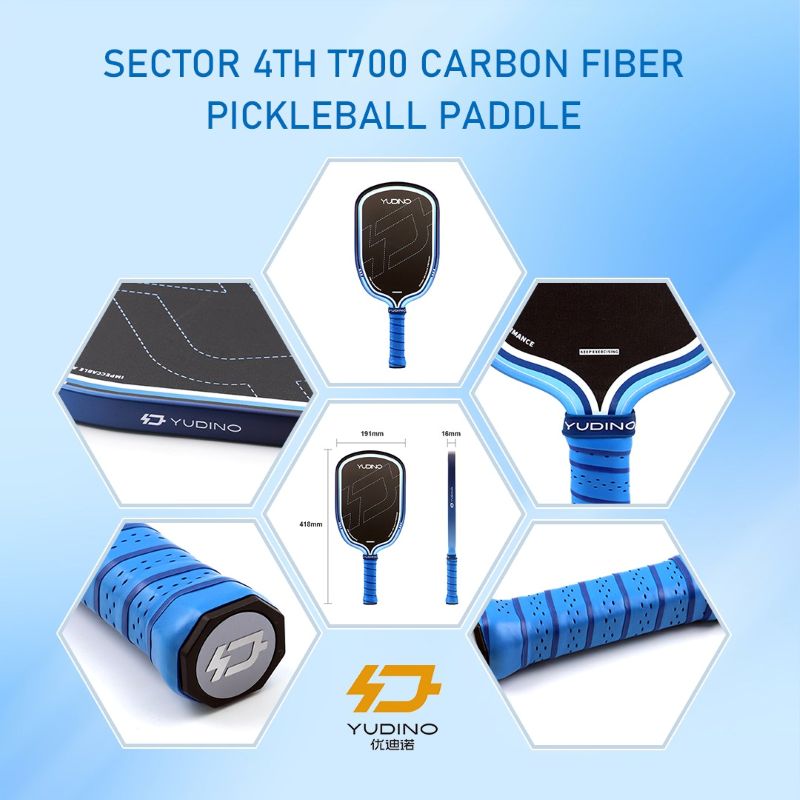
Step One: Define Your Playing Level — The Most Important Filter
Every other selection decision depends on this one. A paddle specification that is ideal for a 4.0 competitive player actively hinders a 2.0 recreational beginner. Matching the paddle to your actual current level — not the level you aspire to reach — is the single most impactful factor in choosing correctly.
2.0 and below — Complete beginner: You are still developing consistent ball contact, learning court positioning, and understanding the rules. At this stage, the paddle should get out of your way. You need maximum forgiveness — equipment that produces acceptable results even when your technique is inconsistent. A carbon fiber pickleball paddle is not the wrong choice here, but the specifications must prioritize forgiveness over maximum performance.
2.5–3.0 — Developing recreational player: You have consistent rallies, are learning the third-shot drop, and are starting to develop kitchen game awareness. This is the level where carbon fiber's advantages start becoming genuinely accessible. Your mechanics are consistent enough that the grit and control benefits translate to perceptible improvement in soft-game play.
3.0–3.5 — Intermediate player: You are working on spin variation, studying court strategy, and playing with some competitive intent. This is the prime carbon fiber upgrade sweet spot. The material's spin generation and precision control capabilities match exactly the skills you are developing at this level.
3.5+ — Advanced and competitive: Paddle specifications become strategic tools. You have specific game strengths — a dominant kitchen game, a punishing drive, strong reset skills — and you need a paddle optimized for those strengths. At this level, the marginal differences between high-quality carbon fiber paddles are noticeable and meaningful.
Step Two: Understand Carbon Fiber Grade — Not All Carbon Fiber Performs Equally
"Carbon fiber" is a material category, not a single consistent specification. The grade of carbon fiber used in the paddle face has a direct and significant impact on performance — particularly on spin generation and surface feel.
T700 carbon fiber is the benchmark grade for serious pickleball performance. T700 refers to the Toray tensile strength classification — 700 kgf/mm² tensile strength. At this grade, the fiber is thin enough that the weave creates a dense, fine surface texture with many contact points per square inch. This texture grips the ball surface momentarily on contact, generating spin rates that lower-grade fiber cannot match.
T300 carbon fiber has a coarser weave and lower modulus. Paddles built with T300 fiber deliver some of the structural stiffness benefit of carbon fiber but significantly less of the spin generation and surface feel advantage. Many budget paddles in the "carbon fiber" category use T300 or unspecified fiber grade. The price is lower; so is the performance.
T800 carbon fiber represents a higher-grade option used in premium paddles. The even finer weave produces more contact points, more consistent spin generation across the face, and a crisper, more defined feel. The performance difference over T700 is real but incremental — meaningful to advanced players with developed technique, less perceptible at developing levels.
Practical guidance: Always verify fiber grade in the technical specification sheet — not just in the product name or marketing description. If the spec sheet does not explicitly list the fiber grade, contact the manufacturer or assume T300 until confirmed otherwise. T700 is the minimum benchmark for a carbon fiber pickleball paddle that delivers genuine spin and performance benefits.
Step Three: Choose Core Thickness to Match Your Game Style
The paddle core — almost universally a polypropylene honeycomb structure in modern paddles — is the component that most directly determines the feel and responsiveness of the paddle on contact. Its thickness, typically 13mm, 14mm, or 16mm, has a more dramatic impact on how the paddle plays than most buyers expect.
16mm core — The control and kitchen game configuration
A 16mm core creates a softer, more cushioned contact feel. The ball dwells on the paddle face slightly longer during impact — this is called dwell time — giving you more time to shape the shot and absorb pace on defensive plays. Off-center hits produce more manageable results. Drops, dinks, and resets feel more controlled and predictable.
The 16mm core has become the dominant configuration in the current competitive market for a specific reason: modern high-level pickleball strategy revolves around the kitchen game, and paddles optimized for soft-game precision win points at the highest levels. Most widely-recommended competitive paddles from the last two years are 16mm.
Choose 16mm if: You are developing your kitchen game, play soft-and-reset focused pickleball, are a beginner or intermediate player, or prioritize control over raw power on drives.
13mm core — The power and pace configuration
A 13mm core is stiffer and more responsive. The shorter dwell time creates a crisper, more explosive contact — energy transfers faster, and drives and overheads feel more powerful. Players who built their game around pace, hard drives, and aggressive baseline play often prefer the 13mm feel.
The reduced forgiveness of the 13mm is a real trade-off: off-center hits and timing errors produce less controlled results than with the 16mm. This core rewards consistent technique; it is less patient with developing mechanics.
Choose 13mm if: You play aggressively from the baseline, your game is built around pace and drives rather than soft-game control, and you have consistent enough technique that forgiveness is not a priority.
14mm core — The middle ground
Some manufacturers offer 14mm cores as a compromise between the 16mm's control and the 13mm's power. It is genuinely useful for players who want to split the difference, though the 16mm has largely captured the market at the control end and 13mm at the power end. If 14mm is available at your price point and your game style falls between the two extremes, it is a legitimate option.
Step Four: Paddle Shape — Standard or Elongated?
The USAPA limits combined paddle length and width to 24 inches. How those inches are distributed creates two distinct playing experiences.
Standard shape (approximately 15.5–16 inches long, 8–8.5 inches wide) offers a larger face area, a bigger sweet spot, and better maneuverability for quick kitchen exchanges. Balls hit toward the edges of the face stay more controlled. The wider profile makes the paddle more forgiving and easier to use effectively in the fast-paced exchanges of net play.
Standard shape is the right choice for: Beginners and intermediates, players whose game is primarily kitchen-focused, players who value consistency over maximum reach, and anyone developing their game who wants the most forgiving face geometry available.
Elongated shape (approximately 16.5–17 inches long, 7–7.5 inches wide) extends the player's effective reach and increases the lever arm from handle to head — which adds pace to drives and overheads. The narrower face provides less forgiveness but is well-suited to players with reliable technique who want to maximize reach and weapon potential.
Elongated shape is the right choice for: Advanced players with consistent technique, players who have been transitioning from tennis and are comfortable with a narrower profile, spin-heavy players who want maximum face length for spin generation on drives, and those who play more frequently from the transition zone or baseline than from the kitchen line.
When uncertain, default to standard. The sweet spot advantage of the standard shape is immediately accessible; the elongated shape's advantages require the technique to exploit them.
Step Five: Weight — Match the Paddle to Your Swing
Paddle weight is the most physically personal specification. The right weight for you depends on your swing speed, physical conditioning, and the balance between power and maneuverability you want.
Under 7.3 oz — Lightweight: Maximum maneuverability and fastest reaction time at the kitchen line. Reduced power contribution from the paddle mass on drives; the player must generate pace entirely through swing speed. Well-suited for players with naturally fast hands, net-game specialists, and players with arm sensitivity who need to minimize impact stress.
7.3–7.7 oz — Light-mid: Faster than mid-weight with slightly more drive stability. Popular with all-court players who prioritize kitchen quickness but want some mass behind drives.
7.8–8.2 oz — Mid-weight: The most versatile range for most players. Enough mass for stable drives without significant sacrifice in maneuverability. First-time buyers almost always fit this range. The overwhelming majority of widely-recommended paddles in competitive play fall in this weight class.
8.3 oz and above — Heavyweight: Maximum momentum through the swing. Drives feel powerful with less swing effort. Extended kitchen exchanges become progressively more fatiguing. Suited for experienced players with good conditioning who want maximum pace on drives and are comfortable maintaining technique with the added weight.
Practical guidance: If you are buying without the ability to demo the paddle, start in the 7.8–8.0 oz range. This is the most universally appropriate starting point across playing styles and conditioning levels. You can add lead tape to increase weight later if you want more mass; you cannot reduce weight below the manufacturer's specification.
Step Six: Grip Size and Handle Length — The Most Overlooked Variables
Most paddle-related arm discomfort — tennis elbow, wrist strain, shoulder fatigue — is exacerbated by incorrect grip size. Players compensate for a grip that is too large or too small by tensing the forearm muscles to stabilize the paddle. That tension reduces touch and feel in soft shots and accelerates fatigue over extended play.
Measuring correct grip circumference: Hold the paddle in your dominant hand with a continental grip (as if shaking hands with the paddle handle). The correct circumference creates approximately one finger's width of space between your fingertips and the base of your thumb. No gap means too small; more than one finger's width means too large.
Most adult players fall in the 4 1/8 to 4 1/4 inch range. Players with larger hands may prefer 4 3/8 inch. When between sizes, choose the smaller — grip can be built up with overgrip tape; it cannot be reduced.
Handle length matters separately from circumference. Standard handles (approximately 5 inches) are comfortable for single-handed grip players. Extended handles (5.5 to 6 inches) accommodate two-handed backhand players — particularly those transitioning from tennis — without requiring a full grip style adjustment. A handle that is too short for a two-handed backhand forces the top hand into an awkward position that reduces power and consistency on that shot.
Step Seven: Construction Method — Thermoform vs. Standard Adhesive
How the paddle is assembled affects both performance consistency and durability in ways that are difficult to evaluate from product listings but genuinely matter in extended play.
Standard adhesive construction bonds the face skins to the honeycomb core using adhesive applied to the contact surfaces. This is a functional method, but it creates microscopic variation in bonding quality across the face — slightly different adhesive distribution means slightly different stiffness at different points on the hitting surface. Over time, adhesive bonds can also loosen at the face-core interface, producing the soft, dead spot that indicates delamination.
Thermoform construction bonds the face skins and core under controlled heat and pressure applied uniformly across the entire paddle face. The result is a more complete, more consistent bond — producing a paddle that feels uniform across every area of the face, transmits vibration more consistently, and maintains structural integrity longer under repeated play stress.
The practical difference between thermoform and adhesive construction is perceptible in feel — particularly in how consistent the paddle feels on contact across different areas of the face — and in long-term durability. Thermoform paddles maintain their performance characteristics longer before delamination or core compression occurs.
Thermoform construction is more manufacturing-intensive, which is why it is more commonly found in paddles above $90. For players investing in a paddle intended to perform consistently over 12 to 24 months of regular play, thermoform is the construction specification worth looking for.
Step Eight: USAPA Approval — Do You Need It?
The USA Pickleball Association tests and certifies paddle models for use in sanctioned competitive play. Approval requirements include maximum combined dimensions of 24 inches, a smooth non-reflective face, no delamination or construction defects, and materials that produce ball behavior consistent with the standard playing experience.
If you play in any organized competitive context — leagues, tournaments, sanctioned recreational programs — verify that any paddle you consider is on the current USAPA approved paddle list. Non-approved paddles cannot be used in sanctioned events, regardless of their performance characteristics. This is a non-negotiable requirement for competitive play.
If you play recreationally only — open courts, social games, informal meetups — USAPA approval is irrelevant. No one checks paddles in recreational settings.
The practical implication: most quality paddles at $60 and above target USAPA approval as a standard selling point. Budget paddles below $40 sometimes do not pursue approval. If competitive play is any possibility in your future, the cost of verification is zero — cross-reference your target model against the current USAPA list before purchasing.
Step Nine: Surface Treatment — Raw vs. Coated Carbon Fiber
The surface treatment applied to the carbon fiber face affects both the spin potential and the longevity of the grit texture.
Raw carbon fiber leaves the fiber weave completely exposed. The uncoated surface maximizes grit — the micro-texture of the weave contacts the ball directly, generating the highest spin rates available from the material. Raw surfaces are the preference for spin-oriented players at intermediate and advanced levels who want the full capability of T700 fiber.
The trade-off: raw surfaces wear faster. The exposed grit diminishes with regular play — typically becoming noticeable between 9 and 18 months depending on play frequency. Moisture and surface abrasion affect raw faces more than coated alternatives.
Coated carbon fiber applies a light protective finish over the weave. This reduces grit slightly relative to raw — producing a more moderate spin response that is more manageable for developing players — while extending the effective surface life of the face material.
Guidance by playing level and frequency:
Beginners and developing players: coated surface. More manageable spin amplification while mechanics develop.
Intermediate players playing 3+ times per week: raw surface. The grit is now a tool you can direct, and the more frequent play justifies accepting faster surface wear.
Recreational players playing 1–2 times per week: coated surface. The extended grit life makes more practical sense at lower play frequency.
The Complete Selection Checklist
Use this as your buying decision framework before any purchase:
| Parameter | Decision Question | Recommendation |
|---|---|---|
| Fiber grade | Is T700 confirmed in specs? | T700 minimum. Verify in spec sheet. |
| Core thickness | Soft game or power game? | 16mm for control/kitchen; 13mm for power |
| Shape | Consistent technique or developing? | Standard for most; elongated for advanced |
| Weight | Fast hands or stable drives priority? | 7.8–8.0 oz for most players |
| Grip circumference | Measured for your hand? | One finger gap test |
| Handle length | One-handed or two-handed backhand? | Standard (5") or extended (5.5"+) |
| Construction | Durability and consistency priority? | Thermoform at $90+ |
| Surface treatment | Developing or advanced mechanics? | Coated for beginners; raw for intermediate+ |
| USAPA approval | Any competitive play? | Verify before purchasing |
| Budget | Committed or evaluating? | $60–$90 to evaluate; $90–$150 to commit |
The good news: at every budget level above $60, genuinely well-performing T700 carbon fiber options are available. The material barrier has largely come down. The remaining barrier is matching specification to player — and this guide gives you the framework to do exactly that.