Why professional players prefer carbon fiber pickleball paddles ?
According to industry surveys by the Sports and Fitness Industry Association (SFIA), the number of people participating in the sport of pick has grown rapidly in the United States over the past few years. As more people play, the requirements for equipment have also risen. In the past, when glass fiber rackets were "enough", they are being completely replaced by carbon fiber. At the professional level, the iterative upgrading of equipment has never stopped, and the widespread use of carbon fiber materials is quietly reshaping the performance boundaries of Peak rackets.
The Intervention Of The Carbon Fiber Pickleball Paddle Just Solved This Pain Point.
In the past, most Peak rackets used glass fiber as the surface material. Although the cost was controllable, there were natural shortcomings in terms of accurate feedback, power transmission and rotation control. As the pace of the game becomes faster and the level of players becomes higher and higher, the requirements for professional players for rackets have also been upgraded from "usable" to "easy to use."
The intervention of the carbon fiber pickleball paddle just solved this pain point.
First, the feedback is direct.
Carbon fiber is much more rigid than glass fiber. The moment when the ball touches the racquet face, the transmission can affect the energy more effectively, and the hand feels direct, clear, and not sloppy. Glass fiber is a bit "boring" when playing, but carbon fiber gives you the feeling that you can clearly control where the ball is and where it goes.
Second, it is light but hard enough.
Carbon fiber is lighter than glass fiber, but its strength is several times higher. This means that under the same weight, the carbon fiber racquet surface can be made more stable, the racquet surface is not easy to deform when hitting the ball vigorously, and the ball trajectory is more predictable. The competition is about stability, which happens to be the strength of carbon fiber.
Third, it is easier to create rotation.
The surface of carbon fiber can be made with a natural texture, slightly rough, not as smooth as glass fiber. When it is necessary to rub or cut the ball, rough surfaces will better bite the ball and produce more rotation. This is a real improvement for a style that is delicate and relies on control.
Fourth, it is resistant to fatigue and can maintain stable performance after long-term use.
Glass fiber is prone to tiny cracks after being used for a long time, and the feel becomes more and more "loose". The fatigue life of carbon fiber is much longer, and the performance degradation is still very small after one or two years of high-strength use. For professional players who train every day, durability is itself a cost.
Many professional players participating in the PPA (Professional Pick Tour) and APP (Professional Pick Association events) now use rackets with carbon fiber panels because it combines control, rotation performance and stability, three elements that are indispensable in high-intensity confrontations.
How To Choose A Carbon Fiber Racket? It Is Enough To Look At Three Indicators.
A look at the material grade: the performance of carbon fiber varies greatly. The industry often uses Japan's Toray T series as a watershed. Among them, the T700 level is recognized as the entry threshold for competition. Compared with ordinary civil grade carbon fiber, its tensile strength and lightweight advantages are obvious.
Second, look at the thickness: the thickness determines the feel and varies from person to person. For players who pursue extreme stability and fault tolerance, 16mm is usually the safer choice, which can balance offense and ball control; but if you prefer fast shots and flexible control, a 13mm or 14mm thin shot may inspire you more. Speed advantage.
Third, look at certification: USAPA certification is an admission ticket to the competition. Rackets without certification can be practiced, but not in an official competition.
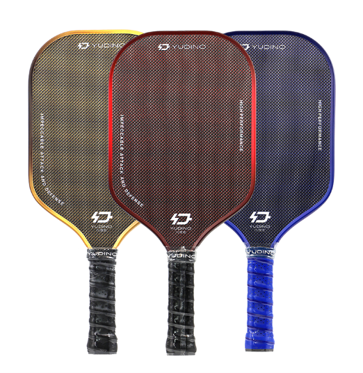
Take The Yudino Carbon Fiber Pickleball Paddle For Example.
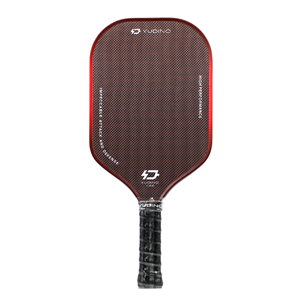
Material: T700 grade titanium wire carbon fiber surface material + 16mm PP honeycomb core.
The feedback is clean and clear, rigid and stable, hard smashes are basically not deformed, and the small ball in front of the net does not bounce away.
Weight: 230 g ±5 g, lightweight design.
The swing speed is fast, and the arm will not be sore against it for a long time. The upgraded structure eliminates excess vibration and remains comfortable for three hours.
Certification: USAPA certification, in compliance with international competition specifications.
It can be used in training and in formal competitions.
The thickness of the YUDINO carbon fiber pickleball paddle is 16mm: Compared with 13mm and 14mm thin rackets, the 16mm core material has obvious advantages in shock absorption and control, and the hitting resilience (pop) is slightly lower. The ball does not bounce randomly, the falling point is more controlled, and it is extremely stable.
Carbon fiber is not a marketing gimmick, but a watershed for Peak rackets from "training level" to "competition level".
If you are looking for a competition racket with clear feedback, accurate control, lightweight shock absorption, and USAPA-certified, YUDINO's T700 titanium carbon fiber +16mm PP honeycomb combination is worth a try.