Carbon Fiber Pickleball Paddle Grip Size Tips
Introduction: The Detail That Changes Everything
You can spend $200 on the most advanced carbon fiber pickleball paddle on the market — aerospace-grade materials, precision-woven surface texture, thermally pressed polymer honeycomb core — and still play below your potential if the grip size is wrong.
Grip size is the most underestimated fit variable in pickleball. Unlike tennis, where decades of mainstream coaching have made grip sizing a standard onboarding step for every beginner, pickleball is still young enough that most players choose paddles based on material, price, and surface texture — and pick whatever grip size happens to be in stock. The result is predictable: hand fatigue that sets in by the third game, a creeping loss of control on dink exchanges, wrist strain that gets blamed on technique rather than equipment, and eventually elbow pain that forces rest.
The connection between grip size and injury risk is well-documented in racket sports research. A grip that is too large forces the hand open, reduces wrist snap, and increases the lever arm on forearm muscles. A grip that is too small encourages over-squeezing, which generates constant tension in the forearm flexors and creates conditions for lateral epicondylitis — pickleball elbow. Neither feels dramatically wrong in the first set. Both become very obvious by the end of a tournament day.
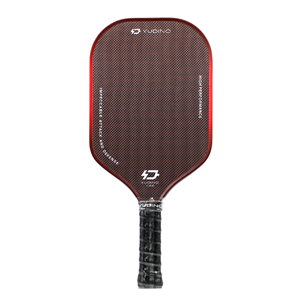
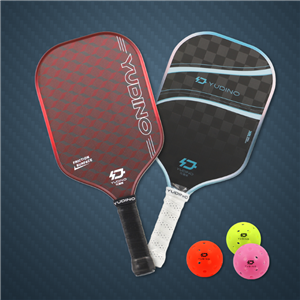
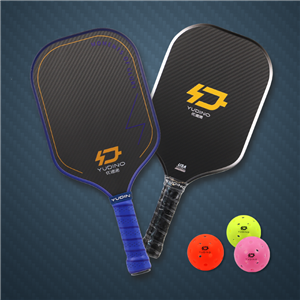
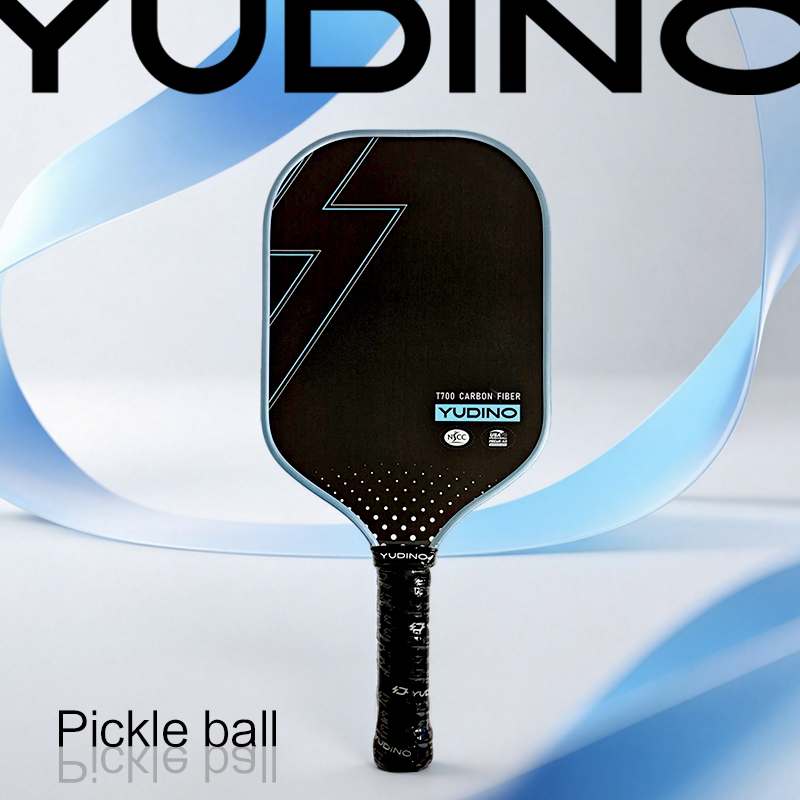
This guide covers everything you need to know about grip size for carbon fiber pickleball paddles: how size is measured and standardized, how the stiffness and texture of carbon fiber construction interact with grip feel, how to measure your own hand correctly, how to match grip size to playing style, and the most common mistakes players make when they rush the selection process. It draws on the engineering expertise of YUDINO (Liaoning) Sports Goods Co., Ltd. — a specialized pickleball paddle manufacturer producing over 50,000 units per year with USAPA-certified products — whose handle design philosophy is grounded in ergonomic research rather than manufacturing convenience.
If you have ever ended a session with an aching forearm, excessive blisters on your palm, or a feeling that your shots are slightly out of control even when your footwork and timing are good, there is a reasonable chance the answer begins with grip size.
Why Grip Size Matters More on a Carbon Fiber Pickleball Paddle
Before measuring your hand, it is worth understanding why grip sizing is a more nuanced issue with a carbon fiber pickleball paddle than it was with the fiberglass or wood paddles that dominated the early years of the sport.
Carbon fiber is a fundamentally stiffer material than fiberglass or composite alternatives. This stiffness is one of its most valuable properties — it transmits power efficiently, provides crisp, immediate feedback at ball contact, and holds its shape under the repeated mechanical stress of competitive play. But that same stiffness has a consequence for the handle: vibration from ball impact travels up the shaft and into the grip more directly than it does through a softer fiberglass construction.
In a poorly fitting grip, those vibrations are amplified. When a player is gripping too tightly — which happens almost automatically when the grip is too small, because the hand overcompensates for the feeling of instability — the forearm muscles are pre-tensioned, and impact vibration travels through already-loaded tissue. This is the physiological pathway to overuse injury, and it is why experienced coaches working with players who use carbon paddles pay particular attention to how the player holds the handle between shots, not just during them.
The corollary is also true: a well-fitted grip on a carbon fiber pickleball paddle allows the player to hold the handle with appropriate — not excessive — tension. The paddle feels like an extension of the arm rather than a tool being controlled. Feedback from ball contact is informative rather than jarring. Players who get this right consistently report that carbon paddles feel "live" and responsive; players with poorly fitted grips describe the same paddle as "harsh" or "difficult to control."
The surface texture of the handle is also a carbon-specific consideration. YUDINO's handle construction — including the titanium carbon fiber line's ergonomic grip system — uses high-friction grip materials that maintain surface engagement even when the hand is hot and sweaty. A grip that fits correctly works with this friction to stabilize the paddle; a grip that is too large requires the player to use muscular force to maintain control that a correct-fitting grip would provide passively.
Understanding the Numbers: How Pickleball Grip Size Is Measured
Pickleball grip size is measured in circumference — the distance around the handle at its widest point, typically the octagonal grip collar — expressed in inches. Unlike tennis, which uses a 0–6 scale (where "4" corresponds to 4 inches of circumference), pickleball manufacturers generally express grip size directly in fractional inches, with the most common sizes clustering around three values:
Small grip: 4 inches (4⅛" on some paddles) — the most common size for players with small to medium hands; the industry default for most women's-fit paddles and many unisex designs
Medium grip: 4¼ inches — the industry midpoint; fits a wide range of adult hand sizes; the most commonly stocked size across major paddle lines
Large grip: 4½ inches — for players with larger hands; less commonly available in standard stock, frequently achieved by building up a medium grip with overgrip tape
One important nuance: many carbon fiber pickleball paddle manufacturers, particularly those producing for the competitive market, sell paddles in a single grip size (usually 4¼") and expect players to size up using overgrip tape rather than down using any form of handle reduction. Building grip size up is easy, safe, and reversible; reducing a handle that is too large is not a standard option. This means that if you are between sizes, starting with the smaller grip and adding tape is the correct approach.
YUDINO's paddle range reflects this manufacturer philosophy. Several models — including the compact penhold-style titanium carbon fiber variant — are specifically designed with 16mm-core compact handles that fit small to medium hands as a priority, recognizing that the majority of competitive players who prioritize control over raw power benefit from a slightly smaller baseline grip.
How to Measure Your Hand for Pickleball Grip Size
There are two reliable methods for measuring your correct pickleball grip size, both of which can be done without a paddle in hand.
The Ruler Method
This is the most precise technique and the one most frequently referenced in coaching literature and Quora discussions about grip sizing.
Hold your dominant hand open with fingers together and fully extended, palm facing upward.
Place the end of a ruler at the base of the middle crease of your palm — the first of the three major horizontal creases closest to your fingers.
Measure to the tip of your ring finger (not the middle or index finger — the ring finger is the correct reference point for grip measurement).
Read the measurement in inches.
Interpretation:
4" or less → Small grip (4" / 4⅛")
4" to 4¼" → Medium grip (4¼")
4¼" to 4½" → Large grip (4½" or medium with overgrip)
Above 4½" → Large grip with additional overgrip layering
For most adult women, this measurement falls between 4" and 4¼". For most adult men, it falls between 4¼" and 4½". These are generalizations, not rules — hand proportions vary enormously among individuals of the same height and gender.
The Index Finger Test
This is the in-store, instant-feedback method that players without a ruler can use when testing a paddle.
Hold the paddle in a continental grip — the same grip used for volleys and dinks, with the base knuckle of the index finger on bevel 2 of the octagonal handle.
Wrap the fingers of your non-dominant hand around the gap between your ring finger and the heel pad of your dominant hand.
Evaluate the fit:
Correct: Your index finger fits snugly into the gap with light contact on both sides
Too large: The gap is larger than your index finger — you are gripping the handle with extra muscular effort to maintain control
Too small: There is no gap, or your ring finger overlaps your palm — you will over-squeeze reflexively during play
This test is reliable for initial screening but has limitations: it does not account for the way a grip feels during sustained play, or how grip size interacts with the overgrip thickness you intend to use.
Accounting for Overgrip Thickness
Virtually every competitive pickleball player uses at least one layer of overgrip tape over the factory grip. Standard overgrip tape (the thin, stretchy type sold in most sports stores) adds approximately 1/16" to 1/8" of circumference per layer. This means:
One layer of thin overgrip: effectively moves you from 4" to 4⅛"
Two layers: approximately 4" to 4¼"
One layer of thicker cushion overgrip: approximately 4" to 4¼" in one step
When measuring for grip size, decide in advance how many overgrip layers you prefer (based on your moisture level during play and personal preference for handle cushion), then subtract that thickness from your target size. If your measurement points to 4¼" and you plan to use two layers of thin overgrip, you should begin with a 4" factory grip.
On Reddit's r/Pickleball community, grip size and overgrip questions appear with remarkable frequency — and the most upvoted advice consistently points in the same direction: "Start smaller than you think you need. You can always add a layer of overgrip. You can't sand down a handle that's too big." This is practical, correct, and worth internalizing before you buy.
Grip Size and Playing Style: The Overlooked Connection
Grip size is not just a comfort variable — it has direct, measurable effects on the mechanics of how you hit the ball. Understanding those effects allows you to calibrate your grip choice based on your game, not just your hand measurement.
Control-First Players: The Case for Going Smaller
Players who build their game around dink consistency, drop shot placement, and soft game control in the non-volley zone (NVZ) benefit from grip sizes at or slightly below their measured optimum. Here is why:
A smaller grip allows the wrist to move more freely. This increased wrist mobility improves the ability to angle the paddle face precisely — critical for cross-court dinks, reset drops, and the subtle adjustments that turn a defensive position into a neutral one. In Quora discussions among advanced players, control specialists consistently mention preferring grips "a touch on the smaller side" specifically because the added wrist articulation improves touch on soft shots.
This preference is particularly pronounced among players who use a continental or eastern backhand grip base. In these grip styles, the paddle is held with the heel pad against a specific bevel of the handle, and even small deviations in handle circumference change how this contact point feels — affecting paddle face awareness and shot precision.
YUDINO's 3K and 12K carbon fiber pickleball paddle models, which target the control and touch segment of the market, are designed with handle dimensions that support this soft-game preference. The slightly rough, textured surface of the 3K weave — which generates more friction between ball and paddle face — pairs naturally with a grip profile that allows maximum wrist articulation.
Power Players: The Case for Going Larger (Slightly)
Players who rely on pace — flat drives, speed-up attacks from the transition zone, aggressive third-ball attacks — benefit from a grip that is at their measured optimum or fractionally above it.
A fuller grip increases contact between palm and handle, distributing the impact force of hard shots across a larger surface area. This reduces the localized pressure that causes hand fatigue during power sequences and provides a more solid, planted feeling during high-speed exchanges. Coaches working with power-oriented players frequently note that players who switch to a correctly sized (or slightly fuller) grip report more consistent power — because they are no longer unconsciously flinching or tensing in anticipation of impact discomfort.
For this profile, YUDINO's titanium carbon fiber pickleball paddle line — featuring aviation-grade titanium alloy wire woven into the carbon composite frame — delivers a handle construction where the titanium wire mesh itself contributes to vibration management. The higher impact dispersion rate inherent in the titanium-carbon composite structure means power hitters receive less transmitted vibration even during aggressive rallies, making the handle interaction with a properly sized grip feel planted and secure rather than jarring.
Two-Handed Backhand Players: A Specific Consideration
Two-handed backhand play is increasingly common in pickleball, borrowed directly from tennis technique. For two-handed backhand players, grip size has an additional variable: the non-dominant hand also contacts the handle.
Most two-handed backhand specialists prefer a slightly smaller grip. The non-dominant hand needs to establish its own purchase on the handle above the dominant hand, and a handle that is correct for the dominant hand alone may feel crowded when both hands are engaged. The compact titanium carbon fiber penhold-style handle in YUDINO's catalog — explicitly designed for the two-handed backhand player — addresses this with a handle geometry that accommodates both hands efficiently without requiring the grips to stack uncomfortably.
As noted directly in YUDINO's product specifications for this model: "Titanium carbon fiber pickleball paddle 16mm compact titanium alloy handle fits small and medium-sized hands, and the grip is more solid when both hands are backhand, and it will not be tired for a long time." This is a manufacturer-level acknowledgment of a playing-style-specific ergonomic need that generic grip sizing advice tends to overlook.
Singles vs. Doubles: Does Format Affect Grip Choice?
Pickleball doubles — the dominant recreational and competitive format — requires sustained soft game, high-frequency small movements, and rapid transition between offense and defense. Grip size recommendations for doubles players lean toward smaller grips, for the same wrist mobility reasons that favor control players.
Singles pickleball, where athleticism, pace, and court coverage are premium qualities, often favors a slightly fuller grip that supports the power shots needed to close out points from the baseline. Players who compete in both formats typically settle on a grip size that works adequately for both rather than switching equipment between formats.
Carbon Fiber Weave and Its Effect on Grip Feel: What Buyers Need to Know
The surface of a carbon fiber pickleball paddle — the face where ball contact occurs — is frequently discussed in terms of spin and control. Less often discussed is how the weave construction of the paddle's shaft and collar affects what the player feels through the handle.
3K Weave Handles
3K carbon fiber — where each fiber bundle contains 3,000 individual filaments — produces a tighter, denser weave with a relatively fine surface texture. On handles, this translates to a shaft that is stiff and responsive, with minimal flex under impact. 3K handles transmit feedback quickly and directly, which control players appreciate; the same directness can feel harsh to players accustomed to softer materials.
For grip size selection with 3K paddles: because feedback is direct and stiffness is high, precise grip fit is more important, not less. Over-gripping on a stiff shaft does more physiological damage than on a softer one. Target your measured size precisely, and do not size up "for extra control" — that logic works in softer materials but not in rigid carbon.
12K and 18K Weave Handles
12K (12,000 filaments per bundle) and 18K weaves are finer, producing a surface with more visible fiber density and a slightly different flex characteristic under load. Compared to 3K, these denser weaves distribute load across more fiber-matrix interfaces, producing marginally less concentrated stress at any single point in the handle. The feel is subtly different: slightly more planted, with a quality that experienced players describe as "solid" rather than merely "stiff."
For grip size selection with 12K and 18K paddles: the additional material density moderates the impact signature slightly, which means players at the borderline between grip sizes have a slightly wider comfortable range. However, the measurement-based approach still applies — do not treat the softer feel of a denser weave as a license to deviate significantly from your measured size.
Titanium Carbon Fiber Handles
YUDINO's titanium carbon fiber line introduces a composite construction where titanium alloy wire is woven into the carbon fiber matrix. This is not a coating or surface treatment — it is a structural integration of titanium at the fiber level, similar to how aerospace composite structures incorporate metallic reinforcement.
The practical effect on grip feel: the titanium wire mesh in the paddle frame increases torsional resistance and reduces handle flex under off-center hits. A carbon fiber paddle without titanium reinforcement will twist slightly when the ball contacts the edge of the paddle face rather than the sweet spot — this torsional flex is transmitted to the grip and felt as instability. The titanium-carbon composite dramatically reduces this twist, meaning off-center hits feel more controlled and the grip remains stable even when contact is not perfect.
This is particularly relevant to grip size because grip pressure is frequently increased reflexively in response to felt instability. Players using non-titanium paddles who feel torsional twist during off-center play tend to squeeze harder — moving into the territory of excessive gripping force regardless of nominal grip size. The structural stability of a titanium carbon construction allows correct grip pressure to be maintained even on imperfect shots, reinforcing the benefit of a correctly sized handle.
Grip Sizing for Different Age Groups and Playing Frequencies
Youth Players
Young players entering pickleball often use paddles designed for adults simply because youth-specific sizing is still limited. A correctly sized grip for a 12–15 year old typically falls in the 3¾" to 4" range — smaller than the adult standard. Adult 4¼" grips on adolescent hands create exactly the over-gripping conditions that produce elbow and wrist injuries during developmental years.
If a junior player is using a standard adult carbon fiber pickleball paddle, prioritizing a 4" factory grip (the smallest readily available) and wrapping with a thin overgrip to achieve a snug rather than loose fit is the correct approach. YUDINO's compact handle variants, designed for small and medium hands, are the most appropriate fit in this segment.
Recreational Players (1–3 days per week)
Recreational players accumulate less total grip time per week, which reduces the injury risk from a slightly imperfect grip size. For this group, the goal is comfort — a grip that does not cause blisters or hand fatigue within a typical 90-minute recreational session. The standard measurement approach applies, but the tolerance for being slightly off-target is wider.
Competitive and Tournament Players
For players competing in rated events or drilling regularly, grip size precision is most important. The cumulative load on forearm musculature across a tournament day (potentially 8–12 games) means that even modest grip size errors — errors that feel insignificant in a single recreational game — become problematic over the course of a full competitive schedule.
Tournament players should also consider the interaction between grip size, paddle weight, and swing weight. A heavier paddle (above 8 oz) transmits more inertial force to the grip during aggressive shots; at the same grip size, this increases loading on forearm flexors relative to a lighter paddle. YUDINO's titanium carbon fiber paddles achieve approximately 280g (roughly 9.9 oz) through the efficiency of the titanium-carbon composite structure — the weight budget is used to provide structural rigidity rather than mass for its own sake. At this weight, grip size fit remains important for extended competitive play.
How to Adjust Grip Size: Practical Techniques
Adding Overgrip: The Standard Method
Overgrip tape is the universal grip adjustment tool in racket sports. For pickleball:
Standard overgrip (thin/stretchy type): Adds approximately 1/16" circumference per layer. Best for players who need minimal size increase and prefer the feel of a thinner wrapping. Brands like Tourna Grip and Wilson Pro Overgrip are widely available.
Cushion overgrip (thicker, foam-padded type): Adds approximately 1/8" circumference per layer. Also provides vibration damping — beneficial for players on stiff carbon shafts who experience discomfort from impact transmission. A good option for players who need both size adjustment and a softer feel.
Moisture-wicking overgrip: Adds minimal circumference but improves grip surface traction during sweaty play. Does not change size meaningfully. Best used as the final outer layer over size-adjusting layers beneath.
Technique for wrapping: begin at the collar (bottom of the grip), stretch the tape to approximately 80% of its natural width, wrap with a 45-degree angle overlap of about 1/4" per revolution, and secure at the top with the adhesive tab or a grip band. Consistent wrap tension produces consistent circumference increase.
Removing and Replacing the Factory Grip
If the factory grip is adding circumference you do not want, it can be removed and replaced with a thinner replacement grip. Replacement grips are sold in various thicknesses and are applied directly to the handle core. For a carbon fiber pickleball paddle with a core handle diameter of 3¾" to 4", using a thinner replacement grip followed by one layer of overgrip can achieve the same final circumference as the factory grip — but with better moisture management and fresher surface friction.
Replace factory and overgrip at any sign of glazing (when the grip surface becomes slippery), tearing, or compression. For regular competitors, this typically means replacing overgrip every 4–8 hours of play and the base grip every 20–40 hours.
Heat Shrink Sleeves
Some high-end paddles use heat-shrinkable polymer sleeves over the handle core instead of traditional tape-wrapped grips. These sleeves provide a uniform circumference increase across the entire handle length and are preferred by players who want consistent diameter from collar to butt cap. They are more expensive than tape alternatives and require a heat gun for installation, but the result is superior consistency. YUDINO's OEM customization capabilities include handle specification options — for B2B buyers ordering custom production runs, handle diameter and grip type can be specified at the manufacturing stage rather than adjusted after delivery.
Common Grip Size Mistakes That Hurt Your Game
Mistake 1: Defaulting to "Medium" Without Measuring
"Medium" is a manufacturing default, not a fit recommendation. The fact that most paddles ship in 4¼" grip size reflects inventory management decisions, not ergonomic research. Buying "medium" without measuring is a coin flip that statistically produces a wrong answer for many players. Take the five minutes to measure your hand before you order.
Mistake 2: Judging Grip Size by How the Paddle Feels in the Store
Standing in a store swinging a paddle for 30 seconds does not replicate the biomechanical conditions of sustained play. Grip-related fatigue and injury develop over time, not in a brief demo. What feels "fine" in a store may feel constraining or loose after 40 minutes of drilling. Use the measurement method as your primary guide, and treat in-store feel as a secondary confirmation.
Mistake 3: Assuming Bigger Is Better for Control
This is among the most persistent grip sizing myths on Quora and Reddit forums. The reasoning sounds logical: a bigger grip covers more of the hand, so it must provide more control. The reality is the opposite: a grip that is too large reduces wrist mobility, making it harder to angle the paddle face precisely. Control comes from wrist freedom, not handle bulk.
Mistake 4: Ignoring the Butt Cap Profile
Handle fit is not just about circumference. The butt cap — the flare at the base of the handle — affects how the paddle sits in the palm and how much leverage the player can generate on wrist snap and forehand roll shots. Some carbon fiber pickleball paddle manufacturers use pronounced butt caps that push the heel of the hand back from the grip; others use flat or minimal butt caps. Players who use a spin-heavy forehand game should verify that the butt cap profile supports their natural grip position and wrist action, not just that the circumference measurement is correct.
Mistake 5: Layering Multiple Overgrips Without a Plan
Adding overgrip layers successively without measuring the cumulative result is a common improvised "fix" for paddles that feel wrong. After three or four layers, many players discover the grip has become tubular — round in cross-section rather than the ergonomic octagonal profile of the original handle — which reduces the bevel feedback that helps maintain consistent grip orientation during play. If you need a significant size increase, investigate whether a thicker replacement base grip is the correct solution rather than stacking multiple overgrip layers.
Mistake 6: Never Changing the Grip
A worn, compressed, or glazed grip has effectively changed its size — the padding has compressed, reducing circumference, and the surface friction has degraded, causing the player to compensate by gripping harder. Players who play regularly and never change their grip are unknowingly creating the exact over-gripping conditions they would avoid if they understood what was happening. Fresh grip tape is a low-cost, high-return maintenance item.
YUDINO's Handle Design Philosophy: Engineering Grip Fit from the Manufacturing Stage
What separates a manufacturer who has thought seriously about grip ergonomics from one who treats the handle as an afterthought is visible in product design details.
YUDINO's handle engineering, visible across the titanium carbon fiber paddle range, reflects deliberate ergonomic choices rooted in how players actually hold and use paddles in competitive conditions:
Metacarpal-fitting geometry: YUDINO explicitly designs handles to fit the metacarpal structure — the arch of the palm behind the fingers. This is not a cosmetic detail. A handle that conforms to the metacarpal arch provides a natural support surface that distributes grip force across the palm rather than concentrating it at a few contact points. This reduces the fatigue-inducing "death grip" that players develop when a handle does not fit the natural shape of their closed hand.
Titanium wire integration for stability: As discussed above, the titanium wire mesh in the composite frame significantly reduces handle torsion under off-center impact. For grip sizing, this means that the correct grip size can actually maintain correct pressure throughout a match, rather than requiring players to compensate for handle instability by gripping harder as the match progresses.
Compact penhold variant for small hands: The explicit availability of a compact handle variant — acknowledged in the product description as fitting "small and medium-sized hands" — reflects real-world recognition that the industry's default handle size does not fit all players. This is a significant commitment for a manufacturer whose production volume of 50,000 units per year makes standardization economically attractive; the decision to maintain multiple handle profiles prioritizes player fit over production simplicity.
High-friction grip material: The non-slip rubber grip material specified in YUDINO's handle design works synergistically with correct grip sizing. Grip friction allows the player to maintain paddle orientation with less squeezing force — which is exactly what an ergonomically correct grip size enables. A high-friction grip on a correctly sized handle is the combination that maximizes both control and endurance.
USAPA certification: Three YUDINO paddle models carry USAPA approval for sanctioned tournament play. Grip size specifications for these certified models fall within USAPA equipment standards, ensuring that players who size their grip correctly and compete in official events are using equipment that is fully compliant.
For B2B buyers — pickleball brands, importers, or retailers building their own labeled product range — YUDINO's OEM and ODM customization capabilities include grip size, handle length, and grip material specification. Custom production runs can be ordered with handle specifications matched to the target market demographic, rather than accepting the manufacturer's default. This is a significant advantage for brands serving specific segments: a women's-focused brand might specify 4" grips as standard; a competitive men's line might default to 4¼" with a stiffer base grip. YUDINO's 50,000-unit annual capacity and 3-day delivery timeline for stock items make this level of specification practical at realistic order volumes.
Putting It All Together: A Step-by-Step Grip Selection Checklist
Before purchasing your next carbon fiber pickleball paddle, work through this checklist:
Step 1 — Measure your hand. Use the ruler method. Measure from the middle palm crease to the tip of your ring finger in your dominant hand. Note the number.
Step 2 — Decide on overgrip preference. How many layers of overgrip do you plan to use? Subtract 1/16" per thin layer from your target size.
Step 3 — Identify your playing style. Control and soft game → consider 1/16" smaller than your measurement. Power and pace → target your measurement exactly. Two-handed backhand → prioritize compact handles.
Step 4 — Match to the paddle's construction. Stiffer material (3K carbon, titanium carbon composite) → grip fit precision is more important. Denser weave (12K, 18K) → slightly wider tolerance.
Step 5 — Verify the handle profile. Does the paddle you are considering have a butt cap profile and handle length that suits your grip style? Long handles (5" and above) provide more leverage for two-handed play; standard handles (4.5") suit single-handed play and NVZ finesse.
Step 6 — Buy smaller, not larger. If you are between sizes, always choose the smaller. You can add circumference with overgrip; you cannot remove it.
Step 7 — Maintain your grip. Replace overgrip regularly. Never play with a glazed or compressed grip. Budget for grip tape as a standard consumable alongside pickleballs.
Conclusion
Grip size is not an afterthought in pickleball — it is a foundational fit variable that affects every shot you hit, every hour you play, and every year of healthy play your forearm and elbow allow you. For players using a carbon fiber pickleball paddle, where the stiffness and directness of the material makes the grip interface more consequential than it would be with softer alternatives, getting grip size right is especially important.
The good news is that the solution is simple: measure your hand using the ruler method, account for your overgrip preference, calibrate for your playing style, and choose the smaller size when in doubt. These four steps — taking perhaps ten minutes of attention before purchase — prevent the common scenarios of chronic hand fatigue, loss of touch, and preventable overuse injury that affect players who skip the sizing process.
YUDINO's handle engineering approach — metacarpal-fitting geometry, titanium-carbon composite stability, compact variants for small hands, and full OEM customization for B2B buyers — reflects a manufacturer's commitment to making grip ergonomics a design priority, not an afterthought. Whether you are a recreational player looking for a comfortable afternoon on the court, a tournament competitor building your game around technical precision, or an importer sourcing a carbon fiber pickleball paddle line for your retail brand, the handle fit question deserves the same scrutiny you give to face material, core thickness, and weight.
Your paddle should feel like part of your hand. Grip size is where that feeling begins.
Frequently Asked Questions
Q1: What grip size should I use if I have average-sized hands and play mostly doubles?
For most adult players with average hands — a palm-to-ring-finger measurement of approximately 4" to 4¼" — a 4¼" factory grip with one thin overgrip layer is a solid starting point for doubles play. Doubles pickleball emphasizes soft game, dinks, and volley exchanges over power rallies, so wrist mobility is at a premium. If you find your ring finger pressing significantly into your palm when you close your grip, move to a 4" factory base. If there is more than a full finger width of space between your ring finger and palm heel, consider a layer of cushion overgrip over the 4¼" base. For players using YUDINO's carbon fiber pickleball paddle range, the standard titanium carbon fiber competition models are available with handle profiles optimized for this use case — and the compact penhold variant is explicitly designed for the two-handed backhand approach that many doubles players incorporate.
Q2: Does grip size affect the power I can generate with my carbon fiber paddle?
Yes — but not in the direction most players assume. Grip size affects power generation by determining how freely the wrist can snap through the ball at contact. A grip that is too large restricts wrist movement and reduces the wrist snap contribution to forehand drives and roll shots, costing both power and topspin. A grip that is correctly sized (or marginally smaller) allows full wrist articulation and maximizes the velocity contribution of wrist snap to the overall swing. Power players who have moved from an oversized grip to a correctly measured one frequently report that they can generate the same or greater pace with less physical effort — because they are working with the mechanics of the swing rather than against a grip that constrains wrist motion. The material stiffness of a quality carbon fiber pickleball paddle means all that power generation potential is efficiently transmitted; grip fit determines how much of it is wasted in constraint.
Q3: How often should I replace overgrip on my carbon fiber pickleball paddle?
Frequency depends on how much you sweat and how often you play, but a general guideline is: replace overgrip when you notice any of the following — slipping during play, visible glazing or smoothing of the surface texture, reduced tackiness when you squeeze the handle, or visible discoloration from absorbed moisture. For regular players (3+ sessions per week), this typically means replacing overgrip every 3–5 hours of court time. For occasional players, a visible and tactile check before each session is adequate, with replacement every 4–8 sessions. Fresh overgrip is inexpensive relative to its effect on play quality and paddle longevity — and it returns your grip to its correct effective size, since compressed old overgrip has lost circumference relative to when it was new.
Q4: Can I use a carbon fiber pickleball paddle with a grip designed for tennis or badminton?
Technically, yes — the tape will adhere to any smooth handle. Practically, it is not recommended. Tennis overgrip tape is designed for larger handles (4" to 4⅝" circumference is standard in tennis) and is often produced in widths optimized for that range; the wrapping geometry works slightly differently on the narrower pickleball handle and may produce uneven thickness distribution. Badminton replacement grips are typically thinner and tacky rather than absorbent, which can be appropriate as a base grip on a pickleball handle but should be verified for diameter compatibility. For best results, use overgrip and replacement grips specifically designed or validated for pickleball — the material properties are calibrated for the grip diameters, hand moisture levels, and impact characteristics of pickleball play.
Q5: Does YUDINO offer custom grip sizes for OEM orders?
Yes. YUDINO's OEM and ODM service — supported by a production capacity of 50,000 units per year and a dedicated export team — allows B2B buyers to specify handle parameters including grip circumference, grip length, base grip material and thickness, and butt cap profile. This means importers, retailers, and brand owners building a carbon fiber pickleball paddle line can specify the grip size that fits their target demographic rather than accepting a manufacturer default. For example, a brand targeting women's recreational play might specify a 4" factory base grip across the product line; a brand targeting competitive male players might specify 4¼" with a thicker cushion grip. YUDINO's engineering team can advise on handle construction options and minimum order quantities for custom specifications. Inquire via the contact page or WhatsApp (+86 15004048823) for a detailed custom specification consultation.
YUDINO — Yudino (Liaoning) Sports Goods Co., Ltd. | USAPA Certified Paddle Manufacturer | 50,000 Units/Year Production Capacity | OEM & ODM Available