Carbon Fiber Pickleball Paddle vs Graphite: Which One Should You Choose?
A complete technical comparison for players, coaches, and buyers who want to make the right material decision — the first time.
Introduction: The Material Question That Divides the Pickleball Community
Walk into any serious pickleball discussion — on Reddit's r/pickleball, on the Quora threads that surface when you Google "best pickleball paddle material," or in the parking lot after any club tournament — and you will encounter a debate that never quite resolves: carbon fiber or graphite?
Both materials are marketed aggressively by paddle manufacturers. Both appear in the paddle specs of top-ranked professionals. Both sound technical enough to justify premium price points. And yet for the majority of players, coaches, team buyers, and sports retailers making actual purchasing decisions, the difference between a carbon fiber pickleball paddle and a graphite paddle remains genuinely unclear — not because the distinction is subtle, but because marketing language has systematically blurred it.
"Graphite" sounds premium. "Carbon fiber" sounds high-tech. Manufacturers on both sides use the terms selectively, sometimes interchangeably, sometimes misleadingly. Players who pick up a "graphite" paddle and a "carbon fiber" paddle at a demo day will feel differences — but may not be able to articulate why those differences exist or whether they matter for their game.
This guide cuts through the marketing and explains the actual material science, the real-world performance differences, the selection criteria that matter, and the common mistakes that lead to expensive wrong choices. Whether you are an individual player choosing your next paddle, a coach equipping a training program, or a buyer sourcing paddles for wholesale distribution or OEM production, the following pages give you the technical foundation to make an informed decision.
Part One: Understanding the Materials — What Carbon Fiber and Graphite Actually Are
Carbon Fiber: The Engineering Definition
In the paddle industry, "carbon fiber" refers to a composite material consisting of carbon fiber filaments — extremely thin strands of carbon atoms arranged in a crystalline structure — embedded in a polymer resin matrix, most commonly epoxy. The result is a material that combines the strength and stiffness of the carbon fiber with the flexibility and formability of the resin, creating a rigid composite sheet that can be molded into paddle face surfaces.
What makes carbon fiber exceptional as an engineering material is its extraordinarily high strength-to-weight ratio. Carbon fiber composite has a tensile strength of 500–700 ksi (thousand pounds per square inch) and a density of approximately 0.055 lb/in³ — roughly five times stronger than steel at one-fifth the weight. In the context of a pickleball paddle face, this translates to a surface that is simultaneously very stiff (enabling crisp ball response) and very light (enabling fast hand speed and maneuverability).
The carbon fiber used in pickleball paddles is classified by its weave pattern, which is visible on the paddle face and influences both the performance characteristics and the aesthetic appearance:
3K Carbon Fiber — "3K" refers to 3,000 filaments per bundle (tow). 3K weave produces a relatively fine, tight pattern. Paddles using 3K carbon have a smoother texture on the face, which generally produces less inherent surface friction and a slightly more consistent contact feel. 3K is commonly used in paddles targeting control-oriented players.
12K Carbon Fiber — 12,000 filaments per bundle creates a coarser, more visible weave pattern. The increased filament count per bundle provides greater raw stiffness and a more pronounced surface texture. 12K carbon paddles tend to offer a slightly more aggressive texture for spin generation while maintaining excellent stiffness.
18K Carbon Fiber — The densest standard weave in premium paddle production. 18K carbon fiber creates the most pronounced surface texture of the standard weave variants, maximizing surface roughness for spin generation. Players who prioritize topspin and slice over raw control or power often prefer 18K.
T700 Carbon Fiber — The "T700" designation refers to the Toray classification system for carbon fiber grades, with T700 being a high-standard industrial grade carbon fiber with a tensile strength of approximately 711 ksi. T700 is used in aerospace and industrial applications and represents a step up from standard sporting-goods carbon fiber in terms of material consistency and mechanical properties. Paddles made with T700 carbon fiber face sheets benefit from the superior uniformity of the fiber, which translates to more consistent deflection behavior across the paddle face.
Titanium Carbon Fiber — A hybrid composite that combines carbon fiber with titanium-reinforced fibers or titanium oxide treatment of the carbon fiber surface. The addition of titanium elements increases the impact resistance and surface hardness of the face material while retaining the low weight of carbon fiber construction. Titanium carbon fiber paddles are at the premium end of the carbon fiber market, offering enhanced durability without a significant weight penalty.
Graphite: The Engineering Reality
In pickleball paddle marketing, "graphite" is where the terminology becomes genuinely confusing. Here is the technical reality: graphite is a form of carbon. Graphite and carbon fiber share the same elemental composition — both are made of carbon atoms — but their atomic structure is fundamentally different, which produces dramatically different mechanical properties.
Graphite in its pure form consists of carbon atoms arranged in flat hexagonal sheets (graphene layers) stacked on top of each other with relatively weak van der Waals bonds between the layers. This structure makes graphite slippery, electrically conductive, and relatively soft — it is the material in pencil lead and industrial lubricants.
In paddle manufacturing, what is marketed as a "graphite paddle" is not pure graphite. It is almost universally a graphite-reinforced polymer composite — a material where graphite fibers or graphite-impregnated carbon fiber are used as the reinforcement in an epoxy or polymer matrix, similar in manufacturing approach to carbon fiber composites but using graphite-derived fibers rather than high-modulus carbon fiber.
The practical mechanical difference between the two composite materials:
| Property | Carbon Fiber Composite | Graphite Composite |
|---|---|---|
| Tensile Strength | Very high (500–700 ksi) | High (250–400 ksi) |
| Stiffness (Modulus) | Very high | Moderate to high |
| Weight | Very light | Light |
| Surface Hardness | High | Moderate |
| Vibration Dampening | Lower (stiffer material) | Better (more flex) |
| Cost | Higher | Lower to moderate |
The key performance implication: carbon fiber is stiffer; graphite is more flexible. Stiffer materials transfer energy more efficiently and produce a crisper feel; more flexible materials absorb more impact energy and produce a softer, more dampened feel.
The Industry Terminology Problem
Before comparing performance, it is worth acknowledging a significant issue that appears repeatedly in Reddit and Quora discussions about paddle materials: many manufacturers use "graphite" and "carbon fiber" inconsistently or interchangeably.
Some paddles marketed as "graphite" use graphite-coated carbon fiber — technically a carbon fiber product with graphite surface treatment. Some "carbon fiber" paddles use graphite fiber composites with carbon fiber in the name for marketing purposes. A player on Reddit's r/pickleball who spent weeks comparing "graphite vs carbon fiber" paddles noted: "After doing a deep dive on this, I realized half the paddles I was comparing weren't actually using different base materials — just different marketing names for variations of the same carbon composite."
This confusion is not accidental — it reflects the legitimate overlap between the two materials' chemistry. But it does mean that comparing paddles by material label alone is insufficient. The specific grade, weave, thickness, and construction of the face material matter more than the category name.
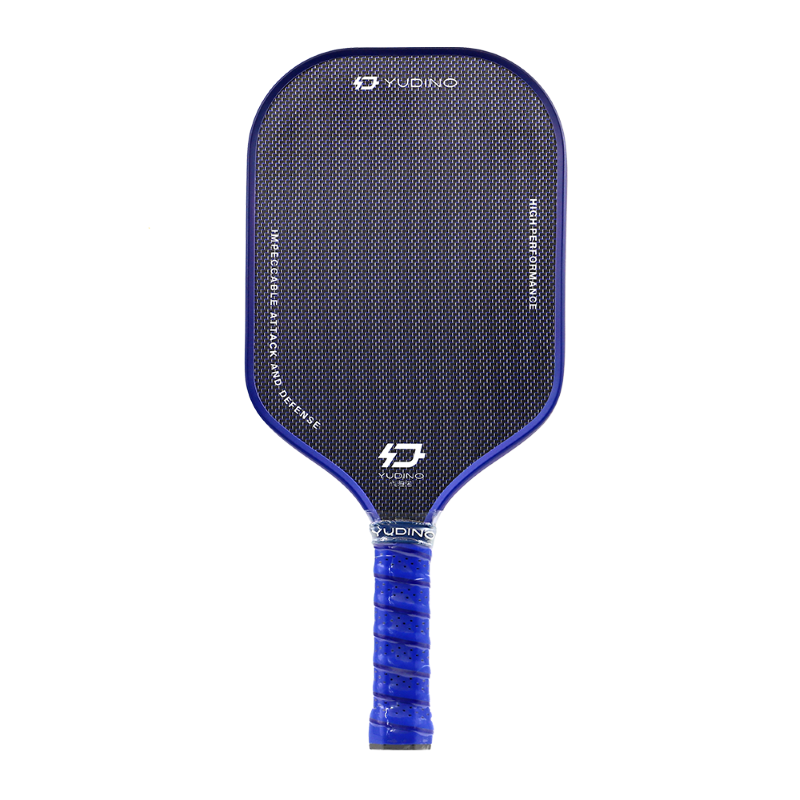
Part Two: Performance Differences on the Court
Feel and Touch: Soft Hands vs. Crisp Response
The most immediately noticeable difference between a carbon fiber pickleball paddle and a graphite paddle is the feel at contact — the tactile feedback the player receives when the ball meets the paddle face.
Carbon fiber paddles produce a crisper, more "popping" feel at contact. The higher stiffness of the carbon fiber face means the face deforms very little when the ball strikes it — energy is transferred quickly and efficiently, and the contact duration is brief. Players describe this feel as "precise," "responsive," and "electric." Aggressive players who want to feel exactly where they hit the ball on the face — and want maximum energy return on every shot — tend to prefer carbon fiber.
Graphite paddles produce a softer, more dampened feel. The slightly more flexible face absorbs a fraction more impact energy, which results in a softer sensation at contact and slightly longer ball dwell time. Players describe graphite feel as "comfortable," "forgiving," and "controlled." Players with arm sensitivity issues (tennis elbow, shoulder problems) often find graphite paddles more comfortable for extended play precisely because the vibration dampening is higher.
This distinction generates passionate discussion in pickleball communities. A representative Quora exchange illustrates the divide: one experienced player argued that "carbon fiber gives you feedback that graphite simply cannot — you can feel every millimeter of where the ball contacts the paddle face," while another responded that "for anyone not at the competitive tournament level, that extra feedback just translates to more frustration when you mishit — graphite is more forgiving and that forgiveness has real value for 95% of players."
Both are correct — for their respective player profiles. The key insight is that "better feel" is not an objective standard; it is player-preference-dependent.
Power and Energy Transfer
Carbon fiber paddles have a measurable power advantage derived from their higher stiffness. When a stiff material is struck, it stores and releases elastic energy more efficiently than a flexible material — the physics of elastic energy storage favor higher-modulus materials. A well-struck drive from a quality carbon fiber pickleball paddle will consistently carry more power at the same swing speed compared to a graphite paddle of equal geometry.
This advantage is most pronounced in hard-hitting situations: drives from the baseline, reset attempts that need to be punched back into play, overhead smashes, and third-shot drives. For players who rely on power as a primary weapon, the carbon fiber advantage in energy transfer is genuine and significant.
Graphite paddles sacrifice a fraction of peak power in exchange for control at the touch game. The softer face bends slightly into the ball on dinks, drops, and reset shots, effectively extending the contact time and giving the player a greater sense of control over placement. In the kitchen game — which at the 4.0+ level is where points are decided — this additional control touch is often worth more than the power advantage graphite gives up on drives.
Spin Generation: Surface Texture and Grit
Carbon fiber paddles — particularly those with 12K or 18K weave patterns and textured surfaces — excel at spin generation. The surface texture of carbon fiber composites grips the ball during contact, allowing players to generate topspin, backspin, and sidespin with relatively modest technique adjustments. T700 and titanium carbon fiber faces, in particular, offer a surface profile that interacts aggressively with the ball's surface, enabling high-spin patterns that are increasingly central to advanced play strategy.
The USAPA (USA Pickleball Association) regulates paddle surface texture, so manufacturers work within defined roughness limits — but within those limits, carbon fiber composite faces consistently achieve near the maximum permissible texture, giving players the full allowed spin advantage.
Graphite paddles are generally smoother than their carbon fiber counterparts. A graphite face feels slicker to the touch and generates somewhat less inherent surface spin. This does not mean graphite paddles cannot produce spin — they can, with proper technique — but the ceiling on spin generation is lower than with a premium-grade carbon fiber surface.
For players whose game increasingly depends on spin-heavy patterns (heavy topspin thirds, slice drops, aggressive ATP shots), this difference represents a meaningful performance gap.
Control and Placement
Graphite paddles traditionally have the edge in control — particularly for players at the 3.0–4.0 level who are developing their game and need maximum forgiveness on mishits. The more flexible face provides what engineers call a "larger sweet spot" effect: even off-center hits transmit reasonable force and reasonable direction, reducing the penalty for imperfect contact.
Carbon fiber pickleball paddles at the advanced level offer precision that graphite cannot match — but this precision works against players who are not yet consistent enough to exploit it. A carbon fiber paddle hit consistently in the sweet spot is more precise than a graphite paddle; a carbon fiber paddle hit slightly off-center is less forgiving than a graphite paddle. The tradeoff is expertise-dependent.
As an analogy from the tennis world (often cited in pickleball communities): a stiff, thin-beam racket in the hands of a professional is more precise and powerful; the same racket in the hands of a developing player produces arm pain and erratic shots. The material's performance advantage is only accessible to players who can exploit it.
Durability and Long-Term Performance
Carbon fiber paddles — particularly those built with T700 or titanium carbon fiber face sheets — have superior durability relative to graphite. The higher stiffness and surface hardness of carbon fiber composites resists edge chipping, surface abrasion from ball contact, and structural deformation over time. A premium carbon fiber paddle from a quality manufacturer maintains its performance characteristics longer through heavy use than a graphite paddle of comparable price.
Graphite paddles are more prone to edge wear and surface degradation over time, particularly in conditions of heavy use or aggressive play styles. The softer surface can develop micro-scratches that gradually change the surface texture and spin characteristics. This is rarely a concern for recreational players who use their paddles 2–3 times per week; it becomes relevant for coaches, club programs, and serious competitors who may put hundreds of hours per year on a single paddle.
Part Three: Who Should Choose What — Player Profile Matching
The Carbon Fiber Player Profile
A carbon fiber pickleball paddle is the right choice if you identify with most of the following:
Playing level: 4.0 and above, or aspiring toward competitive tournament play
Playing style: Aggressive baseline player, power-oriented, spin-heavy game
Primary strengths: Hard driving, overhead smashes, aggressive third-shot drives
Physical profile: No significant arm sensitivity issues; comfortable with stiffer equipment
Technical maturity: Consistent enough that precision is an asset, not a liability
Budget: Willing to invest in premium material for performance and durability
Priority: Maximum performance ceiling over broad forgiveness
Carbon fiber is also the correct choice for:
OEM buyers and sports brand managers sourcing paddles that will be marketed as performance equipment
Tournament organizers looking for paddles that can withstand competition-level play without performance degradation
Coaches who have developed consistent technique and are in the kitchen game at a high level
The Graphite Player Profile
A graphite paddle is the right choice if you identify with most of the following:
Playing level: 2.5–4.0, recreational play, or returning to the sport after injury
Playing style: Control-oriented, kitchen-dominant, dink-heavy finesse game
Primary strengths: Touch, placement, soft-game management
Physical profile: Tennis elbow, shoulder sensitivity, preference for comfortable vibration dampening
Technical maturity: Still developing consistency; mishits are common enough that forgiveness matters
Budget: Moderate investment comfortable; not yet ready for premium material pricing
Priority: Playability and consistency over maximum performance ceiling
Graphite is also well-suited for:
Club and recreational program equipment buys where player skill levels are mixed
Youth programs where comfort and ease of play encourage continued participation
Beginner-to-intermediate players who want a responsive face without the full stiffness of carbon fiber
The Middle Path: Carbon Fiber Surface, Polymer Core
An important point that Reddit and Quora discussions consistently raise: the paddle face material is only half of the performance equation. The core — almost universally a polymer honeycomb in premium paddles — determines a great deal of the overall feel and power characteristics. A thin carbon fiber face on a softer, thicker polymer core may actually feel more similar to a graphite paddle than to a thin carbon fiber paddle on a stiffer, denser core.
This is why identical-sounding materials specifications can produce dramatically different paddles on the court — and why experienced players test actual paddles rather than buying from spec sheets alone. The interaction between face stiffness and core stiffness creates the actual contact feel, and that interaction is not fully captured by the face material designation alone.
Part Four: Technical Parameters — What to Look for in Specifications
Weight and Balance
Both carbon fiber and graphite paddles are available across the standard weight range of 7.2–8.8 oz. The material choice does not inherently determine weight — construction, core thickness, handle length, and edge guard design all contribute. However, high-performance carbon fiber paddles tend to concentrate weight in the face and throat region rather than the handle, producing a slightly head-heavy balance that aids power generation on drives.
Weight guidelines for player type:
| Player Type | Recommended Weight | Rationale |
|---|---|---|
| Power player / aggressive baseline | 7.8–8.4 oz | Head weight supports drive power |
| Control/kitchen player | 7.2–7.8 oz | Lighter paddle enables faster hand speed at net |
| Senior/injury-prone player | 7.2–7.6 oz | Reduces arm fatigue and joint stress |
| All-around player | 7.5–8.0 oz | Balance between power and maneuverability |
Paddle Thickness and Core Density
Paddle thickness — measured at the core — is one of the most important parameters affecting feel and control, and it interacts directly with face material choice:
14–16mm thickness: Thinner paddles with carbon fiber faces produce a stiffer, more powerful, lower-dwell-time hit. Favored by power players and at the professional level.
16mm thickness: The most common all-around thickness; works with both carbon fiber and graphite faces to produce balanced performance.
16–21mm thickness: Thicker cores with carbon fiber faces create a paddle that combines the surface characteristics of carbon fiber with enhanced ball control due to increased dwell time. This combination has become increasingly popular as the game shifts toward control at higher levels.
Handle Length and Grip
For carbon fiber paddles — which tend to favor aggressive, full-swing play styles — longer handles (5–6 inches) are common, allowing two-handed backhand shots and full-swing drive generation. Graphite paddles are more commonly found with standard handle lengths (4.5–5 inches) that suit a dink-forward, compact-stroke game.
Grip circumference (4–4.5 inches is standard) affects control. Players with smaller hands benefit from smaller grips that enable more wrist action; players with larger hands prefer larger grips for stability.
Surface Roughness and Spin Potential
Within USAPA regulation limits, surface roughness varies between paddle models. Carbon fiber faces — particularly 12K, 18K, and titanium carbon — typically achieve near the maximum permitted roughness level, which directly translates to spin potential. Before purchasing for competitive play, verify that any paddle's surface meets current USAPA texture standards, as regulations in this area have been updated in recent years.
USAPA Compliance
For tournament and competitive play, confirm USAPA approval status. Both carbon fiber and graphite paddles exist in approved and non-approved versions. YUDINO's carbon fiber paddles are designed to meet international competition standards — a critical point for buyers sourcing paddles for competitive programs or branded retail.
Part Five: Buying for Wholesale, OEM, and Team Programs
Why Material Choice Matters More at Scale
Individual players making a paddle decision can demo products, get feedback from peers, and iterate. Wholesale buyers, sports brand managers, and team program administrators making bulk decisions do not always have that luxury — they need to get the specification right before committing to a container order or a team equipment budget.
The stakes of a material mismatch at scale are significant. A fitness club that orders 40 graphite paddles for a beginner program and finds their membership is split between true beginners and serious competitive players will quickly discover that the competitive players outgrow the equipment within months, creating pressure for early replacement. A sports brand that sources carbon fiber paddles for a market segment that turns out to be primarily recreational players may face higher-than-expected returns due to arm sensitivity complaints.
Getting the specification right requires knowing your end user — before placing the order.
Recommendations by Use Case
| Use Case | Recommended Material | Priority Specs |
|---|---|---|
| Competitive club program | T700 or Titanium Carbon Fiber | 16–16mm thickness, 7.6–8.0 oz, textured surface |
| Recreational/fitness club fleet | Graphite or 3K Carbon Fiber | Durable edge guard, mid-weight, forgiving feel |
| Youth training program | Graphite or 3K Carbon Fiber | Lightweight (7.2–7.5 oz), standard handle |
| OEM / private label premium line | Titanium or 18K Carbon Fiber | Customized graphics, USAPA-approved, premium packaging |
| OEM / private label entry line | Graphite or Fiberglass | Cost-effective at volume, broad player appeal |
| Tournament prize or sponsor paddle | Titanium Carbon Fiber | Visual premium, top performance, brand prestige |
OEM Customization: What's Possible with Carbon Fiber
One of the significant advantages of working with a specialized manufacturer like YUDINO is the ability to customize carbon fiber paddles far beyond the face material choice. Carbon fiber composite construction allows for:
Custom graphics and logos applied at the face layer — designs can be embedded in the carbon weave pattern for a premium visual effect that is not achievable with painted finishes
Custom colorways in edge guard, handle wrap, and face graphic treatment
Custom weight and balance tuning by adjusting core density and face thickness within a fixed external dimension
Custom handle length and grip size for specific market segments or player demographics
Private label branding with full documentation and compliance certification
The lead time and minimum order quantities for OEM carbon fiber paddle production vary by specification complexity. Standard customization (graphics, color) typically requires 3–4 weeks from approved artwork to production. Structural customization (core thickness, face grade) typically adds 2–4 weeks for sample approval. YUDINO's engineering team supports the complete OEM process from initial specification review through final quality inspection and export documentation.
Part Six: YUDINO's Carbon Fiber Paddle Line — Technical Overview
YUDINO has built its product line around carbon fiber excellence, with each product tier targeting a distinct player profile and performance requirement. The product range reflects genuine manufacturing expertise in carbon composite construction — not a collection of re-branded commodity paddles, but purpose-engineered equipment developed in close collaboration with player feedback and technical testing.
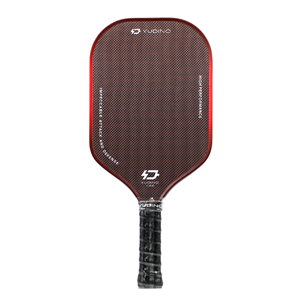
Titanium Carbon Fiber Pickleball Paddle
The flagship product in YUDINO's lineup. Titanium carbon fiber construction provides the highest surface hardness and impact resistance in the range — critical for players who generate maximum swing speed and put maximum stress on the paddle face. The titanium integration increases the surface's resistance to edge chipping and abrasion without adding measurable weight. The result is a paddle that maintains its performance characteristics through heavy competition use better than standard carbon fiber.
Target player: Tournament competitors, aggressive power players, coaches with heavy daily use requirements.
T700 Carbon Fiber Pickleball Paddle
T700-grade carbon fiber — Toray aerospace-grade material — delivers the consistency and mechanical property uniformity that serious players demand. The T700 paddle face shows minimal variation in stiffness and deflection behavior across the face surface, producing a more consistent sweet spot and more predictable shot response than paddles built with lower-grade carbon materials.
Target player: 4.0–5.0 players who have developed technique sophisticated enough to benefit from the T700's precision response.
18K Carbon Fiber Paddle
The 18K weave creates the most pronounced surface texture in YUDINO's standard carbon fiber line. Players who build their game around heavy spin — aggressive topspin drives, heavy slice drops, extreme angles — will find the 18K surface enables spin generation at the ceiling of what the paddle construction can achieve within USAPA limits.
Target player: Spin-oriented 4.0+ players; players transitioning from tennis who rely heavily on topspin patterns.
12K Carbon Fiber Paddle
The 12K weave represents the balanced middle of YUDINO's carbon line — more texture and stiffness than 3K, less extreme than 18K. An excellent all-around performance paddle for competitive recreational players who want carbon fiber performance without the polarized characteristics of the specialized variants.
Target player: 3.5–4.5 players seeking an upgrade from entry-level paddles; team buyers for competitive recreational programs.
3K Carbon Fiber Paddle
3K carbon fiber provides a smoother face with a finer weave — the most control-oriented of YUDINO's carbon fiber options. The smoother surface produces a more consistent and slightly softer contact feel, making 3K an appropriate transition paddle for players moving from graphite or fiberglass into carbon fiber construction for the first time.
Target player: 3.0–4.0 players upgrading from graphite; control-style players who want carbon stiffness without maximum surface aggressiveness.
Fiberglass Pickleball Paddle
YUDINO's fiberglass paddle serves the entry and recreational segment. Fiberglass construction provides a softer, more forgiving face than any carbon fiber variant — maximum dwell time, maximum forgiveness on mishits, comfortable vibration profile. While fiberglass is technically distinct from both carbon fiber and graphite, it serves the same player needs as graphite: beginners, recreational players, youth programs, and price-sensitive applications where durability at reasonable cost is the priority.
Target player: Beginners, recreational club players, youth programs, institutional fleet purchases requiring cost-effective durability.
Part Seven: Common Mistakes When Choosing Between Carbon Fiber and Graphite
Mistake 1: Choosing Based on What Professionals Use Without Considering Your Own Level
The single most common paddle selection mistake at the 2.5–3.5 level is choosing equipment based on what tournament professionals or YouTube reviewers use rather than what is appropriate for the buyer's own game. A professional-grade titanium carbon fiber paddle in the hands of a player whose contact consistency is not yet reliable will not elevate performance — it will amplify every mistake.
Corrective approach: Honest self-assessment of playing level before specification selection. If you have not yet played a full game where your unforced error rate is below 20%, you are not yet in the range where carbon fiber's precision advantage outweighs graphite's forgiveness advantage.
Mistake 2: Ignoring the Core Specification and Focusing Only on the Face Material
As discussed earlier, the paddle core — its thickness, material (typically polypropylene honeycomb), and density — determines more of the paddle's overall feel than the face material alone. Players and buyers who obsessively compare "carbon fiber vs graphite" while ignoring core thickness differences are comparing apples to oranges. A 14mm core carbon fiber paddle and a 16mm core graphite paddle may feel more similar to each other than either feels similar to a 21mm core paddle of either face material.
Corrective approach: Look at the complete specification: face material, face thickness, core material, core thickness, total paddle thickness, and weight. Evaluate all parameters together, not the face material in isolation.
Mistake 3: Assuming "More Expensive = Better for You"
Carbon fiber paddles are more expensive than graphite paddles at equivalent construction quality. This pricing difference reflects real material and manufacturing cost differences — it does not automatically imply that carbon fiber is the better choice for every buyer. A premium carbon fiber paddle purchased for a player who would benefit more from graphite's forgiveness is money spent against the player's interests.
Corrective approach: Budget appropriately for the correct material, not the most expensive available. A quality graphite paddle at $80–120 will outperform a beginner-inappropriate carbon fiber paddle at $180–220 for the player profile it is designed for.
Mistake 4: Buying Without Testing, Especially for Arm Sensitivity
Players with history of tennis elbow, shoulder impingement, or other upper-extremity issues need to take the vibration profile of their paddle seriously. Carbon fiber paddles transmit more vibration than graphite — a characteristic that matters much more for injury-prone players than for healthy ones. Buying a carbon fiber paddle based on performance specs without considering vibration sensitivity can lead to pain and injury that sidelines a player for weeks.
Corrective approach: Demo before you buy if at all possible. If you have arm sensitivity concerns, start with graphite or a thick-core (16–21mm) carbon fiber paddle specifically designed for vibration reduction. Ask specifically about vibration dampening characteristics when consulting with a manufacturer or retailer.
Mistake 5: Overlooking USAPA Compliance for Competitive Use
Both carbon fiber and graphite paddles exist in configurations that are not USAPA-approved for sanctioned tournament play — surfaces that are too rough, dimensions that exceed regulation, or core structures that have been found non-compliant in testing. Buying a paddle for competitive use without verifying its current USAPA approval status is a mistake that can result in disqualification at a tournament or rejection at equipment inspection.
Corrective approach: For any paddle intended for competitive or tournament use, verify USAPA approval through the official paddle approval list before purchase. YUDINO designs its competitive carbon fiber paddle range to meet USAPA standards — but always verify current approval status, as the standard evolves.
Mistake 6: For OEM Buyers — Specifying Material Without Specifying Grade
Wholesale and OEM buyers who specify "carbon fiber paddle" without specifying the carbon fiber grade, weave, and core parameters leave enormous room for quality variation between manufacturers. A "carbon fiber paddle" can mean anything from 3K fibers with a thin polymer coating to genuine T700 aerospace-grade composite face construction — the range spans from commodity to premium, and both can be marketed under the same label.
Corrective approach: When sourcing at scale, require full material specification: fiber grade (T700, standard industrial), weave (3K/12K/18K), face thickness, core material and thickness, and any certifications. Request samples with material test documentation before committing to production quantities. A reputable manufacturer like YUDINO provides full material transparency because genuine quality does not need to hide behind vague labeling.
Conclusion: Material Knowledge Is Your Competitive Advantage
Whether you are stepping onto the court for the first time, competing in your first tournament, managing a club's equipment program, or sourcing paddles for private-label distribution, understanding the real difference between a carbon fiber pickleball paddle and a graphite paddle gives you a decision-making advantage that the majority of the market does not have.
The core conclusions from this technical comparison:
Carbon fiber wins on: Stiffness, power, spin generation, surface precision, durability at high-use levels, and the absolute performance ceiling for developed players. The advanced grades — T700, 18K, titanium carbon fiber — represent the engineering frontier of what a pickleball paddle face can do within regulation limits.
Graphite wins on: Vibration dampening, touch-game forgiveness, arm comfort, ease of play for developing players, and cost-effectiveness for programs that need broad appeal across mixed skill levels.
The right choice is not a universal answer — it is the match between the material's performance profile and the player's game. Players and buyers who approach that matching process with technical knowledge, honest self-assessment, and a clear-eyed view of their actual needs will consistently outperform those who follow marketing language or imitate professional equipment choices without the game to match.
YUDINO builds across the full spectrum of this choice — from fiberglass and graphite-class entry paddles through 3K, 12K, 18K, T700, and titanium carbon fiber performance equipment — with OEM customization available at every tier. The manufacturing depth to produce and document the full range is what separates a genuine paddle engineering company from a marketing company with a contract factory. If you are sourcing paddles at any volume — from a dozen for a club program to thousands for a retail launch — start with the material specification, and let the performance requirements drive the product selection.
Your game, your paddle. Make the material choice count.
FAQ:
Q1. Is a carbon fiber pickleball paddle actually better than graphite, or is it just marketing?
The performance difference is real but context-dependent. A carbon fiber pickleball paddle is genuinely stiffer, more powerful, and better at spin generation than a graphite paddle of comparable construction — these are measurable material science differences, not marketing claims. However, "better" requires a player context. For a player at 4.0+ with consistent technique and an aggressive game, carbon fiber is meaningfully better. For a 2.5–3.0 recreational player, the graphite paddle's forgiveness may deliver more actual court success than the carbon fiber's precision ceiling, simply because the player cannot yet exploit the precision advantage reliably. Better material does not automatically mean better results — it depends on whether the player's game can access the material's performance benefits.
Q2. What does 3K, 12K, and 18K mean on carbon fiber pickleball paddles, and which should I choose?
The K-number refers to the number of carbon fiber filaments in each bundle (tow) of the woven composite: 3K = 3,000 filaments, 12K = 12,000, 18K = 18,000. Higher filament counts create a coarser, more textured weave pattern on the paddle face. Practically: 3K produces the smoothest surface and most control-oriented feel — good for players transitioning from graphite to carbon fiber. 12K offers balanced texture and stiffness — the versatile all-rounder in the carbon fiber lineup. 18K produces the most aggressive surface texture, maximizing spin generation potential — best suited for advanced players who deliberately weaponize spin in their game. For most players upgrading to carbon fiber for the first time, 12K is the recommended starting point. For players specifically building a spin-heavy game, 18K is worth the step up.
Q3. Can I use a carbon fiber pickleball paddle if I have tennis elbow?
With caution, yes — but the selection matters. Standard thin-core carbon fiber paddles transmit more vibration than graphite and are generally not recommended for players with active tennis elbow or recovering from elbow injuries. However, carbon fiber paddles built on thicker cores (16–21mm polypropylene honeycomb) have significantly better vibration dampening than thin-core versions, and some injured players report comfortable use of these configurations. If you have arm sensitivity concerns, (1) start with a 16mm+ core thickness, (2) ensure the handle grip size is appropriate for your hand to avoid excessive grip compensation, (3) demo if possible before purchasing, and (4) consult with a sports medicine professional about your specific condition. Graphite remains the safer default recommendation for players with confirmed arm sensitivity issues, unless you have specific reasons to require carbon fiber performance.
Q4. For OEM or wholesale buying, what's the minimum order quantity for YUDINO's carbon fiber paddles, and can I customize the design?
YUDINO supports OEM and private-label production across its full carbon fiber paddle range, from 3K through Titanium Carbon Fiber. Full customization options include: custom graphics and logos embedded in the carbon fiber face (not surface-printed), custom colorways on edge guard and handle, custom weight specifications within manufacturing feasibility, and custom packaging. Standard OEM MOQ (minimum order quantity) varies by product tier and customization complexity — contact YUDINO's sales team with your target specification and volume for a specific quotation. Sample approval is standard procedure before production commitment. YUDINO provides full material documentation including carbon fiber grade certification, which is increasingly required by retail buyers and online platform compliance programs.