Raw Carbon Fiber Pickleball Paddle Explained
Everything players, coaches, and buyers need to know about raw carbon fiber construction — the material redefining what a pickleball paddle can do.
Introduction: Why "Raw" Changes Everything
There is a moment in every serious pickleball player's development when their current paddle stops feeling like a tool and starts feeling like a limitation. The drives lack the pop they want. The spin just is not there. The touch at the kitchen feels imprecise — like playing through a filter. They start researching, land on review forums and YouTube channels, and encounter a phrase that keeps appearing in descriptions of the highest-rated performance paddles: raw carbon fiber.
Not just carbon fiber. Raw carbon fiber.
The distinction matters more than most players initially realize. It is not a marketing adjective. It refers to a specific manufacturing approach — leaving the carbon fiber surface in its natural, uncoated, untreated state after lamination — that produces meaningfully different performance characteristics from a conventional carbon composite face. Understanding what that means, why it matters, and whether it is the right choice for your game is the purpose of this guide.
Over the past three years, raw carbon fiber pickleball paddles have moved from a niche preference among elite competitive players to a mainstream performance category. Reddit threads that once dismissed raw surface paddles as a fad are now full of 4.0+ players comparing specific raw carbon fiber textures. Quora questions about "what makes raw carbon fiber different" consistently rank among the most-read paddle specification discussions. Google search volume for "raw carbon fiber pickleball paddle" has grown year-over-year as players who started with standard surfaces graduate to performance-oriented equipment.
This guide answers all of those questions comprehensively — from the material science of why raw carbon performs differently, to the specific construction variables that determine how a raw carbon fiber pickleball paddle will feel in your hand and perform in your game, to the selection mistakes that even experienced players make when upgrading to raw carbon. Whether you are a player ready to invest in genuine performance equipment, a coach equipping a competitive training program, or a wholesale buyer sourcing paddles for a performance-oriented retail or OEM line, everything you need to make the right decision is here.
Part One: What "Raw" Actually Means — and What It Doesn't
The Standard Carbon Fiber Paddle Surface
To understand what raw carbon fiber is, you first need to understand what standard carbon fiber paddle construction looks like — because "raw" is defined precisely by what it omits.
In conventional carbon fiber pickleball paddle manufacturing, the carbon fiber composite face goes through a surface finishing process after the lamination and curing stage. This finishing process typically involves one or more of the following treatments:
Coating: A clear or tinted polymer coating is applied to the outer surface of the carbon fiber. This coating serves several functions — it seals the carbon fiber weave, provides a consistent and predictable surface texture, protects the carbon fiber from moisture and UV exposure, and creates a smoother, more uniform appearance. The coating also moderates the surface's interaction with the ball, creating a more consistent friction coefficient across the face.
Sanding: The cured carbon surface is sanded to a specific roughness specification, then coated. Sanding removes surface irregularities from the curing process and creates a predictable baseline texture before coating is applied.
Painting/printing: Graphics, logos, and color patterns are applied either over the coating or between the coating and the carbon fiber surface, creating the visual design of the paddle face.
The result is a finished paddle face that is visually polished, protective, and consistent — but whose surface characteristics are largely determined by the coating and finishing treatment rather than the raw carbon fiber material itself.
The Raw Carbon Fiber Surface
A raw carbon fiber paddle eliminates the coating step. After lamination and curing, the carbon fiber composite face is left in its natural state — the woven fiber texture is exposed directly to the playing surface without a polymer seal or protective coating layer between the fiber and the ball.
This sounds like a minor manufacturing simplification. It is actually a fundamental change in how the paddle surface interacts with the pickleball.
The raw carbon fiber surface is:
More textured — the uncoated weave creates peaks and valleys at the fiber bundle crossovers that are more pronounced than on a coated surface
More porous — the epoxy matrix is present, but the surface has microscopic irregularities and open texture that a coating would have smoothed over
More variable — within the same weave pattern, raw surfaces show more local texture variation than uniformly coated surfaces
More aggressive — in terms of ball-surface interaction, the uncoated fiber grips the ball more effectively
This last characteristic — the enhanced grip on ball contact — is the primary reason raw carbon fiber paddles have captured such attention in the performance paddle market. More ball grip means more spin potential. And in the current era of pickleball strategy, where spin-heavy patterns are increasingly central to high-level play, maximizing spin potential within USAPA regulatory limits has become a primary engineering objective for performance paddle design.
Why "Raw" Is Not Simply "Rougher"
A common misconception — and one that appears frequently in Reddit and forum discussions — is that raw carbon fiber paddles are simply rougher versions of standard carbon fiber paddles, and that more roughness equals more spin. This oversimplification misses what actually makes raw carbon fiber distinctive.
The key is not just surface roughness measured by a profilometer — it is the specific texture geometry that raw carbon fiber produces. The woven structure of carbon fiber creates a regular, directional pattern of ridges and valleys corresponding to the fiber bundle crossover points. When a pickleball contacts this structured surface, the ball does not just encounter random roughness — it encounters a geometric surface that interacts with the ball's surface in a repeatable, mechanically meaningful way.
This structured texture is what enables the efficient energy transfer from paddle-face motion to ball spin that experienced raw carbon paddle users describe as "biting" the ball. The ball is gripped by the fiber structure, energy from the brushing contact is transferred to rotational motion of the ball, and the result is spin rates and spin consistency that are difficult to achieve on coated surfaces regardless of their measured roughness.
One player on Reddit's r/pickleball described the difference precisely: "It's not that the raw surface is scratchy or harsh — it's that when you brush the ball, it actually goes where you intended it to go with the spin pattern you put on it. With my old coated paddle, I felt like I was working for spin. With raw carbon, spin is the default output of any brushing contact."
Part Two: The Science Behind Raw Carbon Fiber Performance
Friction, Dwell Time, and Spin Generation
The performance of any paddle surface can be partially understood through two physical parameters: friction (the force resisting sliding between the ball and the paddle face during contact) and dwell time (how long the ball remains in contact with the face during a stroke).
Higher friction = more spin potential: When the ball slides across the paddle face during a brushing stroke, higher friction causes greater deceleration of the sliding motion, which translates to more rotational energy imparted to the ball. Raw carbon fiber surfaces have higher friction coefficients than equivalent coated surfaces, both because of the surface texture geometry and because the raw fiber material itself is less lubricated than a polymer-coated surface.
Dwell time affects spin energy transfer: The longer the ball remains in contact with the face, the more time the friction force has to act on the ball and impart rotational momentum. Raw carbon fiber paddle construction, particularly when combined with appropriate core specifications, can optimize dwell time for spin-heavy play styles.
The practical result: In controlled testing by paddle engineering teams and independent player evaluators, raw carbon fiber paddle faces consistently produce higher ball spin rates than coated carbon fiber faces of the same weave pattern and core specification. The advantage varies by stroke type and player technique, but independent measurements have shown raw surface paddles generating 5–15% higher spin rates on comparable strokes.
USAPA Surface Regulations and Raw Carbon
USAPA (USA Pickleball Association) regulates paddle surface texture through specifications that limit the maximum surface roughness of approved competition paddles. This regulation exists specifically to prevent paddle surfaces from providing an unfair spin advantage — it defines the ceiling of permissible surface aggressiveness.
Raw carbon fiber surfaces often approach or reach this regulatory ceiling in ways that coated surfaces cannot achieve without purpose-built abrasive treatments. The natural fiber texture of an uncoated 18K or 12K carbon weave sits near the upper boundary of USAPA roughness limits, giving players the maximum spin potential available within the rules.
For competitive players and buyers sourcing paddles for competitive programs, this means: a USAPA-approved raw carbon fiber paddle is operating at the frontier of what the rules allow. There is no further spin advantage available to achieve — the regulatory framework has been used to its full extent.
Critically: raw carbon fiber paddles, like all competition paddles, must carry current USAPA approval to be used in sanctioned tournament play. The approval status should be verified for each specific model, as surface specifications can change between paddle generations and regulatory updates occur periodically.
How Weave Pattern Interacts with Raw Surface Treatment
The choice of carbon fiber weave pattern — 3K, 12K, 18K — has a different effect on a raw surface than on a coated surface. Understanding this interaction is essential for selecting the right raw carbon specification.
On a coated surface: The coating partially fills and smooths the texture differences between weave patterns. A 3K coated surface and an 18K coated surface will feel more similar to each other than their uncoated counterparts, because the coating moderates the texture difference.
On a raw surface: The weave pattern's texture geometry is fully expressed. The difference between a raw 3K surface (finer, more regular texture) and a raw 18K surface (coarser, more aggressive texture) is much more pronounced than between coated versions of the same weaves.
This means that weave selection matters more for raw carbon paddles than for coated paddles, and the choice should be made with clear awareness of how the weave pattern will interact with your game:
| Weave | Raw Surface Texture | Spin Ceiling | Feel Character | Best For |
| 3K | Fine, regular | High | Controlled, precise | Control-spin hybrid players |
| 12K | Medium-coarse | Very High | Responsive, aggressive | All-around competitive players |
| 18K | Coarse, maximum | Highest (within regs) | Maximum grit | Spin-dominant advanced players |
T700 Raw Carbon: The Grade-Material Interaction
When raw carbon fiber construction is combined with T700-grade carbon fiber, the performance characteristics extend beyond surface texture to include structural precision. T700 fiber's higher tensile strength and tighter manufacturing tolerances mean the raw surface of a T700 paddle has more consistent fiber spacing, more uniform weave geometry, and less local variation in surface texture than paddles made with standard industrial-grade carbon fiber.
This consistency matters on a raw surface more than on a coated surface, because on a coated surface, manufacturing variations in fiber placement are smoothed over by the coating. On a raw surface, every variation is expressed directly in the playing surface. T700 raw carbon therefore represents not just the highest-grade material but the most consistent and repeatable raw surface geometry available in the paddle market.
Part Three: How Raw Carbon Paddles Play — On-Court Performance Analysis
The Spin Game: Where Raw Carbon Has Transformed Competitive Play
The most significant on-court impact of raw carbon fiber surfaces has been in spin-based shot patterns that have become increasingly central to high-level pickleball:
Third-shot drive with topspin: On a raw carbon surface, a drive with topspin brush generates enough ball rotation to meaningfully affect trajectory — the topspin causes the ball to dip faster after the apex, making it harder for opponents to time. With a coated surface, generating the same ball rotation requires more extreme swing adjustments that compromise placement accuracy.
Kitchen drops with backspin: Slice drops from mid-court that land softly in the kitchen and kick backward are easier to generate reliably on raw carbon. The surface grip on the downward slicing contact transfers more backspin, and the repeatability of the raw surface means the shot behaves consistently across attempts.
Dink patterns with sidespin: Advanced players use sidespin in the dink game to push opponents out of position, force uncomfortable returns, and set up put-away opportunities. Raw carbon fiber paddle surfaces enable sidespin generation in the compact, wrist-limited strokes of the dink game in ways that smoother surfaces cannot match.
ATP and Erne attacks: These advanced shots require precise ball control at high velocities. The raw carbon surface's grip allows players to control the ball face angle and apply intentional spin on contact even in fast-reaction scenarios.
A competitive player who made the transition to raw carbon documented her experience on Reddit: "I had been playing competitive 4.5 level pickleball for two years. When I switched to raw carbon, my unforced error rate initially went up for about two weeks — the paddle demanded more precise technique because it was responding to everything I was doing with the face. After I adjusted, my spin-based drops became completely different shots. Opponents started commenting on them. The paddle didn't make me spin better — it made my spin patterns actually land where I was aiming them."
Power and Drive Performance
Raw carbon fiber does not compromise power relative to coated carbon fiber. The stiffness properties of the carbon fiber composite — which determine energy return and drive power — are determined by the fiber grade and construction, not by the surface coating. A raw T700 carbon fiber paddle face has identical structural stiffness to a coated T700 paddle of the same construction.
What raw carbon does change in the power game is the feel of hard-hit shots. Because the ball grips the raw surface slightly more during contact, drives feel "louder" and more connected — players report a distinctive, satisfying contact sound and feel from hard drives on raw carbon that is different from the slightly more muted feel of coated carbon. This is partly tactile psychology and partly a real difference in contact dynamics from the higher friction interaction.
The Kitchen Game: Touch, Control, and the Dink
Here is where raw carbon fiber creates the most nuanced on-court experience — and where it most separates experienced players from those still developing their game.
At the kitchen line, most exchanges involve compact, low-swing-speed contacts where the ball barely moves the paddle face. At these low contact energies, the higher friction of a raw carbon surface creates a contact feel that many players describe as "sticky" — the ball seems to adhere to the face briefly before leaving.
For experienced players, this stickiness is an asset: it provides feedback about exactly where the ball contacted the face, enables small intentional spin adjustments even on slow dinks, and creates a sense of "owning" every touch. For developing players, the same characteristic can feel unfamiliar and difficult to control — the ball does not simply bounce off as it does on a coated surface, and until muscle memory adjusts to the longer effective contact, mishits and unintended spin can occur.
This is why the community consensus — consistent across Reddit, Quora, and coaching discussion boards — is that raw carbon fiber paddles reward players who already have solid technique, and punish those who are still working on consistency. The raw surface amplifies everything: good technique becomes excellent technique; poor technique becomes visible immediately in the shot results.
Weather and Environmental Conditions
One practical consideration for raw carbon surfaces that outdoor players and tournament competitors need to understand: moisture affects raw carbon fiber surfaces more than coated surfaces.
In humid conditions, light rain, or after heavy use when perspiration reaches the paddle face, a raw carbon surface can temporarily change its friction characteristics. The absorbed moisture affects the effective contact between the fiber surface and the ball, generally reducing the surface's grip slightly until it dries. Experienced raw carbon paddle users manage this by keeping the paddle face dry between points in humid conditions — a practice that becomes second nature but requires deliberate attention.
Coated surfaces are more moisture-stable because the coating provides a barrier against surface moisture absorption. For players who primarily play in wet climates or under conditions where moisture management is difficult, this practical consideration is worth factoring into paddle selection.
Part Four: Selecting Your Raw Carbon Fiber Paddle — The Right Specification for Your Game
Assessing Whether Raw Carbon Is Right for You
Before diving into specific parameter selection, the most important question is whether raw carbon fiber is appropriate for your current game. Here is the honest assessment framework that experienced players and coaches use:
You are ready for raw carbon if:
You are playing at 4.0+ level and your game includes intentional spin patterns
Your unforced error rate in dink exchanges is below 15% in practice situations
You actively use spin as a strategic tool, not just as an occasional technique variation
You are comfortable with equipment that demands precision and rewards correct technique
You have played enough to understand what contact "feels" good versus poor on your current paddle
You are not yet ready for raw carbon if:
Your game is still primarily about getting the ball back over the net consistently
You make more unforced errors than your opponents in most sessions
Your spin game is aspirational rather than practiced — you intend to develop it, but it is not yet consistent
You are recovering from a break in play and need to re-establish consistency before adding equipment complexity
The community is consistent on this point. As one experienced 4.5 player noted on a Quora thread about raw carbon paddles: "I've seen the raw carbon trend cause a lot of intermediate players to spend $180 on a paddle they're not ready for, get frustrated when their error rate goes up during the adjustment period, and conclude the paddle is 'not for them.' Most of them just needed two more months of development before the paddle made sense. Patience and honest self-assessment matter more than equipment FOMO."
Core Thickness and Its Interaction with Raw Carbon Surface
The single most important structural parameter for a raw carbon pickleball paddle — alongside the surface specification — is core thickness. The interaction between a raw surface's grip characteristics and the core's dampening and dwell time determines the overall feel of the paddle.
14mm core + raw carbon: The thinnest common core creates the stiffest, most direct energy transfer. Combined with a raw carbon surface, this produces maximum power on drives and maximum surface feedback on every contact. The feel is "hard" — very responsive, very precise, demanding. Suited for elite-level power players who want maximum energy from hard strikes and can manage the reduced forgiveness.
16mm core + raw carbon: The most versatile combination. The 16mm core adds a degree of ball dwell that softens the contact slightly relative to 14mm, while retaining most of the raw carbon surface's spin and feedback benefits. This is the most common core thickness in premium raw carbon paddles and works across a wide range of play styles from power-oriented to balanced.
16–21mm core + raw carbon: Thicker cores with raw carbon create a counterintuitive combination: the raw surface provides maximum spin and surface feedback, while the thick core provides extended dwell time and greater forgiveness on off-center hits. This pairing is increasingly popular among players who want the spin advantages of raw carbon without sacrificing the control benefits of thick-core construction. The feel is "softer" than thinner-core raw carbon but more spin-capable than thick-core coated paddles.
Recommendation for most players upgrading to raw carbon: Start with a 16mm core. It provides the right balance of raw surface feedback and core-dampened forgiveness for the adjustment period.
Weight Distribution: Standard vs. Elongated Paddle Shapes
Raw carbon fiber paddles are available in both standard (wide-body) and elongated (long-body) shapes. The choice interacts with how you intend to use the raw surface's spin capabilities:
Standard shape (approx. 7.875" wide × 15.5" long): Larger sweet spot, more forgiving off-center contact, faster hand speed due to lower moment of inertia. Better suited for kitchen-dominant players who want raw carbon's spin capability primarily in the dink game and controlled exchanges.
Elongated shape (approx. 7.0" wide × 16.5" long): Smaller sweet spot, higher moment of inertia, more power on full swings, better reach for groundstrokes and ATPs. Better suited for players whose primary use of raw carbon spin is in drive and groundstroke patterns.
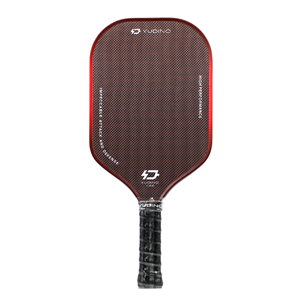
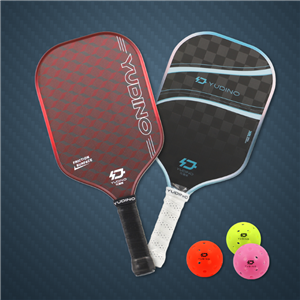
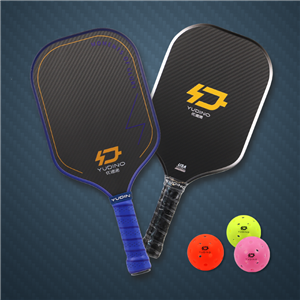
YUDINO's raw carbon paddle development addresses both form factors, recognizing that the spin advantages of raw carbon serve different strategic purposes in different paddle geometries.
Handle Considerations for Spin-Oriented Play
For players whose primary motivation for raw carbon is spin generation, handle length deserves consideration. A longer handle (5.5–6 inches) enables a two-handed backhand that generates maximum swing speed — which, combined with a raw carbon surface, produces the highest achievable topspin on backhand drives. A shorter handle (4.5–5 inches) provides more wrist freedom for one-handed spin generation and kitchen manipulation.
Grip size (circumference) also matters for spin play: smaller grips (4–4.25 inches) allow more finger action and wrist involvement in the stroke, which experienced players use to add spin without additional arm swing. Larger grips (4.25–4.5 inches) provide more stability but reduce wrist mobility.
Part Five: Parameter Recommendations by Player Profile
Aggressive Tournament Competitor (4.5–5.0)
| Parameter | Recommendation | Rationale |
|---|---|---|
| Surface | Raw 18K or Raw T700 | Maximum spin ceiling within USAPA limits |
| Core Thickness | 14–16mm | Direct power transfer; elite-level precision |
| Core Material | Polypropylene honeycomb, medium density | Balance of power and control |
| Weight | 7.8–8.3 oz | Head weight supports drive power |
| Shape | Standard or elongated based on style | Elongated for baseline power; standard for all-court |
| Handle Length | 5.5–6 inches | Enables two-handed backhand |
| USAPA Status | Required and current | Mandatory for sanctioned competition |
Advanced All-Around Player (4.0–4.5)
| Parameter | Recommendation | Rationale |
|---|---|---|
| Surface | Raw 12K or Raw 18K | High spin capability, manageable adjustment period |
| Core Thickness | 16mm | Best versatility across shot types |
| Core Material | PP honeycomb, standard density | Proven all-around feel |
| Weight | 7.6–8.0 oz | Balanced between power and maneuverability |
| Shape | Standard (wide-body) | Larger sweet spot for the kitchen game |
| Handle Length | 5–5.5 inches | Versatile for both kitchen and baseline |
| USAPA Status | Required for tournament play | Verify before purchase |
Control-Style Player Transitioning to Raw Carbon (3.5–4.0)
| Parameter | Recommendation | Rationale |
|---|---|---|
| Surface | Raw 3K or Raw 12K | Lower surface aggression for adjustment |
| Core Thickness | 16–21mm | Thicker core adds forgiveness during transition |
| Core Material | PP honeycomb, soft density | Extended dwell for touch control |
| Weight | 7.4–7.8 oz | Lighter weight for fast hand speed at net |
| Shape | Standard | Maximum sweet spot for consistency |
| Handle Length | 4.5–5 inches | Kitchen-oriented compact stroke |
| USAPA Status | Verify if competitive | Important if entering tournaments |
OEM/Wholesale Buyer for Performance Market
| Parameter | Recommendation | Rationale |
|---|---|---|
| Surface | Raw T700 or Raw Titanium Carbon Fiber | Premium positioning, maximum performance credential |
| Core Thickness | 16mm | Broadest player appeal in performance segment |
| Customization | Full face graphics, logo, colorway | Brand differentiation in competitive retail |
| USAPA Compliance | Required | Essential for serious performance retail |
| Documentation | Material cert, test reports | Increasingly required by major retail buyers |
| MOQ | Discuss with manufacturer | Volume-dependent; sample approval standard |
Part Six: YUDINO's Raw Carbon Fiber Paddle Engineering
Manufacturing Philosophy: No Compromises on Surface
YUDINO's approach to raw carbon fiber paddle production is grounded in a manufacturing philosophy that treats the paddle surface as the primary engineering challenge — not an afterthought after structural design is complete. This perspective, developed through years of producing carbon fiber paddles for demanding export markets including the USA and Europe, drives every production decision from fiber grade selection through final quality inspection.
The raw carbon fiber surface on a YUDINO paddle is not simply an "unfinished" standard paddle. It is a surface that has been engineered from the lamination stage to produce the optimal raw texture for the target weave pattern. Curing parameters — temperature profile, pressure, time — are controlled specifically for raw surface production. Post-cure handling protocols protect the uncoated surface through inspection and packaging. The result is a raw carbon surface whose texture geometry is consistent and intentional, not a byproduct of omitting a finishing step.
The Titanium Carbon Fiber Raw Surface
YUDINO's titanium carbon fiber paddle — the flagship of the performance line — brings titanium-enhanced fiber construction to a raw surface format. The titanium integration increases the surface hardness of the raw fiber, which has two practical consequences*
Greater durability of the raw texture: Standard raw carbon fiber surfaces are subject to gradual texture wear as the unprotected fiber weave contacts the ball thousands of times. The surface microstructure can degrade over weeks of heavy play, progressively reducing the spin performance that attracted the player to raw carbon in the first place. Titanium-enhanced fiber hardens the surface and resists this texture wear more effectively, maintaining the raw surface's performance characteristics through extended use.
Consistent performance over time: A raw surface that maintains its texture consistency delivers predictable performance throughout the paddle's service life. A degrading surface creates an unpredictable change in paddle feel that forces players to adjust technique — a frustrating experience that can be avoided with appropriate material engineering.
T700 Raw Carbon: Precision at the Surface Level
YUDINO's T700 carbon fiber raw surface paddles benefit from the dimensional consistency of aerospace-grade fiber. When raw carbon fiber is produced from T700-grade material:
Fiber bundle dimensions are tighter and more consistent, producing more regular weave geometry
The epoxy matrix distribution is more uniform, creating consistent surface porosity across the face
The resulting texture has lower local variation — the surface performs the same at different points across the face, not just at the geometric center
For players who have experienced inconsistent raw carbon paddles from lower-grade manufacturers — where the surface feels different at the edges versus the center, or where spin generation is inconsistent across strokes — T700 construction is the technical solution. The precision of the material eliminates the quality variance that plagues commodity-grade raw carbon production.
Quality Control for Raw Carbon: More Demanding, Not Less
A common misunderstanding among buyers is that raw carbon paddles are less expensive to produce because they skip the coating step. This is incorrect. Raw carbon paddle production is in several ways more demanding than coated production:
Surface damage risk: Without a protective coating, the paddle face is vulnerable to surface damage at every stage of production after curing — handling, inspection, packaging. Manufacturers without purpose-built raw surface production protocols produce high scrap rates from surface damage that would be invisible on a coated paddle but is unacceptable on a raw surface.
Inspection requirements: Raw surface quality is evaluated differently from coated quality. The visual and tactile inspection of a raw carbon surface requires trained inspectors and appropriate lighting and magnification to identify surface irregularities that affect performance. Automated inspection systems designed for coated surfaces are insufficient.
Consistency requirements: As discussed, the performance of a raw surface is more sensitive to manufacturing variation than a coated surface. Tighter process control at every stage — from fiber layup through curing — is required to produce consistent raw surface quality.
YUDINO's production infrastructure for raw carbon paddles was purpose-built for this manufacturing discipline, reflecting the company's commitment to raw surface quality as a genuine performance engineering challenge.
Part Seven: Common Mistakes When Buying a Raw Carbon Fiber Paddle
Mistake 1: Buying Raw Carbon Because It Looks Cool, Not Because Your Game Is Ready
This is the most prevalent mistake in the raw carbon market — particularly among players at the 3.0–3.5 level who are enthusiastic about the sport but have not yet developed the technique consistency to benefit from what raw carbon offers.
Raw carbon's surface responsiveness amplifies all contact, including imperfect contact. A player whose kitchen game has notable inconsistencies in contact point will find that raw carbon makes those inconsistencies more consequential. The ball will respond to every small variation in face angle and contact point in ways that a coated paddle would partially absorb and moderate. The experience of "the paddle is doing things I didn't intend" is raw carbon telling you exactly what your stroke is doing — which is valuable information, but only for players ready to use that feedback constructively.
Rule of thumb: If your coach has not yet identified spin generation and precise ball control as areas of focus in your development, you are not yet in the segment of the player population that raw carbon serves best.
Mistake 2: Assuming All Raw Carbon Paddles Are Equivalent
The raw carbon label covers an enormous range of actual material and construction quality. A raw carbon paddle made with commodity-grade carbon fiber, inconsistent curing parameters, and minimal surface quality control is not the same product as a raw carbon paddle made with T700-grade fiber, precision-controlled manufacturing, and purpose-built raw surface quality inspection.
Players who try one low-quality raw carbon paddle, find the surface inconsistency frustrating, and conclude that "raw carbon is overrated" have not actually experienced what quality raw carbon construction delivers. The surface variation they experienced was a manufacturing quality problem, not an inherent characteristic of raw carbon construction.
Corrective approach: Research the manufacturer's quality credentials before purchasing. Look for manufacturers who can specify the carbon fiber grade (not just "carbon fiber"), who provide surface consistency documentation, and who have established OEM relationships with quality-conscious retail buyers — these relationships require and validate manufacturing discipline that commodity producers cannot meet.
Mistake 3: Ignoring the Core Specification When Buying Raw Carbon
Buyers attracted by the raw carbon surface label often spend all their research time on surface comparisons and give insufficient attention to core specification — which, as established earlier, determines as much of the paddle's feel as the surface.
A raw 18K carbon fiber face on a very stiff, thin core is a completely different playing experience from a raw 18K face on a thick, soft-density core. Both are "raw 18K carbon fiber paddles" by label, but one would suit a power-first player and the other a control-first player. Buying based on surface label without core specification is like buying a car based on the exterior color without checking the engine.
Corrective approach: Always ask for and evaluate the complete specification: surface weave, surface treatment (raw vs. coated), core material, core thickness, total paddle thickness, and weight. Evaluate the package, not the individual elements*
Mistake 4: Failing to Account for the Adjustment Period
Nearly every player who transitions to raw carbon reports a performance dip during the initial adjustment period — typically 1–4 weeks depending on how much they play. The higher surface friction and more pronounced contact feedback require technique adjustments that the player's muscle memory has not yet made.
Players who buy a raw carbon paddle for a critical tournament or competition in the next week are making a mistake: they will be competing with equipment they have not adjusted to, which creates unnecessary uncertainty and performance risk.
Corrective approach: Build in an adjustment period of at least 2–4 weeks of regular play before relying on a new raw carbon paddle in competitive settings. Practice with it, note what is changing in your shot patterns, and make intentional adjustments before the competitive pressure of tournament play.
Mistake 5: For OEM Buyers — Not Requesting Sample Approval Before Production
The difference between manufactured raw carbon surface quality levels is not visible in product photos or catalog descriptions. A manufacturer can show beautiful photography of a raw carbon surface that looks premium without that image conveying the actual surface consistency, texture uniformity, or durability characteristics of the production batch.
OEM buyers who skip the sample approval process for raw carbon paddles — to save time or reduce cost — are accepting unknown quality. For a coated paddle, surface coating largely standardizes appearance; for a raw carbon paddle, the actual surface is the product, and only physical inspection of production-representative samples can validate quality.
Corrective approach: Always require production-representative samples for raw carbon paddle orders before committing to production quantities. Evaluate samples under multiple lighting conditions, examine surface consistency across the face, and ideally play-test representative samples to assess actual on-court performance. YUDINO's standard OEM process includes sample approval as a mandatory step before production commitment — a practice that protects both manufacturer and buyer.
Mistake 6: Overlooking USAPA Compliance for Competitive Purchases
This mistake applies broadly to performance paddles and is particularly important for raw carbon purchases because raw carbon surfaces specifically exist to maximize performance within the regulatory framework. A raw carbon surface that exceeds USAPA texture limits would be disqualified at equipment inspection — wasting the investment and leaving the player without approved equipment at a competition.
USAPA conducts ongoing paddle surface compliance testing, and paddles that pass at one regulatory cycle may be re-evaluated at a subsequent cycle if standards change. For any paddle purchased for competitive tournament use, current USAPA approval status must be verified through the official database at the time of purchase, not at the time of the paddle's original release.
Conclusion: Raw Carbon Fiber Is Not a Trend — It Is a Technical Evolution
The rise of raw carbon fiber pickleball paddles over the past several years represents something more significant than a marketing trend or a passing equipment fashion. It reflects a genuine evolution in how players understand the relationship between paddle construction and on-court performance — and a maturing of the pickleball equipment market toward the kind of material science precision that tennis and other racket sports developed over decades.
A raw carbon fiber pickleball paddle delivers a documented performance advantage in spin generation, surface feedback, and precision contact feel. That advantage is real, measurable, and increasingly central to competitive play strategy at 4.0 and above. The players who have integrated raw carbon into their games — and adjusted their technique to use it effectively — report that returning to coated surfaces feels like playing with a filter between their intent and the ball's behavior.
But the performance advantage is not unconditional. It requires technique maturity to exploit, an adjustment period to access, manufacturing quality to be reliable, and honest player self-assessment to be worth the investment. A premium raw carbon surface in the hands of a player who needs forgiveness is a tool used incorrectly.
The summary for every buyer and player considering raw carbon:
Assess your game honestly first. Raw carbon rewards developed technique and punishes inconsistency more than forgiving surfaces. Know which category describes your current game before committing.
Specify the complete paddle, not just the surface. Core thickness, fiber grade, and weave pattern together determine what the raw carbon surface actually delivers. Surface label alone is insufficient as a specification.
Demand manufacturing quality evidence. Raw carbon paddle quality varies enormously between manufacturers. Grade of fiber, consistency of curing, surface inspection protocols — these production details determine whether a raw carbon paddle performs as promised or disappoints.