Custom T700 Thin Core Pickleball Paddle: OEM Guide for Brands
For brands, distributors, and competitive pickleball clubs, creating a custom T700 thin core pickleball paddle is more than aesthetic customization—it’s a strategic business decision. This guide covers everything from material sourcing to OEM production, MOQ planning, cost structure, and market positioning, ensuring your custom paddle delivers competitive performance and strong B2B profitability.
1. Why Brands Choose Custom T700 Thin Core Paddles
Competitive players increasingly demand high-performance paddles with optimized spin, power, and responsiveness. OEM custom paddles allow brands to:
Differentiate in saturated markets
Control branding and packaging aesthetics
Optimize pricing tiers and profit margins
Guarantee quality consistency through controlled supplier relationships
Decision Value: B2B buyers who understand paddle differentiation can justify higher margins and stronger brand loyalty.
2. Material Considerations for Custom T700 Paddles
The foundation of performance lies in material selection:
2.1 T700 Carbon Fiber Surface
Why it matters: T700 carbon fiber provides superior stiffness and energy return, preferred by competitive players over standard 3K paddles.
Procurement Tip: Verify material certificates and tensile strength tests; unverified T700 claims can undermine brand credibility.
2.2 Thin Core Composition
Typically 13–14mm polymer or composite core
Thinner cores increase power transfer and responsiveness, critical for competitive performance
Ensure core thickness tolerance ±0.5mm for consistency across bulk orders
2.3 Surface Texture & Grip
Textured surfaces enhance spin and control
Customized grip designs improve player ergonomics
Decision Factor: OEM customization in texture can be a strong differentiator for clubs and retailers
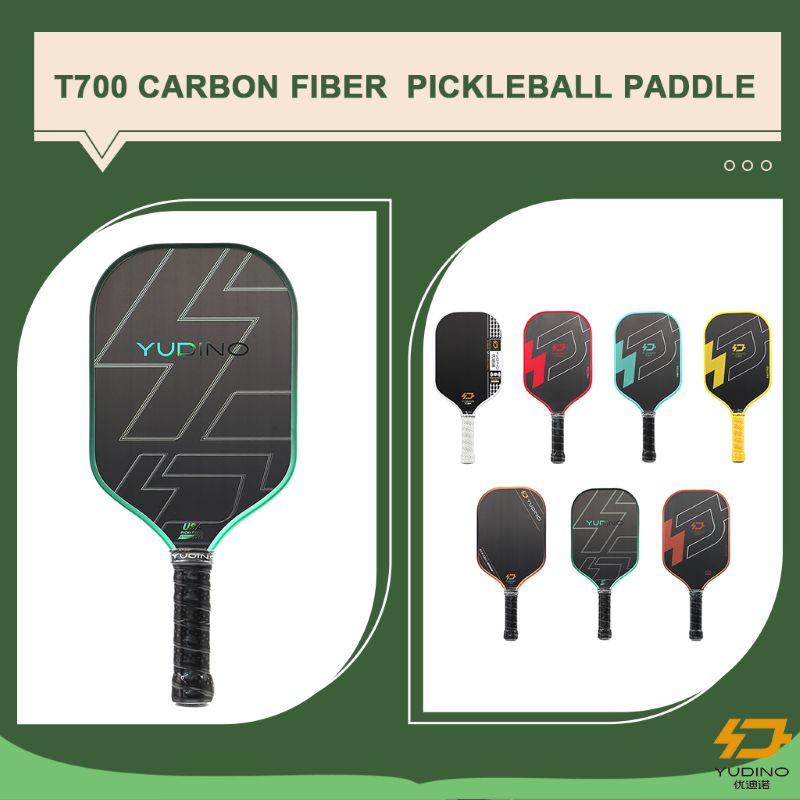
3. OEM Customization Options
3.1 Logo and Branding
UV printing, sublimation, or laser etching for durability
Multi-color printing allows brand identity to stand out on competitive paddles
3.2 Paddle Shape and Edge Design
Slightly elongated or wider shapes can target specific player preferences
Reinforced edges reduce chipping in tournament environments
3.3 Packaging Customization
Premium tubes, branded boxes, or protective cases increase perceived value
Packaging can communicate paddle specs, performance data, and brand story
OEM customization enhances resale potential and brand recognition in competitive segments.
4. Cost Structure and Pricing Strategy
Custom T700 paddles have a higher base cost than standard paddles, but offer higher perceived value and margins:
| Custom Paddle Tier | Factory Price (500–1000 pcs) | Recommended Wholesale Price | Expected Retail Price | Margin |
| Basic Custom T700 | $28–$35 | $60–$75 | $120–$150 | 45–55% |
| Mid-tier Custom T700 | $36–$45 | $75–$95 | $140–$180 | 50–55% |
| Premium Custom T700 | $46–$55 | $90–$120 | $160–$200 | 50–60% |
Decision Value: Pricing tiers allow distributors to target different market segments without diluting brand positioning.
5. MOQ and Order Planning
Typical OEM MOQ: 300–500 paddles
Larger orders reduce unit cost, but inventory carrying costs rise
Recommended strategy: staggered batches to test market response, adjust design and features after initial feedback
A staggered approach minimizes financial risk while testing B2B channels.
6. Quality Control for OEM T700 Paddles
High-quality OEM paddles require rigorous quality assurance:
Pre-production samples: Test for weight, balance, and responsiveness
Bulk inspection: Random checks for core thickness, surface quality, and grip adhesion
Durability tests: Drop tests, edge chip tests, repeated impact tests
Defect Rate Benchmark: Aim for ≤3% for bulk shipments
Quality consistency reduces returns and strengthens distributor trust.
7. Supplier Selection Criteria
Selecting an OEM supplier for T700 paddles involves:
Experience in T700 carbon fiber paddles
Capacity for customization (logos, edge design, surface texture)
Production consistency (weight tolerance ±5g, core tolerance ±0.5mm)
Transparency: Certificates, test reports, production logs
Decision Value: Suppliers with traceable quality and OEM expertise reduce risk and enable confident branding.
8. Market Positioning and Distribution Strategy
Custom paddles must align with competitive market expectations:
High-end clubs and professional tournaments prefer paddles with performance validation
Retailers and distributors may leverage custom branding to differentiate offerings
Marketing focus: Highlight T700 material, thin core design, and spin-enhanced surface to appeal to serious players
Clear positioning justifies premium pricing and supports brand credibility.
9. Risk Management in OEM Production
Key risks for brands procuring custom T700 paddles:
Material mislabeling: T700 claims must be verified
Production delays: MOQ and supplier reliability impact launch timelines
Inventory obsolescence: Misjudged demand can tie up capital
Market mismatch: Ensure paddle specs match target player preferences
Mitigation strategies: pre-production samples, pilot runs, supplier audits, and staged MOQs.
10. Performance Testing for Competitive Market Adoption
Brands should conduct performance testing:
Power transfer analysis: Measure energy return vs standard 3K paddles
Spin generation: Evaluate textured surface effect under tournament conditions
Weight and balance consistency: Ensure ±5g consistency across production
User feedback loop: Engage clubs and competitive players for early insights
Verified performance supports higher pricing and stronger adoption.
11. Profitability Analysis for OEM T700 Paddles
Production cost: $28–$55 per paddle
Wholesale price: $60–$120
Retail price: $120–$200
Margin Insights:
Brands can achieve 50%+ profit margins with premium positioning
Customization allows tiered pricing strategies for different market segments
Strong differentiation reduces price sensitivity
12. Strategic Recommendations for Brands
Prioritize T700 certification and thin core precision
Use pilot batches to test custom designs
Align branding and packaging with competitive market expectations
Monitor defect rates and supplier consistency
Optimize MOQ and staged ordering to manage cash flow