How to Find a Reliable Pickleball Paddle Manufacturer in China
To find a reliable pickleball paddle manufacturerin China, verify factory ownership, test product samples, assess quality control procedures, review OEM and ODM capabilities, and confirm experience with international exports and USAP-compliant paddle production. Manufacturers that can provide transparent production processes, consistent product quality, and proven export experience are generally more reliable than suppliers competing primarily on price.
Why Is It Important to Choose the Right Pickleball Paddle Manufacturer?
A paddle supplier directly affects product quality, customer satisfaction, brand reputation, and future growth.
Choosing the wrong manufacturer can result in:
Inconsistent product quality
Delayed deliveries
High defect rates
Poor communication
Certification issues
Customer complaints and returns
In contrast, a reliable manufacturer can help maintain product consistency, reduce sourcing risks, and support future product development.
How Can You Verify Whether a Supplier Is a Real Factory?
Many suppliers advertise themselves as manufacturers, but some are trading companies that outsource production.
Before requesting a quotation, ask for:
Factory photos
Production workshop videos
Manufacturing equipment information
Employee and facility details
Quality control documentation
A genuine manufacturer should be able to explain every stage of paddle production, including carbon fiber layup, honeycomb core assembly, thermoforming, surface finishing, and final inspection.
Signs of a Real Manufacturer
A reliable factory typically has:
Dedicated production workshops
Composite material processing equipment
Thermoforming production lines
Product testing facilities
Engineering and development teams
The more transparent a supplier is about its production process, the easier it becomes to evaluate its capabilities.
Why Should You Always Test Product Samples?
Samples reveal information that specifications and product photos cannot.
Even when two paddles use similar materials, their performance may differ significantly due to manufacturing quality and construction methods.
When testing samples, evaluate:
Weight Consistency
Professional manufacturers maintain tighter weight tolerances between paddles.
Balance Point
A balanced paddle improves player control and comfort.
Surface Texture
Surface technology affects spin generation and durability.
Sweet Spot Performance
A larger and more stable sweet spot generally improves playability.
Overall Build Quality
Inspect:
Edge guard installation
Grip quality
Surface finishing
Structural stability
Sample testing is often the fastest way to identify quality issues before mass production.
What Quality Control Systems Should a Reliable Manufacturer Have?
Quality control is one of the most important factors when evaluating a paddle factory.
Reliable manufacturers usually implement inspections throughout the production process.
Incoming Material Inspection
Raw materials such as carbon fiber sheets, honeycomb cores, and adhesives should be checked before production begins.
In-Process Inspection
Production staff monitor:
Paddle dimensions
Surface consistency
Bonding quality
Structural integrity
Final Product Inspection
Completed paddles should be inspected for:
Weight accuracy
Surface defects
Edge guard quality
Handle stability
Packaging quality
Manufacturers with documented quality control systems typically produce more consistent products over multiple production runs.
How Important Are OEM and ODM Capabilities?
Not all suppliers provide the same level of customization.
OEM Services
OEM manufacturing generally includes:
Custom logos
Custom graphics
Packaging design
Accessory customization
ODM Services
ODM capabilities are more advanced and may include:
New paddle development
Mold creation
Surface technology development
Material optimization
Performance engineering
For brands seeking long-term growth, ODM capability is often more valuable than simple logo printing.
What Materials Are Used in Modern Pickleball Paddles?
Understanding materials helps buyers evaluate product quality more effectively.
Fiberglass
Fiberglass paddles are often chosen for:
Lower manufacturing costs
Strong power generation
Beginner-friendly performance
Carbon Fiber
Carbon fiber remains one of the most popular materials because it offers:
Better control
Improved durability
Consistent performance
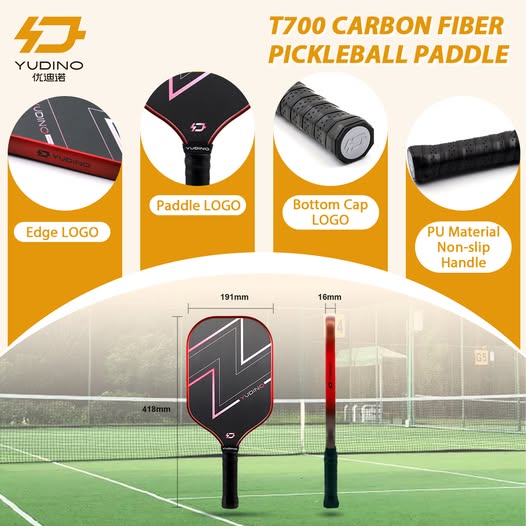
T700 Carbon Fiber
T700 carbon fiber is frequently used in premium paddles because it provides:
Excellent stiffness-to-weight ratio
Enhanced spin potential
Improved responsiveness
18K Carbon Fiber
18K carbon fiber has become increasingly popular due to:
Distinctive appearance
Improved vibration dampening
Larger sweet spot characteristics
Kevlar Hybrid Materials
Kevlar-based paddle faces are gaining attention for:
Increased durability
Better impact resistance
Unique playing feel
Understanding material specifications helps buyers compare products beyond pricing alone.
Why Does USAP Experience Matter?
For brands targeting the North American market, understanding USAP requirements can simplify product development.
Manufacturers familiar with competitive paddle standards often have experience with:
Paddle performance requirements
Testing procedures
Design considerations
Production consistency
Even if certification is handled separately, previous experience with compliant paddle production can reduce development risks.
How Can Export Experience Reduce Sourcing Risks?
Manufacturing capability is only one part of successful sourcing.
Export experience helps ensure smooth communication, documentation, and logistics management.
Ask suppliers:
Which countries they export to
How many years they have exported sports equipment
Whether they work with distributors or brands
Whether they have experience serving North American and European customers
Manufacturers with proven export records are often better equipped to handle international business requirements.
Common Mistakes Buyers Make When Choosing a Pickleball Paddle Manufacturer
Choosing Based Only on Price
The lowest quote does not always represent the lowest overall cost.
Poor quality often leads to:
Product returns
Customer complaints
Brand damage
Skipping Sample Evaluation
Many sourcing problems could be avoided through proper sample testing.
Ignoring Production Capacity
A supplier may produce excellent samples but struggle with large-volume orders.
Failing to Review Quality Control Procedures
Without a clear quality system, consistency becomes difficult to maintain.
Not Verifying Export Experience
International business requires more than manufacturing capability alone.
Questions to Ask Before Selecting a Pickleball Paddle Supplier
Before placing an order, consider asking:
Do you own your manufacturing facility?
How many years have you produced pickleball paddles?
What materials do you use?
Do you offer OEM and ODM services?
What quality inspections do you perform?
Can you provide product samples?
What is your minimum order quantity?
What is your production lead time?
Which countries do you export to?
Do you have experience producing USAP-compliant paddles?
The answers often provide a clearer picture of a supplier's capabilities than pricing alone.
Finding a reliable pickleball paddle manufacturer in China requires more than comparing quotations. Buyers should verify factory ownership, evaluate samples, review quality control systems, assess OEM and ODM capabilities, and confirm export experience before making a decision. Manufacturers that demonstrate transparency, consistent quality, and long-term production reliability are generally better partners than suppliers focused solely on offering the lowest price.