How to Source Carbon Fiber Pickleball Paddles in Bulk
Introduction
The pickleball industry has exploded. With over 36 million players in the United States alone and rapidly growing adoption across Europe, Southeast Asia, and Australia, the global pickleball equipment market is projected to surpass $1.7 billion by 2028. At the center of this boom is one product category that has redefined performance standards at every level of play: the carbon fiber pickleball paddle.
But if you're an importer, wholesale distributor, brand owner, or OEM buyer reading this, you already know the surface-level story. What you really need to know is which type of carbon fiber paddle performs, how the material science translates into court results, what separates a manufacturer worth partnering with from one that will burn your margins with inconsistent quality — and ultimately, how to source the right product at scale.
This guide was written from the ground up for B2B buyers who need more than a sales pitch. We go deep into the technical specifications, weave structures, core configurations, and the manufacturing variables that determine whether a paddle succeeds in the market or ends up in a returns pile. We also address the most common sourcing mistakes that cost importers money and reputation, and provide the evaluation framework you need to make a confident buying decision.
Whether you're looking to launch a private-label pickleball brand, expand an existing sporting goods portfolio, or fulfill retail and e-commerce demand at volume, this is the article you need to read before placing your next order.
What Is a Carbon Fiber Pickleball Paddle? The Technical Foundation
Before we talk sourcing, pricing, or customization, let's establish a clear technical baseline. The term "carbon fiber pickleball paddle" is used loosely in the market, and that ambiguity costs buyers money.
Carbon fiber is a composite material made from thin filaments of carbon atoms, typically 5 to 10 micrometers in diameter, bonded together in a crystalline structure. When woven into sheets and laminated with resin, these filaments produce a material that is:
Five times stronger than steel by weight
Significantly stiffer than fiberglass or wood
Resistant to deformation under repeated impact stress
Dimensionally stable across temperature and humidity ranges
In pickleball paddle manufacturing, carbon fiber is used primarily as the face surface (the hitting surface) and, in some advanced constructions, as a structural frame reinforcement. The core is almost universally a polypropylene (PP) honeycomb structure. This hexagonal cell lattice provides the internal cushioning, vibration dampening, and energy return characteristics that determine how the paddle "feels" at contact.
What this means for end-users: a carbon fiber face captures the ball more efficiently, generates more surface friction for spin, and provides more tactile feedback than fiberglass or composite alternatives. For B2B buyers, this translates into a product with a premium positioning story that is easy to communicate and easy to sell.
The number before the "K" refers to the number of carbon filaments per tow (bundle). This is one of the most misunderstood specifications in the market, and getting it wrong can mean mismatching the product to the target consumer segment.
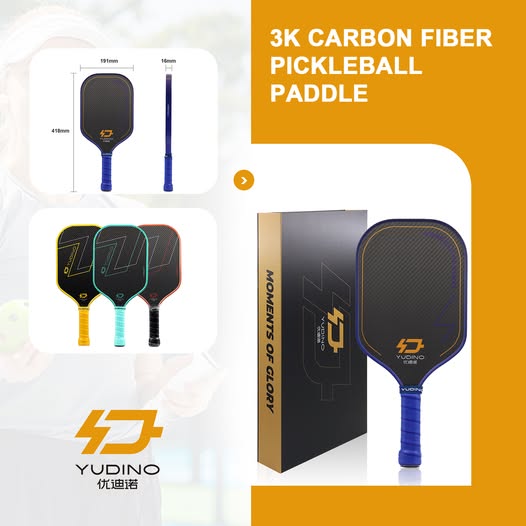
3K Carbon Fiber
3,000 filaments per tow
Finer, tighter weave pattern
Creates a more pronounced aesthetic texture — the classic "honeycomb" visual that many consumers associate with carbon fiber
Slightly softer surface feel, moderate spin generation
Ideal for training paddles, beginner-to-intermediate players, and price-sensitive retail channels
Strong visual appeal in consumer packaging
12K Carbon Fiber
12,000 filaments per tow
Coarser weave, thicker filament bundles
Higher surface density provides more grip on the ball at contact
Excellent balance of spin generation and power transfer
Suitable for intermediate-to-advanced players; strong positioning in tournament-level retail and club wholesale
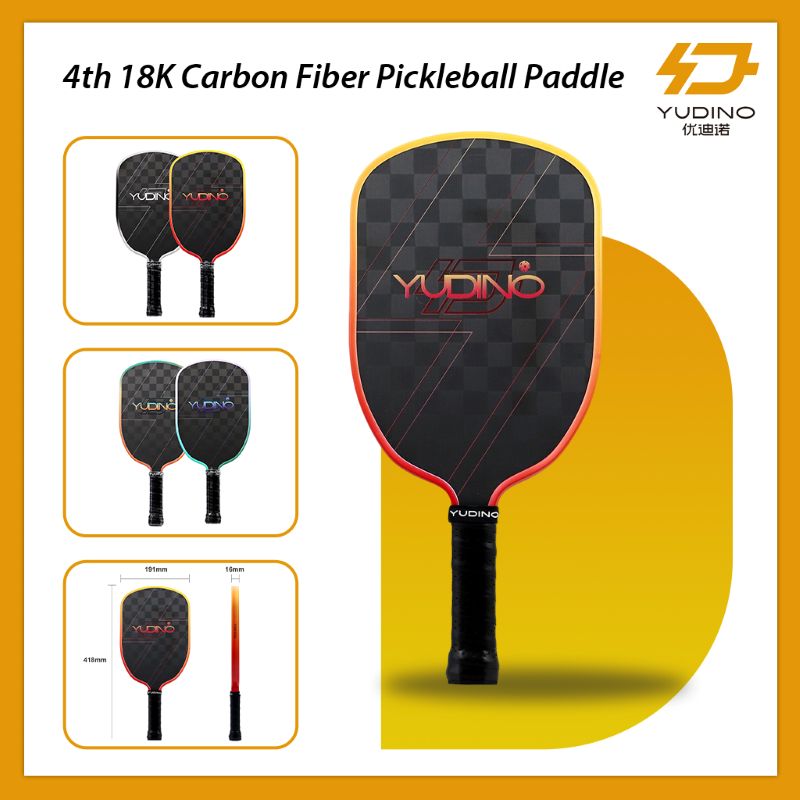
18K Carbon Fiber
18,000 filaments per tow
Maximum surface density of the standard carbon fiber grades
Produces a paddle face with very high friction coefficient — critical for spin-heavy playing styles
Combined with a PP honeycomb core, delivers superior stability across repeated high-impact contacts
Premium segment product; ideal for brand owners targeting competitive and professional players
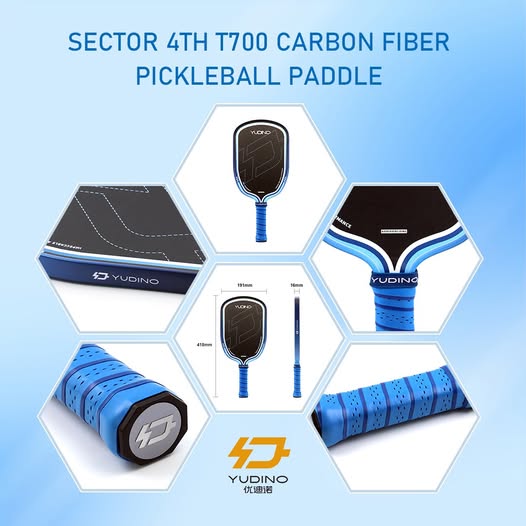
T700 Carbon Fiber
A grade designation rather than a weave count — T700 refers to the tensile modulus and strength rating of the raw fiber (Toray T700 standard)
Tensile strength: 4,900 MPa; tensile modulus: 230 GPa
T700 fiber is used in aerospace and high-performance sports equipment
When used in paddle faces, T700 provides exceptional stiffness-to-weight ratio, allowing manufacturers to build paddles that are both lightweight and high-performing
Positioned at the premium and ultra-premium end of the market
Titanium Carbon Fiber (Titanium Wire Carbon Fiber)
A proprietary hybrid construction in which titanium wire is integrated into the carbon fiber layup during the pressing process
Titanium adds tensile resilience — the face resists micro-deformation more effectively than pure carbon fiber under sustained rally conditions
Results in a paddle that maintains consistent ball feedback and spin generation over a much longer product lifespan
Critical differentiator in competitive play environments: the paddle performs the same in game 50 as it did in game one
This is the flagship material at YUDINO's production line, used in the Competition and Professional series paddles
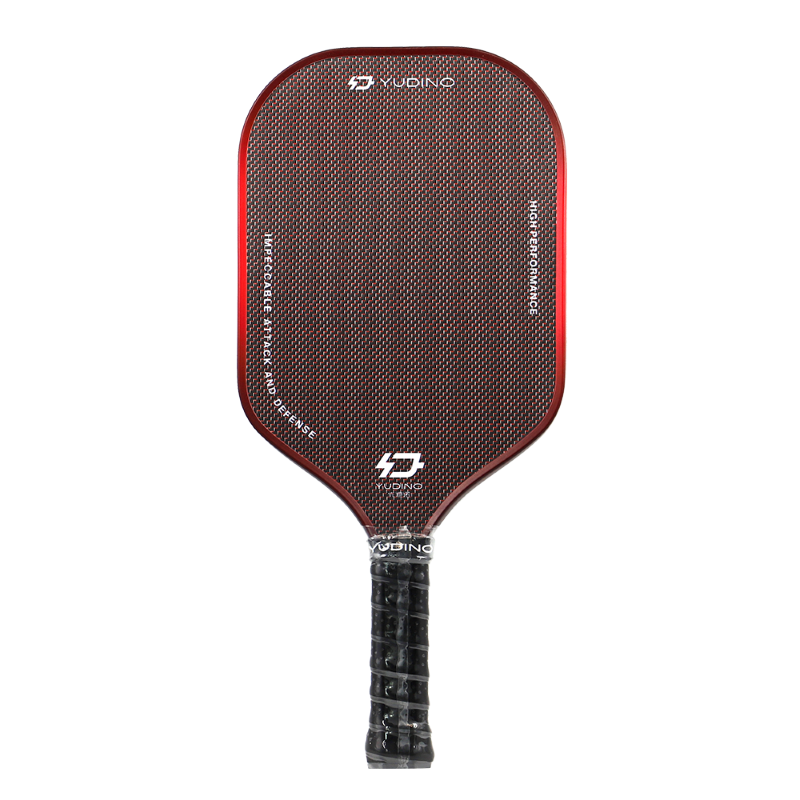
Core Structure: Why PP Honeycomb Is the Industry Standard
The polypropylene honeycomb core is the heart of modern carbon fiber paddle performance. Here's what the cell geometry does for players:
Energy return: Hexagonal cells compress and recover faster than solid foam, delivering a more responsive "pop" at contact
Vibration damping: Cell walls absorb and dissipate shock waves, reducing arm fatigue over long matches
Weight management: The hollow structure keeps overall paddle weight in the performance range of 220–245g without sacrificing structural integrity
Consistency: PP honeycomb is highly resistant to moisture and temperature variation, maintaining performance in outdoor and tournament environments
Core thickness is the specification buyers get wrong most often. Here's the practical breakdown:
| Core Thickness | Play Style Benefit | Market Segment |
|---|---|---|
| 13mm | More power, faster ball exit speed | Power players, beginners |
| 14mm | Balanced — moderate power and control | All-around players |
| 16mm | Maximum control, larger sweet spot, reduced vibration | Control players, kitchen specialists |
Why Carbon Fiber Paddles Win in the Market: The Competitive Advantages
For retail buyers and brand owners, understanding the competitive advantages of carbon fiber paddles is not just about product knowledge — it's about building a compelling market narrative that drives sell-through.
Performance Advantages That Sell Themselves
Superior Spin Generation
Carbon fiber's textured surface creates a friction coefficient that simply cannot be replicated by fiberglass or wood. When a player brushes the ball with a carbon fiber face, the surface "grabs" the ball for the microseconds of contact, applying rotational force more efficiently. For competitive players, this means more consistent topspin and slice execution. For brand owners, it means you can legitimately claim a technical performance advantage in your marketing.
In practice, players using 18K or Titanium Carbon Fiber paddles report spin RPM increases of 15–20% compared to fiberglass paddles under equivalent swing conditions. This is not marketing copy — it's a measurable outcome of the higher surface density.
Precision Ball Control
The stiffness of carbon fiber reduces flex at contact. Flex absorbs energy and introduces variability — every time the face flexes differently, the ball exits at a slightly different angle. Carbon fiber's rigidity transfers energy more directly and consistently from the swing to the ball, which is what serious players mean when they describe a paddle as having "precise feedback."
The combination of a carbon fiber face and a 16mm PP honeycomb core creates what is widely regarded as the optimal configuration for control-oriented play. The face provides stiffness and feedback; the core provides just enough cushion to create a consistent "dwell time" — the window in which the ball stays in contact with the paddle face during the shot.
Durability and Lifespan
Carbon fiber paddles substantially outlast fiberglass paddles in high-volume use environments — which matters enormously in club wholesale, rental programs, and professional training contexts. A carbon fiber face is resistant to surface abrasion, edge chipping, and the gradual delamination that afflicts lower-grade composite paddles.
For B2B buyers supplying clubs, academies, or rental programs, this translates into a lower total cost of ownership: higher unit price per paddle, but fewer replacement cycles and better end-user satisfaction.
Weight Optimization
Modern carbon fiber paddle construction enables manufacturers to hit precise weight targets that match specific player profiles. With titanium-carbon hybrid faces and PP honeycomb cores, a paddle can be engineered to land within 2–3 grams of a target weight consistently — a precision that matters in OEM relationships where your brand specification is non-negotiable.
The Premium Positioning Story
From a brand owner's perspective, carbon fiber paddles offer something that fiberglass paddles cannot: a technology story. Consumer markets respond to material technology narratives — "aerospace-grade fiber," "titanium-reinforced face," "18K high-density weave." These are not just technical terms; they are marketing assets.
The B2B implication is clear: carbon fiber paddles carry higher ASPs (average selling prices), command better margins at retail, and build brand equity in a way that commodity fiberglass products cannot. In a market that is maturing rapidly and segmenting by player level, the brands that win will be the ones that can articulate a credible technical differentiation — and that starts with the product specification you choose to source.
Pain Points Every B2B Buyer Faces When Sourcing Paddles
This section is important. Most sourcing guides skip the problems and jump straight to the pitch. We're not going to do that, because understanding the common failure modes in this category is what separates profitable sourcing decisions from costly ones.
Inconsistent Quality Across Production Batches
This is the most frequently cited complaint from importers who have worked with multiple Chinese manufacturers. The first sample impresses; the production batch reveals inconsistencies in weight (±15g variance instead of ±5g), surface texture variation, and edge guard adhesion failures.
What causes it: Manufacturers without automated pressing lines and weight-calibrated dispensing systems rely on manual processes that introduce variability. Surface texture on carbon fiber faces is especially sensitive to pressing temperature and pressure — small deviations produce tactile differences that players can feel immediately.
What to look for: Factories with automated hot-press systems, precision injection molds, and in-line weight verification checkpoints. Ask specifically about their batch-to-batch tolerance on weight and surface hardness.
USAPA Compliance Gaps
The United States of America Pickleball Association (USAPA) maintains specific equipment standards for paddle face roughness, overall dimensions, weight, and material composition. Paddles sold into the North American market that do not meet USAPA approval standards cannot be used in sanctioned tournament play — which limits their marketability to the casual recreational segment only.
Many manufacturers claim USAPA compliance without maintaining current certification. The standard is updated periodically, and paddles approved under a previous specification may no longer be compliant.
What to look for: Verified, current USAPA approval documentation. Ask for the specific paddle model approval number and cross-reference it with the USAPA approved equipment list.
OEM Customization Capability — Gap Between Claim and Reality
Almost every manufacturer claims "full OEM customization." The practical reality is more limited. Many factories can apply a custom graphic and change handle wrap color. Far fewer can reliably execute:
Custom carbon fiber face specifications (specific weave count or hybrid construction)
Non-standard shapes (elongated, round, or custom die geometries)
Specific weight targeting within ±3g tolerance at scale
Custom packaging for retail or e-commerce (clamshell, window box, set packaging)
Co-branding or white-label documentation for multiple markets simultaneously
What to look for: Request a full OEM capability statement, including minimum order quantities for customized versus standard production, lead times, and a sample of existing OEM work for reference clients.
Lead Time Reliability
Sporting goods import timelines are unforgiving. Seasonal demand peaks — particularly Q4 in North American and European markets — require supply chain precision. Manufacturers who promise 7-day lead times and deliver 21-day lead times destroy your inventory planning and cost you retail placement windows.
What to look for: Manufacturers with pre-built inventory buffers for standard SKUs and documented production scheduling for custom orders. Ask for reference contacts at current wholesale clients.
How to Evaluate a Carbon Fiber Pickleball Paddle Manufacturer: The Complete Selection Framework
With the pain points in focus, here is the structured evaluation framework that experienced importers use when assessing manufacturer partners in this category.
Manufacturing Infrastructure Assessment
A credible manufacturer of carbon fiber pickleball paddles should be operating with the following production capabilities at minimum:
Carbon fiber layup and pressing
Automated or semi-automated hot-press systems with temperature-controlled molds
Polymer material pressing and forming equipment (dedicated to paddle face production, not repurposed from other applications)
Precision injection molding for edge guards and grip components
Surface finishing and quality control
UV inkjet printing capability for graphic application
Edge burning and sealing equipment (critical for preventing delamination at the paddle perimeter)
Grinding and polishing lines for surface consistency
Testing infrastructure
In-house weight and balance verification (scale precision to 0.1g)
Surface abrasion testing equipment
Sweet-spot impact performance testing
Visual inspection stations for surface texture and graphic consistency
YUDINO's production facility in Dandong, Liaoning operates all of these systems within its 3,000㎡ manufacturing base. The factory's quality management practices are certified to ISO 9001, which provides a documented, auditable framework for production consistency — a critical assurance for B2B buyers who cannot be present for every production run.
Certification and Compliance Documentation
For buyers targeting North American markets, the following documentation is non-negotiable:
USAPA Approval: Current equipment approval for any paddle model destined for tournament-eligible markets
ISO 9001: Quality management system certification confirming documented production standards
Material safety documentation: Compliance with relevant import regulations for composite materials (especially relevant for EU buyers under REACH regulations)
For buyers targeting European markets, additional CE marking documentation may be required depending on product classification.
OEM and Customization Depth
The following customization dimensions define true OEM capability in this category:
Material selection
Face material: 3K, 12K, 18K carbon fiber, T700 carbon fiber, titanium-carbon hybrid, fiberglass, or hybrid constructions
Core material and thickness: 13mm, 14mm, or 16mm PP honeycomb configurations
Geometry and ergonomics
Paddle shape: Standard, square, round, elongated (Perseus-style), or fully custom die
Handle length, grip circumference, and flare geometry
Anti-slip grip material selection
Weight configuration
Lightweight category: under 220g
Mid-weight category: 230g ±5g
Heavy category: over 240g
Custom target weight with stated tolerance
Aesthetics and branding
Full custom graphics and color schemes
Matte or gloss surface finish
Custom logo placement and application method
Retail-ready packaging: single paddle, set configurations with balls and paddle bags, window boxes, hang tags
Packaging and compliance
Country-of-origin labeling
SKU and barcode integration
Multi-language documentation (critical for multi-market distribution)
Market Experience and Brand Reference Validation
Manufacturer credibility in the B2B market is partially established by the company's existing client roster and market presence. Relevant signals include:
Brand partnerships: Manufacturing relationships with established global brands validate the factory's ability to meet brand-owner quality and consistency standards. YUDINO has manufacturing partnerships with Franklin and JOOLA — brands with significant retail presence in North American and European markets.
Professional event supply: Supplying equipment to professional events (YUDINO has been a supplier to PPA Tour-related activities) demonstrates that the factory's products have passed the scrutiny of professional players and event standards.
Export market diversity: Factories exporting to North America, Europe, Southeast Asia, and Australia simultaneously are managing multi-regulatory compliance across multiple quality-sensitive markets — which is a strong quality indicator.
Technical Specification Guide: Matching Paddle Specs to Market Segments
One of the most valuable things a knowledgeable sourcing partner can do is help you map product specifications to target market segments. This section provides exactly that framework.
Recreational and Entry-Level Market
Target consumer: Casual players, new adopters, recreational clubs, physical education programs
Recommended specification:
Face material: 3K carbon fiber or fiberglass
Core thickness: 13mm or 14mm
Weight: Mid-weight (230g±5g)
Shape: Standard
Surface finish: Gloss (visually appealing, cost-efficient)
USAPA compliance: Optional (recreational use)
B2B positioning note: This segment prioritizes visual appeal, value, and ease of use over technical performance. The 3K carbon fiber paddle is ideal here because it delivers the "carbon fiber" premium aesthetic story at a price point accessible to mass retail channels.
Intermediate and Club Market
Target consumer: Regular players, club members, intermediate competitive players
Recommended specification:
Face material: 12K carbon fiber or 18K carbon fiber
Core thickness: 14mm or 16mm
Weight: Mid-weight to heavy (230–245g)
Shape: Standard or square
USAPA compliance: Required for club use in sanctioned environments
B2B positioning note: This is the highest-volume segment in established pickleball markets. Club wholesale buyers prioritize durability, performance consistency, and USAPA compliance. The 12K and 18K paddle lines are the core revenue drivers for most distributors in this segment.
Competitive and Professional Market
Target consumer: Tournament players, professional coaches, performance-oriented players
Recommended specification:
Face material: 18K carbon fiber or Titanium Carbon Fiber (titanium-wire hybrid)
Core thickness: 16mm
Weight: Precise to target (lightweight for agility-focused players; mid-weight for balanced performance)
Shape: Elongated (Perseus-style) or custom
USAPA compliance: Mandatory
Surface texture: Specifically engineered for spin performance
B2B positioning note: This segment drives brand equity and margin even at lower volume. The titanium carbon fiber paddle — combining titanium wire reinforcement with high-density carbon fiber face and 16mm PP honeycomb core — is the benchmark product for this category. Its performance stability over hundreds of hours of play is the defining selling proposition for serious players and brand owners targeting the competitive segment.
Common Sourcing Mistakes That Cost B2B Buyers Money
This is the section that experienced importers wish someone had shared with them before their first order.
Mistake #1 — Selecting Supplier Based on Sample Performance Alone
First samples are often made by hand or from prototype tooling. They look and perform excellently. Production tooling and processes are different. Always request a pre-production sample run (50–100 units) from the actual production line before committing to a large order. The investment in pre-production validation pays for itself many times over in avoided returns and re-orders.
Mistake #2 — Ignoring Core Thickness in the Brief
Most buyers specify face material carefully and ignore core thickness. This is a significant error. A 13mm core and a 16mm core made with the same face material produce dramatically different on-court experiences. Buyers who don't specify core thickness in their purchase order often receive whatever the factory has in stock — which may not match the performance profile your end customers expect.
Always include core thickness as an explicit line item in your product specification document.
Mistake #3 — Underestimating USAPA Compliance Lead Time
USAPA approval is not instantaneous. If you are launching a new OEM paddle model that requires USAPA approval, build the approval timeline (which can take 4–6 weeks depending on the cycle) into your go-to-market plan. Factories that have existing USAPA-approved models in a range of specifications can sometimes provide a faster path by working within existing approved parameters — understanding this option requires knowing the manufacturer's current approval portfolio.
Mistake #4 — Confusing "Carbon Fiber" with Consistent Quality
Not all carbon fiber is equal. The raw fiber source, resin system, pressing temperature, and curing time all determine the final mechanical properties of a carbon fiber paddle face. A paddle listed as "18K carbon fiber" from a low-cost supplier may use inferior resin or an uncalibrated pressing process that produces a face which technically qualifies as 18K weave but performs below the standard. Always request material test documentation and physical samples for evaluation alongside any price negotiation.
Mistake #5 — Skipping Factory Audits for Long-Term Partners
For B2B buyers committing to ongoing volume relationships, factory audits are not optional. An on-site audit or a third-party audit commissioned through a quality assurance firm will reveal production capabilities, workforce quality, quality control procedures, and material sourcing practices that no catalog or product sample can communicate. Manufacturers with ISO 9001 certification have documented production processes that make audit reviews more efficient and transparent.
FAQ
Good sourcing decisions are built on good questions. Here are the most common questions that B2B buyers ask during the evaluation and procurement process, with direct answers.
Is carbon fiber better than fiberglass for a pickleball paddle?
For performance-oriented segments, yes — carbon fiber paddles deliver meaningfully superior spin generation, ball control precision, and long-term surface consistency compared to fiberglass. Carbon fiber's higher stiffness produces more direct energy transfer and more consistent ball feedback, while its textured surface creates higher friction for spin production. Fiberglass remains a viable and cost-effective option for entry-level and budget-conscious consumer segments. For B2B buyers, the question is market positioning: carbon fiber commands a premium ASP, higher margin, and a more compelling technology narrative at retail.
What weave should I choose — 3K, 12K, or 18K?
Match the weave to your target consumer:
3K: Recreational, entry-level, visually premium, moderate performance
12K: Intermediate, competitive club, high performance-to-value ratio
18K: Advanced, competitive, maximum spin and feedback performance
For most brand owners building a tiered product line, offering a 3K model at accessible price points and an 18K or Titanium Carbon Fiber flagship model provides the best portfolio coverage.
What does USAPA approval mean and do I need it?
USAPA (United States of America Pickleball Association) approval certifies that a paddle model meets the official equipment standards for sanctioned tournament play. If you are selling into:
Recreational retail channels only → USAPA approval is optional but beneficial for credibility
Club wholesale, pro shops, or tournament channels → USAPA approval is effectively mandatory for marketability
All YUDINO carbon fiber paddle models are USAPA approved, providing immediate clearance for North American competitive and professional markets.
Yes. YUDINO supports full OEM and ODM customization including:
Custom graphics, colors, and logo application
Face material selection (3K to Titanium Carbon Fiber)
Core thickness specification (13mm, 14mm, 16mm)
Shape selection (standard, square, elongated, custom die)
Weight targeting (lightweight to heavy)
Handle configuration (length, grip material, flare)
Retail-ready packaging (single paddle, sets with balls and bags, window box, e-commerce packaging)
Minimum order quantities vary by customization scope. Standard in-stock configurations have lower MOQs and 3-day lead times. Contact our sales team for a customization brief.
What is the minimum order quantity for carbon fiber paddles?
MOQ varies by product configuration and customization level:
Standard in-stock models: Small trial orders accepted — contact for current MOQ
Custom OEM orders (unique graphics, specifications): MOQ depends on production line requirements; our team works with you to find the minimum viable order size for your go-to-market timeline
Annual supply capacity: 50,000 units per year across all paddle categories
We actively support brand owners who are launching new product lines and understand that early-stage orders require flexibility. Reach out to discuss your specific volume and timeline requirements.
Why Manufacturing Matters: Inside the YUDINO Production Process
Understanding how a paddle is made is directly relevant to what it costs, how consistently it performs, and whether your supplier can scale with your business.
From Raw Material to Finished Paddle — The Production Journey
Step 1: Carbon Fiber Sheet Preparation
Raw carbon fiber fabric (3K, 12K, 18K, or T700 grade) is cut to paddle face dimensions using automated CNC cutting machines. Precision cutting ensures consistent fiber orientation and eliminates the edge variability that manual cutting introduces.
Step 2: Hot Press Forming
Carbon fiber sheets are layered with resin and pressed in temperature-controlled molds at precisely calibrated pressure and temperature profiles. The hot press process cures the resin and bonds the fiber layers into a unified, rigid composite face. For Titanium Carbon Fiber paddles, titanium wire is incorporated into the layup at this stage.
Step 3: PP Honeycomb Core Assembly
The cured carbon fiber face is bonded to the PP honeycomb core using high-performance adhesive applied by automated dispensing equipment. This stage is critical: inconsistent adhesive application is the leading cause of delamination failures. Automated dispensing (vs. manual application) ensures uniform bond quality across every unit.
Step 4: Edge Guard Molding and Installation
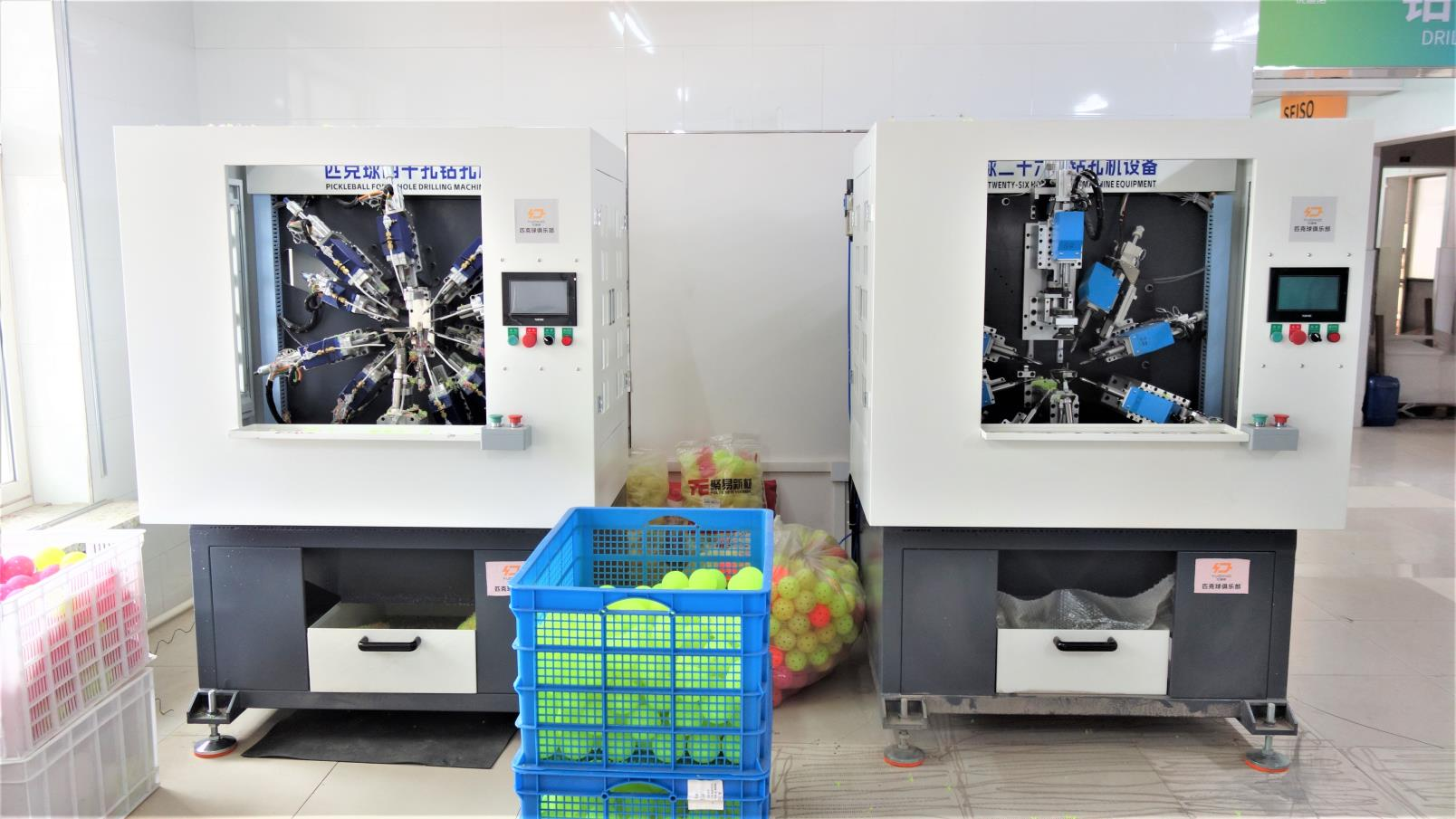
Edge guards are produced using precision injection molding equipment and installed with high-temperature adhesion processes. The edge burning machine seals the perimeter to prevent moisture ingress and improve impact resistance at the paddle edge.
Step 5: Surface Finishing
The paddle face is ground and polished to achieve the target surface texture. For carbon fiber paddles, surface texture is a performance-critical specification — it directly determines the friction coefficient and spin generation capability of the finished paddle.
Step 6: Graphic Application
Custom graphics and brand markings are applied using UV inkjet printing systems that produce color-accurate, durable surface graphics resistant to court abrasion.
Step 7: Quality Control and Testing
Each finished paddle is verified against the following parameters before leaving the production line:
Weight verification (target ±5g)
Balance point measurement
Sweet-spot performance evaluation
Surface texture and graphic inspection
Edge guard adhesion check
Overall dimensional verification
Paddles that fall outside specification tolerances are pulled from the production batch and logged. This process, documented under ISO 9001 procedures, provides buyers with auditable quality records for each production run.
Sustainability in Production
Modern B2B buyers — particularly those supplying European and North American markets — face increasing scrutiny from retail partners and end consumers on environmental practices. YUDINO's manufacturing operations incorporate:
Clean energy utilization in the production facility
Certified sustainable raw material sourcing
Wastewater recycling and treatment systems
These practices align with national environmental standards and are increasingly relevant to European buyers operating under EU supply chain due diligence requirements.
Market Intelligence: What's Driving Demand for Carbon Fiber Paddles in 2025–2026
Understanding the macro demand environment helps B2B buyers make better inventory and portfolio decisions.
The Professionalization of Pickleball
Pickleball has undergone a fundamental demographic shift. What began as a retirement-community recreational activity is now one of the fastest-growing competitive sports in the United States and increasingly globally. The PPA Tour (Professional Pickleball Association), APP Tour, and MLP (Major League Pickleball) have created a professional ecosystem that drives equipment aspirationalism down through recreational and club player segments — the same dynamic that made tennis racket technology accessible to mainstream consumers.
This professionalization effect directly benefits the carbon fiber paddle category. When professional players use titanium carbon fiber paddles on broadcast courts, it creates aspirational demand that flows through to club players, serious recreational players, and beginners who want to "train like the pros." Brand owners who have their products visible in professional play environments enjoy a demand tailwind that has real sell-through impact.
The B2B Segment Breakdown
Understanding where the volume is helps buyers prioritize their product mix:
Specialty Retailers and Pro Shops: High ASP, low volume per door, strong brand equity requirements. Carbon fiber paddle lines with USAPA approval and professional player associations perform best in this channel.
Club and Academy Wholesale: Medium volume, performance and durability priority, often requires USAPA compliance. 12K and 18K paddle lines are the workhorses of this channel. Branded programs (custom club paddle with club logo) are a growing trend.
E-Commerce (Amazon, DTC): High volume potential, strong price competition, differentiated positioning requires clear technology storytelling in product listings. 18K and Titanium Carbon Fiber lines perform well at premium price points with strong review velocity.
International Distribution: Southeast Asian markets (Philippines, Thailand, Vietnam, Malaysia) are in early growth phases and represent significant volume opportunity. European markets (UK, Germany, Netherlands) have established recreational communities with growing competitive interest.
How to Start Your Carbon Fiber Paddle Sourcing Process
For buyers ready to take the next step, here is a practical process map:
Step 1 — Define Your Product Brief
Before contacting any manufacturer, document your requirements:
Target consumer segment (recreational, intermediate, competitive)
Required face material (3K, 12K, 18K, titanium carbon fiber)
Core thickness preference
Weight target and tolerance
Shape and geometry requirements
Branding and customization requirements
USAPA compliance requirement (yes/no)
Target retail price point and required FOB cost structure
Order volume and delivery timeline
A well-prepared product brief saves multiple weeks of back-and-forth and ensures that the factory quotes you accurately on the first pass.
Step 2 — Request Samples for Evaluation
Request samples of the specific models that best match your brief. Evaluate samples across the following dimensions:
On-court performance (spin generation, control feedback, power response)
Weight consistency (weigh every sample — variance tells you about production control)
Surface texture uniformity
Edge guard adhesion quality
Graphic application quality
Do not skip this step, even for standard catalog models.
Step 3 — Negotiate Terms and Confirm Documentation
Before placing any order, confirm:
USAPA approval documentation (model-specific)
ISO 9001 certification (current)
Material safety documentation as required for your market
Production timeline and delivery schedule
Payment terms and incoterms
Quality claim procedures and replacement policy
Step 4 — Pre-Production Validation
For custom or OEM orders, always request pre-production samples from the production line (not prototype tooling) before authorizing full production. This step catches the most common production variances before they become a full-batch problem.
Conclusion: Your Carbon Fiber Paddle Sourcing Strategy Starts with the Right Foundation
The carbon fiber pickleball paddle market is growing fast, but it is also maturing rapidly. The buyers who will win — the importers who build profitable long-term businesses in this category — are the ones who understand the material science deeply enough to specify correctly, who know what to look for in a manufacturing partner, and who match their product portfolio to the segments where the demand is strongest.
The difference between an 18K paddle and a 3K paddle is not just a price point. It is a technology story, a consumer positioning decision, and a reflection of the manufacturing precision behind the product. The difference between a USAPA-compliant paddle from an ISO 9001 factory and a sample-only quality product is the difference between a sustainable B2B business and a costly sourcing mistake.
At YUDINO, we manufacture carbon fiber pickleball paddles for brand owners, importers, and wholesale buyers who demand precision, compliance, and consistency at scale. With a 3,000㎡ production facility in Dandong, Liaoning, ISO 9001 certification, USAPA-approved paddle lines, and established OEM relationships with brands including Franklin and JOOLA, we have built the infrastructure to be a reliable long-term manufacturing partner.
Whether you are launching a new pickleball brand, expanding an existing sporting goods portfolio, or fulfilling growing demand from club and retail channels, we are ready to work with you. Contact our team to discuss your product brief, request samples, or explore customization options.
Product FAQ
Q1: What materials are available for YUDINO carbon fiber pickleball paddles?
We offer a full range of face materials: 3K carbon fiber (entry to intermediate), 12K carbon fiber (intermediate to advanced), 18K carbon fiber (advanced to professional), T700 carbon fiber (lightweight high-performance), Titanium Carbon Fiber / titanium wire hybrid (flagship professional grade), and fiberglass (entry-level value option). All models can be paired with PP honeycomb cores in 13mm, 14mm, or 16mm configurations.
Q2: Are your paddles USAPA approved?
Yes. All YUDINO carbon fiber paddle models are USAPA approved, making them compliant for use in sanctioned tournament play in the United States and eligible for sale in professional and competitive retail channels in North America.
Q3: What is the minimum order quantity for OEM or private-label paddles?
MOQ varies depending on customization scope. Standard in-stock models can be ordered in small trial quantities. Custom OEM orders (unique graphics, specifications, packaging) have production-dependent MOQs. Please contact our sales team with your product brief for a specific MOQ and lead time quotation.
Q4: How long does delivery take?
Standard in-stock paddle models ship within 3 business days. Custom OEM orders are scheduled based on production capacity — typical lead times for fully customized orders range from 2–4 weeks depending on complexity and current production scheduling. For large volume orders, we recommend discussing forecast planning to ensure stable lead times.
Q5: Can you produce paddles to a specific weight target?
Yes. We offer weight category targeting (lightweight <220g, mid-weight 230g±5g, heavy >240g) and for OEM customers with specific weight requirements, we can target custom weights within manufacturing tolerance. Our automated dispensing and in-line weight verification processes maintain tighter weight consistency than manual production methods.
YUDINO (Liaoning) Sports Goods Co., Ltd. is a professional manufacturer of carbon fiber pickleball paddles with ISO 9001 certification, USAPA approval, and OEM manufacturing partnerships with leading global sports brands. Contact us to discuss your sourcing requirements.