Is a Carbon Fiber Pickleball Paddle USAPA Legal?
Introduction
You've invested in a carbon fiber paddle. You've spent weeks dialing in your spin game, developing your third-shot drop, and building confidence with a piece of equipment that genuinely feels like an upgrade. Then the day before a sanctioned tournament, someone raises the question you suddenly realize you've never seriously investigated: Is your paddle actually legal to play with?
It's not a paranoid question. It's a consequential one. Show up to a USAPA-sanctioned event with a non-approved paddle, and you cannot compete. Attempt to play through and get flagged by a referee, and you face a game loss or disqualification. Order a bulk supply of paddles for your club, retail operation, or coaching program from a manufacturer whose equipment hasn't been properly certified, and you've potentially locked your entire customer base out of competitive play.
The carbon fiber paddle category is where this confusion is most acute. Carbon fiber is the dominant face material in competitive pickleball—and it's also the material category that has triggered the most USAPA enforcement actions, guideline revisions, and player complaints over the past three years. The reasons are rooted in physics: carbon fiber's exceptional spin-generation capability means that poorly regulated carbon fiber surfaces can push past the limits of what the governing body considers fair play.
This guide answers every dimension of the legality question. We cover what USAPA approval actually means, how the testing process works, what specifically gets a carbon fiber pickleball paddle rejected, how to verify certification status before buying, and what the community's ongoing debates about these rules actually reveal about the future of paddle regulation.
Whether you're an individual player, a tournament director, a coach managing equipment, or a wholesale buyer sourcing paddles for resale, this is the definitive resource you need.
What "USAPA Legal" Actually Means — And Why It's More Complex Than You Think
"USAPA legal" is a term that players use colloquially to mean "approved for competitive tournament play under USA Pickleball rules." But understanding what that approval actually involves requires unpacking a system that has evolved significantly and continues to evolve.
USA Pickleball (formerly the United States of America Pickleball Association — USAPA) is the national governing body for the sport in the United States. It maintains the official rulebook, organizes sanctioned competitive play, and operates the Approved Paddle List — the official registry of equipment that has been tested and approved for use in sanctioned tournaments.
The Approved Paddle List: What It Is and What It Covers
The USA Pickleball Approved Paddle List is a publicly accessible database of paddle models that have passed USA Pickleball's evaluation criteria. Being on this list means the manufacturer submitted the paddle for evaluation, it passed all required tests, and USA Pickleball has formally approved it for tournament use.
Being absent from the list is definitive: paddles not on the approved list cannot be used in sanctioned tournament play, regardless of how they feel or perform. There is no grey area here from a competition standpoint.
The list is regularly updated — new models are added as they're approved, and models can be removed if they're found non-compliant upon re-evaluation or if manufacturer specifications change without resubmission.
The Testing Parameters
USA Pickleball evaluates paddles across multiple dimensions:
Dimensions: Total paddle length cannot exceed 24 inches. Total length plus width cannot exceed 24 inches. No minimum length is specified. The playing surface (face) must be at least 17 inches long.
Weight: No maximum weight is specified in the current rulebook, though paddle manufacturers typically target under 9.5 oz to remain practical for players.
Deflection/Stiffness: This test measures how much the paddle face deflects under a standardized load. Too much deflection (too soft) or too little (too stiff) can produce performance characteristics outside acceptable parameters.
Surface roughness: This is the test that matters most for carbon fiber paddles, and it's where the most regulation action has occurred. Surface roughness (Ra value) must not exceed a maximum specification. USA Pickleball uses profilometry — a precision measurement of surface micro-texture — to evaluate this.
No reflective surfaces: Paddle surfaces that create a glare or reflection that could distract opponents or obstruct vision are not permitted.
No features that enhance spin beyond approved parameters: This is the rule that has driven the most controversy and enforcement activity.
The Carbon Fiber Spin Problem: Why This Material Attracted Regulatory Scrutiny
To understand why carbon fiber paddles have faced the most regulatory scrutiny of any face material, you need to understand what makes them so effective at generating spin — and why that effectiveness eventually attracted governing body attention.
How Carbon Fiber Generates Spin
A carbon fiber pickleball paddle face generates spin through a mechanism rooted in surface texture. The woven carbon fiber surface — particularly in higher-K count constructions like 12K and 18K — creates a topography of microscopic ridges and valleys. When the paddle face contacts the ball during a stroke, these ridges engage the ball's polymer surface, creating friction that translates the player's stroke mechanics into ball rotation.
The higher the K-count, the more open and aggressive the weave pattern, and the more surface topography is available for ball engagement:
3K carbon fiber: 3,000 filaments per tow, tight weave, relatively smooth surface compared to higher-K counts
12K carbon fiber: 12,000 filaments per tow, visibly textured surface, strong spin generation
18K carbon fiber: 18,000 filaments per tow, aggressive open weave, maximum spin generation in the carbon fiber family
Titanium carbon fiber: Titanium-integrated matrix that preserves and enhances natural carbon fiber texture while adding structural resilience
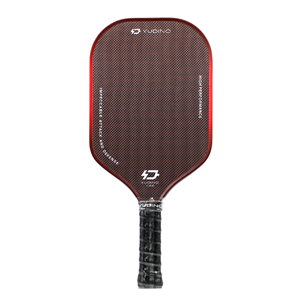
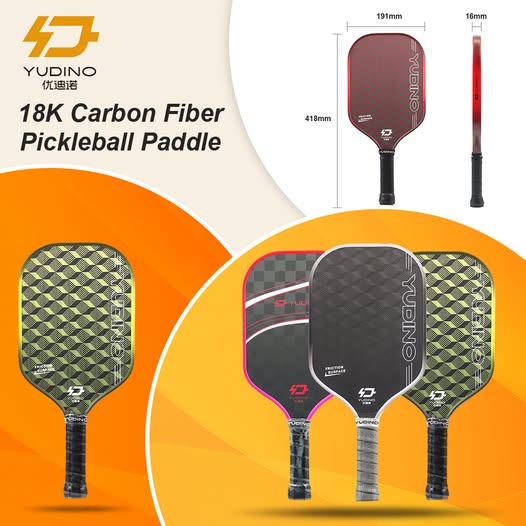
Yudino's 18K Power Pro, for example, combines an 18K carbon fiber face with a PP honeycomb core and 16mm interior thickness — a configuration specifically engineered to maximize spin without sacrificing stability.
The Raw Texture Controversy
In 2023, USA Pickleball introduced a new evaluation category: "raw carbon fiber" surfaces. The concern was that certain manufacturers were producing carbon fiber paddle faces with surface roughness values that exceeded what USA Pickleball considered appropriate for fair competitive play — generating spin levels that gave players using those paddles an outsized advantage over opponents using any other face material.
USA Pickleball began requiring that carbon fiber paddles pass a specific surface roughness measurement (Ra value) and introduced a new "Meets Surface Roughness Guidelines" marking on the approved paddle list to indicate paddles that specifically passed the revised friction evaluation.
This triggered significant community debate. Players who had invested in high-performance raw carbon fiber paddles found that some models were removed from or rejected for the approved list. Manufacturers had to evaluate and in many cases modify paddle designs to achieve approval under the updated standards.
The regulatory intent was clear: ensure that spin generation capability remains within a range where player skill, not paddle surface engineering, is the primary determinant of competitive outcomes.
What Gets a Carbon Fiber Paddle Rejected: The Specific Failure Points
Understanding the precise failure modes for carbon fiber paddle certification helps buyers make informed decisions.
Excessive Surface Roughness (Ra Value)
This is the most common reason carbon fiber paddles fail USAPA evaluation. Surface roughness is measured as Ra — the arithmetic mean of the absolute deviations of surface profile from the mean line, typically expressed in micrometers.
USA Pickleball specifies maximum Ra values for paddle face surfaces. A carbon fiber surface whose texture exceeds this threshold produces friction levels considered beyond fair-play parameters. In practical terms: a surface that is too rough generates too much spin.
The challenge for manufacturers is that the same surface properties that make a paddle feel exceptional on court — the tactile grab that players love on a quality 18K or titanium carbon fiber face — are the exact properties being measured and capped by profilometry evaluation. Engineering a carbon fiber face that stays within USAPA Ra limits while maximizing spin within those limits is the current technical frontier in paddle design.
Delamination or Structural Inconsistency
During evaluation, paddles are examined for any delamination — areas where the face material has separated from the underlying core. Delaminated paddles fail for safety and performance consistency reasons.
Quality thermoformed construction, like that used in Yudino's 12K tournament series, significantly reduces delamination risk. Thermoforming applies heat and pressure during manufacturing that fuses the face, core layers, and structural elements into a cohesive unit — producing a denser, more structurally consistent paddle that maintains compliance standards over time.
Dimension Non-Compliance
Paddles that exceed dimension specifications or misrepresent face dimensions in submitted documentation fail evaluation. This is less common but occasionally surfaces with elongated handle designs or unusually shaped paddle heads.
Prohibited Surface Treatments
Applying textured sprays, grip-enhancing compounds, or any after-market substance to the paddle face — even if the paddle itself was originally approved — constitutes a rules violation. A critical distinction: the approval attaches to the paddle as manufactured and submitted. Any post-purchase modification that alters the surface beyond normal cleaning voids the paddle's compliance status for competition purposes.
Reflective or Distracting Surface Finishes
Some high-gloss carbon fiber finishes can produce reflections under court lighting. While rare, this can trigger non-approval. Most reputable manufacturers address this with surface matte treatments during manufacturing.
How to Verify USAPA Certification: A Step-by-Step Process
This is practical information that every competitive player, coach, and equipment buyer needs.
Step 1: Access the Official USA Pickleball Approved Paddle List
The official list is maintained at usapickleball.org. Navigate to the Equipment section and access the Approved Paddle List. This is the only authoritative source — third-party sites, retailer claims, and manufacturer marketing materials are not substitutes.
Step 2: Search by Manufacturer and Model Name
The list is searchable by manufacturer name, paddle model name, and material specifications. Search for the exact model name as it appears on the paddle or in the manufacturer's specification sheets. Slight name variations can cause search misses — if your initial search returns no results, try partial name matching or search by manufacturer name alone to see all listed models from that brand.
Step 3: Check the Surface Roughness Compliance Marking
Since USA Pickleball introduced the enhanced surface roughness evaluation, approved paddles are marked to indicate whether they meet the updated surface roughness guidelines. When evaluating a carbon fiber pickleball paddle for tournament use, confirm this marking is present — not just that the paddle appears on the list.
Step 4: Confirm the Specific Model and Variant
Certification attaches to specific paddle models, including specific weight variants, color variants, and edition releases. A manufacturer's certification for one model does not automatically extend to a newer version of that model. When in doubt, verify the specific paddle in hand against the list.
Step 5: Check the Approval Date and Status
Some paddles are conditionally approved, on temporary approval, or have had their approval status changed. The list includes approval dates and status indicators. Confirm that the paddle's approval is current and in good standing.
Certified vs. Uncertified: The Real-World Differences
Beyond tournament eligibility, the certification question has practical implications across several contexts that players and buyers often underappreciate.
For Club and Recreational Play
In recreational and club play outside sanctioned tournaments, paddle certification is not mandatory. Players can use any paddle they choose, certified or not. However:
Players who aspire to competitive play should develop their game with equipment that matches tournament legal specifications — switching to a compliant paddle after months of practice with a non-compliant one creates unnecessary adjustment periods.
Certified paddles are certified because they've been tested and found to meet objective performance standards. The certification process, whatever its limitations, provides more information about what you're buying than uncertified equipment without transparent specifications.
For Competitive Players
For players who compete in any USA Pickleball sanctioned event — from local club tournaments to regional open events to national championships — only approved paddles are permitted. Tournament officials have the authority to inspect paddles and require players to use approved alternatives if a non-compliant paddle is discovered.
In high-level competition, this rule is enforced rigorously. The 2024 enforcement of surface roughness standards at major tournaments resulted in visible equipment changes across multiple professional and advanced amateur players.
For Coaches and Program Directors
Coaches who supply paddles for programs, lessons, and camps have a responsibility to their students that includes equipment compliance. If a student is developing their game on equipment that won't be legal when they enter their first tournament, the transition creates unnecessary friction. Quality programs stock certified equipment.
For Wholesale Buyers and Resellers
For businesses sourcing carbon fiber pickleball paddles for retail, distribution, or club supply, certification status is a commercial necessity. Customers who discover after purchase that paddles are not approved for the events they want to play will seek returns and replacements, and may choose different suppliers for future purchases. Supplier credibility depends on certification transparency.
Working with manufacturers who hold verifiable USA Pickleball certification — like Yudino's competition-grade paddle lines, which carry multiple USA Pickleball approvals including friction parameter certifications — ensures that inventory is sellable across the full competitive market.
Community Perspectives: What Reddit and Quora Reveal About Real Player Experiences
The regulatory questions around carbon fiber paddle legality generate consistent and illuminating discussion in pickleball communities.
A frequently upvoted Reddit post in r/Pickleball framed the frustration many players feel: "I bought a paddle based on a YouTube review that called it 'tournament-ready carbon fiber.' Showed up to my first sanctioned tournament and was told it wasn't on the approved list. The seller never mentioned certification status. Complete waste of $140."
Responses to that post crystallized community knowledge about the verification process: "The only list that matters is the USA Pickleball official site. Any retailer or manufacturer claiming their paddle is 'tournament legal' without a specific reference to the approved paddle list is either uninformed or being misleading."
On Quora, a certified pickleball instructor and equipment reviewer explained the surface roughness issue in practical terms that resonated with players: "The 2023 raw carbon fiber rules caused a lot of confusion because many paddles that were approved before the rule change were still being sold and marketed as tournament legal — but they weren't anymore. Players who bought those paddles during the transition period were caught in the middle through no fault of their own."
The same contributor noted the manufacturer distinction: "The brands that survived the transition well were the ones who had already been engineering their surfaces within sustainable parameters rather than maximizing surface roughness to the absolute edge of what was previously acceptable. Those brands had less to adjust."
Another Reddit discussion highlighted the coaching perspective: "As a coach, I only demo and recommend paddles that are currently approved. Not from two years ago — now. The list changes. Your due diligence has to be ongoing, not a one-time check."
A Quora thread specifically about carbon fiber legality surfaced an insight about thermoforming and compliance: "Thermoformed paddles tend to have more consistent surface properties because the manufacturing process is more controlled. Random variation in surface roughness is lower, which means they tend to perform more consistently in profilometry testing and maintain compliance over time rather than drifting."
Common Mistakes Players and Buyers Make Around Paddle Certification
After analyzing community discussions and buyer experiences, these are the most consistently occurring mistakes around carbon fiber pickleball paddle certification.
Mistake #1: Assuming Any Carbon Fiber Paddle Is Automatically Legal
"Carbon fiber" is a face material, not a certification status. The material can be made into paddles that pass USAPA standards and paddles that don't. The surface roughness, construction method, and dimensional specifications all determine whether a specific carbon fiber paddle achieves certification. Never assume — verify.
Mistake #2: Relying on Retailer or Marketplace Claims
Third-party retailers, Amazon listings, and general sports equipment marketplaces frequently carry paddles with marketing language like "tournament-grade," "competition-ready," or "professional quality" that has no formal relationship to USAPA approval status. These phrases are marketing language. Cross-reference against the official USA Pickleball Approved Paddle List regardless of what the listing says.
Mistake #3: Checking Certification Once and Not Again
The Approved Paddle List is a living document. Paddles are added, removed, and updated. A paddle that was certified twelve months ago may have had its status changed — either because a manufacturer resubmitted a modified version (creating a separate listing) or because the paddle was found non-compliant on re-evaluation. Check certification status periodically, not just at initial purchase.
Mistake #4: Assuming OEM or Custom-Branded Paddles Inherit Certification
Some paddle manufacturers offer OEM (original equipment manufacturer) production — creating paddles built to a client's specifications under the client's brand. The original manufacturer's certification does NOT automatically transfer to OEM versions. A paddle made on the same production line as a certified model, but sold under a different brand name, requires independent certification submission and approval for that brand name and model designation.
This is a critical point for buyers sourcing OEM carbon fiber paddles for private label or retail distribution. Insist on certification documentation that specifically names the paddle model as it will be sold, not the underlying production model.
Mistake #5: Thinking Certification Is Permanent
USA Pickleball can and does remove paddles from the approved list. Reasons include: subsequent testing revealing non-compliance, manufacturer changes to paddle specifications without resubmission, or evolving standards that existing approved models no longer meet. Long-term compliance requires manufacturers to stay actively engaged with the certification process.
Mistake #6: Applying Surface Treatments to Approved Paddles
Players who apply any product to the paddle face — even cleaning products that leave residue, waxes, or "paddle restorers" marketed to pickleball players — risk altering the surface properties that were certified. Some of these products are marketed specifically to enhance grip and spin on worn carbon fiber faces. Using them on tournament paddles is a rules violation, regardless of what the product's marketing claims.
The rule is clear: clean your paddle to remove contamination, but add nothing to the surface.
Mistake #7: Confusing General Approval with the Roughness Compliance Mark
Since the introduction of enhanced surface roughness evaluation, there are paddles on the approved list that meet original standards but predate the surface roughness evaluation. These paddles appear on the list but may not carry the updated roughness compliance mark. For current tournament play at most competitive levels, the roughness mark matters. Know which version of compliance you're looking at.
What Certified Manufacturers Do Differently: The Production Discipline Behind Compliance
Understanding why some manufacturers consistently produce certified paddles while others struggle illuminates what buyers should look for when evaluating suppliers.
Controlled Surface Engineering from Day One
Manufacturers who reliably achieve USAPA certification engineer their paddle faces with compliance parameters in mind from the initial design phase. They don't create the most extreme surface texture possible and then try to walk it back — they design to a target performance profile within compliance parameters.
Yudino's approach exemplifies this philosophy. Their product lines are differentiated by weave density and construction method:
3K paddles: Tight, consistent weave with controlled surface roughness suited to control-oriented play
12K thermoformed paddles: Aggressive texture achieved through thermoforming, which produces consistent surface properties across the face — minimizing the random variation in Ra values that can push surface areas over certification thresholds
18K paddles: Maximum spin-generation surface engineering that targets compliance-compatible performance rather than raw maximum friction
Titanium carbon fiber paddles: Premium surface engineering that integrates structural enhancement without compromising surface compliance
Each product tier is designed to deliver maximum performance within its applicable standards — not to push past them.
Consistent Manufacturing Processes
Certification attaches to a specific paddle model as tested. If manufacturing processes vary significantly from batch to batch, the paddle you sell today may not have the same surface properties as the paddle that passed evaluation. Certified manufacturers maintain tight process control to ensure production consistency.
Thermoformed construction is one method that supports this consistency. The heat-and-pressure process of thermoforming produces surfaces with lower batch-to-batch variation than hand-layup or standard bonded constructions — because the surface properties emerge from a controlled physical process rather than variable manual application.
Ongoing Engagement with Governing Body Standards
USAPA rules evolve. Manufacturers who maintain certification over time actively monitor rule changes, engage with the evaluation process proactively, and submit updated models for re-evaluation when standards change rather than waiting to be found out of compliance.
The friction parameter certifications carried by Yudino's competition models — including the YUDINO Friction V4 series certifications — represent this kind of ongoing engagement. Multiple friction certification documents indicate a manufacturer that tests its products against evolving standards and documents compliance systematically, not one that submitted a single product years ago and hasn't engaged with the certification process since.
Selecting a Certified Carbon Fiber Paddle: A Practical Buyer's Checklist
For players, coaches, and wholesale buyers who need to navigate this confidently, use this checklist before committing to a carbon fiber pickleball paddle purchase.
Certification verification:
The model is searchable on the official USA Pickleball Approved Paddle List at usapickleball.org
The specific model name matches exactly between the list and the product
The paddle carries the surface roughness compliance mark (for paddles to be used in events that enforce the updated standard)
Approval status is current (not conditionally approved or recently removed)
Manufacturer credibility:
Manufacturer provides certification documentation that can be independently cross-referenced
Manufacturer specifies face material (including K-count for carbon fiber) and construction method transparently
The manufacturing process is documented (thermoformed vs. standard construction)
The manufacturer has a track record of maintaining certification across product cycles, not just certifying one model
For OEM/wholesale buyers specifically:
Certification documentation names the specific model as it will be sold (not the base production model under a different brand name)
Sample evaluation is available before bulk commitment
Manufacturer provides documentation of the certification process, not just a certificate image
Product specifications:
Core material and depth specified (PP honeycomb, Nomex, etc.)
Core thickness specified (13mm / 16mm)
Weight range specified
Grip length and size specified
The Future of Carbon Fiber Paddle Regulation: What's Coming
The regulatory landscape for pickleball equipment — especially carbon fiber paddles — is actively evolving. Players and buyers who understand where regulation is heading can make better long-term equipment decisions.
Surface Roughness Standards Will Likely Continue Tightening
The competitive pickleball community has not reached consensus on how much spin is "appropriate." The shift toward spin-dominant play at the professional level has increased pressure on USA Pickleball to maintain limits that keep the game accessible to players without extreme equipment advantages. Surface roughness standards have already been revised once; further refinement is probable.
The implication for buyers: paddles that sit near the upper limit of current surface roughness standards carry more regulatory risk than paddles engineered conservatively within those limits. Manufacturers who design for long-term compliance — rather than maximum current-standard exploitation — produce equipment that remains legal through standard revisions.
Testing Technology Will Improve
Current profilometry testing measures surface roughness at standardized sample points. As testing technology improves and testing becomes more comprehensive, paddles with inconsistent surface roughness (compliant in some areas but not others) will face greater scrutiny. This reinforces the manufacturing quality advantage of thermoformed constructions with consistently uniform surfaces.
International Governing Body Alignment
As pickleball grows globally, alignment between USA Pickleball standards and international governing bodies (IFP — International Federation of Pickleball) is increasingly relevant. Paddles that are USA Pickleball certified but not IFP-compliant may face challenges in international competition, and vice versa. Manufacturers with international market ambitions need to track both regulatory frameworks.
Why Yudino's Certification Approach Sets a Standard for B2B Buyers
For wholesale buyers, brand resellers, and equipment program managers sourcing carbon fiber pickleball paddles, manufacturer certification approach matters as much as individual paddle certification.
Yudino (Liaoning) Sports Goods Co., Ltd. holds multiple USA Pickleball certifications across its competition paddle line. The YUDINO Friction V4 certification series — evidenced by multiple sequential friction parameter certificates — represents a systematic approach to compliance documentation rather than a single submission.
This documentation pattern tells experienced buyers several things:
The manufacturer tests proactively: Multiple friction certifications indicate a manufacturer that tests different product variants and different production parameters against compliance standards, not one that tests once and hopes for the best.
The manufacturer engages with evolving standards: Sequential certification versions (V4 being a version designation) indicate a manufacturer that revises and resubmits as standards evolve, maintaining compliance through regulatory changes.
The manufacturer maintains transparency: Certification documentation that can be viewed and verified provides a level of accountability that separates professional manufacturers from those who rely on unchecked marketing claims.
For B2B buyers whose business depends on the compliance status of products they sell, this documentation discipline is directly commercially relevant. Stocking certified, documentation-backed inventory from manufacturers who maintain active engagement with USA Pickleball approval processes protects your customer base, your reputation, and your revenue.
Conclusion: Yes, Carbon Fiber Paddles Can Be USAPA Legal — But Only If You Choose Correctly
The direct answer to the question this guide set out to answer: Yes, carbon fiber pickleball paddles can be fully USAPA legal and approved for competitive tournament play. Carbon fiber as a material is not inherently prohibited — it's the specific surface engineering of individual paddles that determines compliance.
But "can be legal" and "is legal" are different claims. The market is populated with carbon fiber paddles that are not USA Pickleball approved, marketed with language that implies tournament-readiness without the certification that backs it up. Players, coaches, and buyers who don't verify certification status directly against the official Approved Paddle List are operating on assumption — and in competitive contexts, assumptions about equipment legality carry real consequences.
The path to confident equipment selection is straightforward: choose manufacturers who certify transparently, verify certification directly from the official source, understand which compliance markings apply to your competitive context, and treat certification as an ongoing check rather than a one-time confirmation.
Carbon fiber's dominance in competitive pickleball is not accidental. The spin-generation capability, performance consistency, and engineering flexibility of carbon fiber — across 3K, 12K, 18K, and titanium constructions — make it the material of choice for players who take their game seriously. Certified, high-quality carbon fiber paddles from manufacturers with documented compliance processes give you everything this material has to offer, within the rules of the sport.
That's the combination worth looking for. Anything else is a risk you don't need to take.
FAQ
Q: How do I check if a specific carbon fiber pickleball paddle is on the USA Pickleball Approved Paddle List?
A: Navigate to usapickleball.org, find the Equipment section, and access the official Approved Paddle List. Search by manufacturer name or exact model name. The list is the only authoritative source — retailer claims, manufacturer marketing materials, and third-party review sites cannot substitute for direct list verification. When searching, confirm the exact model name matches what's printed on your paddle, as name variations between product revisions can create separate listings. Also confirm the paddle carries the surface roughness compliance marking if you're playing in events that enforce the updated 2023 and later standards.
Q: If my carbon fiber pickleball paddle was approved two years ago, is it still legal to use in tournaments?
A: Not necessarily. The USA Pickleball Approved Paddle List is regularly updated, and paddles can be removed or have their status changed. A paddle approved two years ago may have remained continuously approved, had conditional status changes, or been removed entirely — particularly if it was approved before USA Pickleball introduced enhanced surface roughness evaluation standards. Check the current list directly to confirm your specific paddle's current status. When in doubt, contact USA Pickleball's equipment team directly with your paddle model for a definitive answer.
Q: Can a manufacturer's OEM carbon fiber paddle inherit the certification of the base production model it's built on?
A: No. USA Pickleball certification is model-specific and brand-specific. A carbon fiber paddle produced on the same manufacturing line as a certified model, but sold under a different brand name or model designation, requires independent evaluation and approval for that specific brand/model combination. Buyers sourcing OEM or private-label carbon fiber paddles must obtain certification documentation that specifically names the paddle as it will be sold — not the underlying production model under the manufacturer's own brand. Yudino supports wholesale buyers and brand resellers with certification documentation for OEM arrangements; ask specifically for certification documentation that names your branded model if you're purchasing for resale under a private label.
Q: What happens if I show up to a tournament with a non-approved carbon fiber paddle?
A: Tournament officials have the authority to inspect paddles for compliance. If your paddle is found to be non-approved — either not on the Approved Paddle List or identified as non-compliant based on observable characteristics — you will typically be required to switch to an approved paddle before continuing play. If you cannot produce an approved alternative, you may face a game loss or withdrawal from the event. At higher-level events, officials may also test paddle surfaces on-site using measurement tools. Prevention is straightforward: verify certification before your event, not the morning of.
Q: Does Yudino's carbon fiber pickleball paddle line meet current USA Pickleball surface roughness standards?
A: Yudino's competition-grade carbon fiber paddle line carries multiple USA Pickleball certifications, including YUDINO Friction V4 series friction parameter certifications — which specifically verify surface interaction compliance, not just dimensional standards. The multiple sequential friction certifications indicate ongoing engagement with USA Pickleball's evolving evaluation standards. For wholesale buyers or competitive players who need to verify current approval status for a specific Yudino model, we recommend confirming directly against the current USA Pickleball Approved Paddle List at usapickleball.org and requesting current certification documentation from Yudino's team. Certification status is maintained as a live document across our product line.
Yudino (Liaoning) Sports Goods Co., Ltd. manufactures professional-grade pickleball paddles across the full carbon fiber performance spectrum — 3K, 12K, 18K, T700, and titanium carbon fiber constructions. Competition-grade models carry USA Pickleball certification with documented friction parameter compliance. Wholesale orders, OEM design, custom branding, and sample availability on select models. Contact our team for certification documentation, product specifications, and purchasing information.