Private Label Pickleball Paddles: A Complete Guide for Brand Owners
Launching a pickleball paddle brand does not always require building your own factory.
For many sports brands, retailers, distributors, e-commerce sellers, and emerging businesses, private label pickleball paddles provide a faster way to enter the market while maintaining control over product design, branding, packaging, and positioning.
However, private labeling is more than putting a logo on an existing paddle.
A successful private-label program requires decisions about the product specification, target customer, certification, packaging, quality control, minimum order quantity, production schedule, logistics, and long-term supply.
This guide explains how private-label pickleball paddle sourcing works and what brand owners should evaluate before placing an order.
1. What Are Private Label Pickleball Paddles?
Private label pickleball paddles are paddles manufactured by a third-party factory and sold under your own brand.
Instead of investing in your own production equipment, you work with a manufacturer that handles manufacturing while you control the commercial side of the product.
Depending on the supplier, private-label services can include:
Your brand logo
Custom colors
Custom graphics
Paddle specifications
Grip branding
Retail packaging
Product labels
Accessories
Shipping preparation
The level of customization varies between manufacturers.
A basic private-label order may use an existing paddle model with your logo and packaging.
A more advanced program can involve customized materials, paddle dimensions, core thickness, surface treatment, handle configuration, and packaging.
This distinction is important because the production cost, MOQ, development time, and investment can be very different.
2. Private Label vs OEM vs ODM: What Is the Difference?
Brand owners often use these terms interchangeably, but they can describe different levels of product development.
| Model | Product Development | Customization | Typical Use |
| Private Label | Existing manufacturer model | Logo, graphics, packaging | Fast market entry |
| OEM | Based on customer's specifications | High | Established brands |
| ODM | Manufacturer provides product design | Medium–High | Brands without an engineering team |
| Fully Custom | New product development | Very high | Premium or differentiated brands |
Private Label
The manufacturer already has a product platform.
You customize the branding and selected specifications.
This is generally the fastest route to market.
OEM
You provide detailed product requirements, and the manufacturer produces according to those requirements.
ODM
The manufacturer contributes product design and technical development while the brand controls the final market positioning.
Fully Customized Development
The product may require new molds, structural changes, new materials, or specialized testing.
For new brands, starting with a proven paddle platform and gradually moving toward deeper customization can reduce initial development risk.
3. Who Should Consider Private Label Pickleball Paddles?
Private labeling is not limited to traditional sports companies.
It can be suitable for:
Sports Brands
Existing sports brands can add pickleball to their product portfolio without establishing a dedicated manufacturing line.
Sporting Goods Retailers
Retailers can develop exclusive paddle collections that are not directly comparable with generic products from other sellers.
E-Commerce Sellers
Private-label paddles can help sellers build a recognizable product line rather than competing only on price.
Pickleball Clubs
Clubs can develop branded paddles for members, tournaments, training programs, and promotional activities.
Distributors
Regional distributors can create products adapted to their target market and sales channels.
New Startups
Entrepreneurs can test a new pickleball concept without investing in their own factory.
The most important question is not:"Can I put my logo on a paddle?"
It is:"Can I build a consistent product that customers will recognize and buy again?"
4. What Can You Customize on a Private Label Paddle?
A private-label project can range from simple branding to complete product customization.
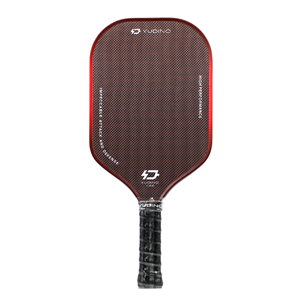
At YUDINO, available customization can cover multiple parts of the product.
Paddle Face
Possible materials include:
3K carbon fiber
12K carbon fiber
18K carbon fiber
T700 carbon fiber
Titanium-carbon-fiber constructions
Fiberglass
YUDINO's product range includes several carbon-fiber constructions as well as fiberglass paddles.
Core
Brands can discuss:
Core material
Core thickness
Core construction
Performance characteristics
Current YUDINO paddle configurations include different thickness options such as 13mm, 14mm, and 16mm.
Shape
Options can include:
Wide-body
Standard
Elongated
Custom shapes
Weight
A brand can define a target weight according to its intended customer.
For example:
Lightweight
Mid-weight
Heavyweight
YUDINO also supports weight targeting and weight consistency control for OEM products.
Handle
Customization can include:
Handle length
Grip size
Grip material
Grip appearance
Brand labeling
Surface
Depending on the product, brands can specify:
Surface finish
Texture
Graphics
Logo
Color treatment
Packaging
Packaging can be customized for:
Retail stores
Amazon and other e-commerce channels
Sports clubs
Distributor sales
Gift sets
Tournament programs
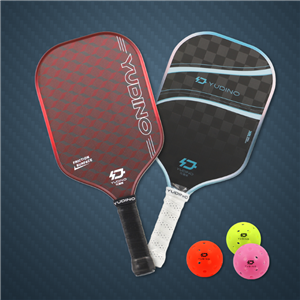
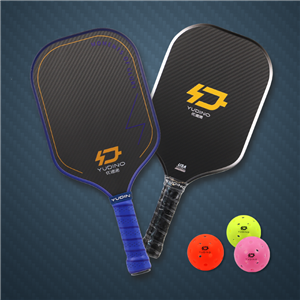
YUDINO supports customized packaging, including individual paddle packaging and sets containing paddles, balls, bags, and other accessories.
5. Should a New Brand Start With a Standard Model or a Fully Custom Paddle?
This is one of the most important decisions for a new brand.
A completely new paddle may sound attractive, but it also introduces more variables.
For a first launch, a practical approach can be:
Existing proven construction → Custom branding → Market testing → Product optimization → Deeper OEM development
This allows the brand to test:
Retail price
Customer response
Product reviews
Preferred weight
Preferred thickness
Preferred materials
Packaging
Sales channels
Once sufficient market feedback has been collected, the next generation can be developed around actual customer demand.
For an established brand with clear technical requirements, a deeper OEM project may make more sense from the beginning.
6. How to Choose the Right Paddle for Your Brand
Do not select a paddle simply because its carbon fiber specification looks impressive.
The product should match your target customer.
For example:
| Target Customer | Possible Product Positioning |
| Beginners | Forgiving, affordable paddle |
| Recreational players | Balanced power and control |
| Intermediate players | Carbon fiber performance paddle |
| Advanced players | High-performance carbon fiber |
| Competitive players | Tournament-oriented construction |
| Premium customers | T700 / advanced composite construction |
| Junior players | Lightweight, smaller configuration |
The goal is to create a clear reason for the customer to buy your paddle.
A brand with a $70 target retail price should not necessarily use the same specification as a brand positioned at $200.
The product architecture should support the intended retail market.
7. What Certifications Should Brand Owners Check?
Certification is particularly important when paddles are intended for competitive or regulated sales channels.
For the U.S. market, buyers should determine whether the specific paddle model is USA Pickleball approved when tournament eligibility is part of the product positioning.
YUDINO's website lists USA Pickleball certifications for its paddle products.
However, brand owners should not simply assume that one certification applies to every customized product.
When developing a customized paddle, confirm:
Which exact model is certified
Whether the customized specification remains within the approved configuration
Whether additional testing is required
What documentation can be supplied
This is particularly important if you plan to market the paddle as suitable for sanctioned tournament play.
8. Why Sample Approval Is Important
A product specification on paper cannot completely describe how a paddle feels in actual use.
Before placing a large order, brand owners should evaluate samples.
A sample inspection should cover:
Appearance
Check:
Logo
Colors
Graphics
Surface finish
Edge quality
Packaging
Physical Specifications
Check:
Length
Width
Thickness
Weight
Handle length
Grip size
Playing Characteristics
Test:
Power
Control
Ball response
Vibration
Balance
Spin
Comfort
Production Consistency
For larger programs, consider evaluating more than one sample.
The purpose is to determine whether the manufacturer can reproduce the specification consistently.
YUDINO supports sample orders before bulk purchasing.
9. What Should Be Included in a Private Label Product Specification?
A clear product specification can prevent misunderstandings between a brand and manufacturer.
Before requesting a quotation, prepare the following information:
Basic Product Information
Product name
Target market
Target customer
Expected retail price
Paddle Construction
Face material
Core material
Core thickness
Paddle shape
Paddle dimensions
Target weight
Handle length
Branding
Logo
Graphics
Color
Position of branding
Packaging
Retail box
Paddle cover
Accessories
Barcode
Product label
Carton requirements
Order Information
Estimated quantity
First order quantity
Expected annual demand
Target delivery date
Destination market
The more complete the specification, the more meaningful the supplier's quotation will be.
10. What Is the MOQ for Private Label Pickleball Paddles?
MOQ is one of the first questions most brand owners ask.
But there is no universal MOQ for every private-label project.
It depends on:
Existing model or new development
Material
Graphics
Custom mold
Packaging
Production setup
Order quantity
YUDINO states that its MOQ varies according to the customization level. Standard products can support small trial orders, while customized OEM orders have production-dependent MOQs.
This gives new brands an opportunity to validate the market before committing to a large production run.
For example, a first-stage strategy could be:
Sample → Small Trial Order → Customer Feedback → Repeat Order → Larger Production
This can be more practical than placing a large first order before the product has been validated.
11. How Long Does Private Label Production Take?
Lead time depends heavily on how much of the product is customized.
Standard Products
Selected stocked YUDINO models can generally ship within approximately 3 business days.
Custom Branding
Products requiring customized branding and packaging typically require additional production preparation.
YUDINO currently indicates approximately 15–25 business days for custom production, depending on quantity and artwork complexity.
Deeper OEM Development
A project involving structural modifications, new materials, or significant product development can require a longer schedule.
Therefore, brand owners should distinguish between:
Production Lead Time
and
Complete Product Development Time
A new product may require:
Design → Sample → Testing → Approval → Production → Inspection → Packaging → Shipment
12. What Quality Control Should a Private Label Buyer Expect?
Quality control is particularly important for private-label products because the paddle carries your brand name.
A supplier's manufacturing problem can therefore become your customer's complaint.
A professional QC process should cover several stages.
Raw Materials
Check:
Carbon fiber
Fiberglass
Core material
Adhesives
Grip materials
Production
Monitor:
Forming
Bonding
Assembly
Surface treatment
Weight
Finished Product
Inspect:
Dimensions
Weight
Balance
Appearance
Surface
Handle
Edge
Structural integrity
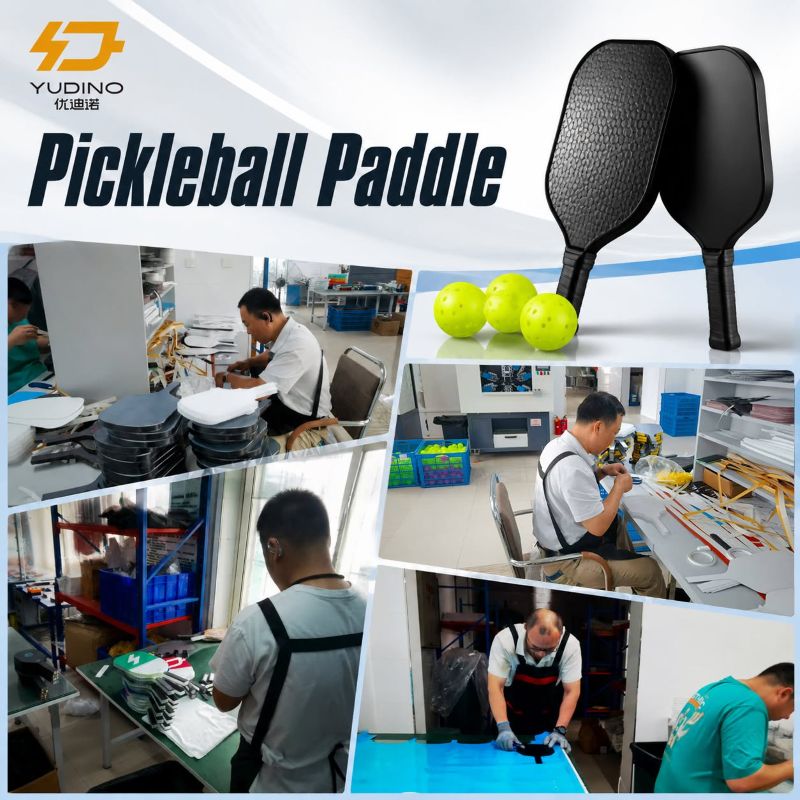
YUDINO describes a quality process covering raw-material verification, in-line production checks, weight and balance consistency, and final performance inspection before shipment.
For larger B2B orders, buyers can also request inspection documentation and testing information.
13. What Should Brand Owners Ask About Defective Products?
This question is often overlooked during purchasing.
Before confirming an order, clarify:
How defects are defined
Acceptable defect rate
Inspection procedure
Who performs final inspection
How defects are reported
Replacement policy
Compensation procedure
Evidence required for claims
These terms should ideally be agreed upon before mass production.
A clear quality agreement can prevent disputes after shipment.
For private-label brands, this is particularly important because the manufacturer may be invisible to the end customer.
The customer sees your logo.
14. Can Private Label Paddles Be Sold on Amazon?
Yes, private-label pickleball paddles can be developed for e-commerce channels such as Amazon.
However, the product should be designed around the channel from the beginning.
Consider:
Retail packaging
Product dimensions
Shipping weight
Barcode
Carton dimensions
Product photography
Compliance documentation
Customer reviews
Replacement strategy
YUDINO states that it has experience supporting cross-border e-commerce logistics and can cooperate with customers for shipments to Amazon FBA warehouses and overseas warehouses.
For an Amazon-focused brand, packaging should also be designed to protect the paddle during international transportation and warehouse handling.
15. How Should You Plan Private Label Packaging?
Packaging is part of the product experience.
For a premium paddle, low-quality packaging can reduce the perceived value of the product.
Depending on the sales channel, brands can consider:
Individual Retail Box
Suitable for:
Sports stores
E-commerce
Premium products
Paddle Bag
Useful for:
Premium products
Club sales
Gift sets
Paddle + Ball Set
Suitable for:
Beginners
Starter packages
Promotional campaigns
Complete Pickleball Set
Can include:
Paddles
Balls
Carrying bag
Accessories
YUDINO supports customized packaging and product combinations according to customer requirements.
16. What About Shipping and Logistics?
Private-label buyers should calculate the complete landed cost rather than looking only at the factory price.
The final cost may include:
Product Cost + Packaging + Inspection + Inland Transportation + Freight + Duties/Taxes + Destination Charges
For smaller shipments, express services such as DHL or UPS may be appropriate.
For medium and larger orders, air or sea freight can provide a more economical solution. YUDINO states that it supports different shipping methods according to order size and customer requirements.
If you sell through Amazon or an overseas warehouse, confirm the required shipping labels, carton specifications, and delivery arrangements before production.
17. How Can Brands Reduce the Risk of Their First Order?
The safest private-label strategy is not necessarily the lowest unit price.
Instead, focus on reducing commercial risk.
A practical approach is:
Step 1: Define Your Market
Determine:
Country
Customer type
Retail price
Sales channel
Competitor positioning
Step 2: Choose the Product Platform
Select:
Material
Thickness
Shape
Weight
Performance category
Step 3: Order Samples
Evaluate actual product performance.
Step 4: Finalize Branding
Approve:
Logo
Graphics
Packaging
Labels
Step 5: Confirm Quality Standards
Define acceptable specifications and inspection requirements.
Step 6: Place a Trial Order
Test customer response.
Step 7: Analyze Sales
Review:
Conversion rate
Customer feedback
Return rate
Product reviews
Repeat purchases
Step 8: Develop the Next Generation
Use real market data to improve the product.
This approach turns private labeling into a product-development process rather than simply a purchasing transaction.
18. What Makes YUDINO Suitable for Private Label Pickleball Paddles?
YUDINO focuses specifically on pickleball equipment and integrates R&D, design, and manufacturing. Its current product range includes carbon fiber paddles using 3K, 12K, 18K and advanced composite materials, as well as fiberglass paddles.
For B2B customers, YUDINO supports:
Private label
OEM/ODM
Custom logo
Custom graphics
Custom colors
Material selection
Core thickness selection
Paddle shape selection
Weight targeting
Handle customization
Packaging customization
Sample orders
Quality inspection
The company's reported annual production capacity is approximately 50,000 pickleball paddles, giving it the ability to support both smaller trial programs and larger-volume supply.
YUDINO also states that it has experience working with international sports brands and retail customers.
19. What Is the Typical Private Label Workflow With YUDINO?
For a new brand, the process can be organized into the following stages:
1. Send Product Brief
Provide your target:
Material
Thickness
Weight
Shape
Quantity
Logo
Packaging
Market
2. Product Recommendation
YUDINO can recommend an existing model or suitable construction based on the requirements.
3. Quotation
The quotation can be based on:
Product specification
Quantity
Packaging
Customization
Delivery requirements
4. Sample Development
A sample is produced for evaluation.
5. Sample Approval
The brand checks the product and branding.
6. Mass Production
Production begins according to the approved specification.
7. Quality Inspection
Finished products are inspected before shipment.
8. Packaging and Shipment
Products are prepared according to the agreed packaging and logistics requirements.
This workflow gives both sides a clear reference point before the bulk order is shipped.
20. Private Label Does Not Mean "One Product for Everyone"
One of the biggest opportunities for brand owners is product segmentation.
Instead of launching one paddle, a brand can gradually develop several product levels.
For example:
Entry Series
Fiberglass + 16mm core
Target:
Beginners and recreational players.
Performance Series
12K carbon fiber + 14/16mm core
Target:
Intermediate and advanced players.
Premium Series
18K or T700 carbon fiber + advanced construction
Target:
Performance-oriented and premium customers.
This creates a clearer product ladder and gives customers a reason to upgrade within the same brand.
The exact specifications should be developed according to the target price, player profile, and intended market.
21. Questions to Ask a Private Label Pickleball Paddle Manufacturer
Before placing an order, brand owners should ask at least these questions:
What paddle materials do you offer?
Can you customize the face material?
Can you customize the core thickness?
Can you customize paddle shape and weight?
Can you produce my logo and graphics?
Can you provide customized packaging?
What is the MOQ for my specific product?
Can I order samples before bulk production?
What is the sample lead time?
What is the mass-production lead time?
What quality inspection process do you use?
Can you provide inspection reports?
Can you provide certification documentation?
Can you support Amazon FBA or overseas warehouse delivery?
What happens if defective products are found?
Can you support repeat orders with consistent specifications?
What is your annual production capacity?
Can you help develop the next generation of the paddle?
The answers to these questions are often more useful than comparing suppliers based only on the lowest quotation.
22. Frequently Asked Questions
What is a private label pickleball paddle?
A private-label pickleball paddle is manufactured by a third-party factory but sold under your own brand. Depending on the supplier, you can customize the logo, graphics, colors, packaging, and selected product specifications.
What is the difference between private label and OEM?
Private label normally starts with an existing product platform and focuses on branding and selected customization. OEM generally involves producing according to the customer's detailed specifications and can involve deeper structural customization.
Can I put my own logo on YUDINO paddles?
Yes. YUDINO supports custom branding, including logo application, graphics, colors, and private-label packaging.
Can I customize the paddle material?
Yes. YUDINO offers materials including fiberglass, 3K, 12K, 18K and advanced carbon-fiber constructions.
What is the MOQ for private-label pickleball paddles?
MOQ depends on the product and customization level. YUDINO states that it accepts small trial orders for standard products, while custom OEM MOQs depend on production requirements. Its FAQ also states that orders can start from one piece for applicable products.
Can I order samples before placing a bulk order?
Yes. Sample orders are available so buyers can evaluate the paddle before committing to bulk production.
How long does private-label production take?
For stocked products, selected models can generally ship within approximately 3 business days. Custom production is typically around 15–25 business days, depending on quantity and artwork complexity.
Can YUDINO customize packaging?
Yes. Packaging can be customized for retail, e-commerce, clubs, distributors, and other sales channels.
Can YUDINO ship directly to Amazon FBA?
YUDINO states that it supports shipments to Amazon FBA warehouses and overseas warehouses and can cooperate with customers on logistics and packaging requirements.
Can I develop a completely new paddle?
Yes. YUDINO supports OEM/ODM development. The development schedule and MOQ depend on the degree of structural and material customization.
Does YUDINO support USA Pickleball-approved paddles?
YUDINO's website lists USA Pickleball certifications for its paddle products. For a customized product, buyers should confirm the certification status of the exact model and specification before using tournament-approval claims in marketing.
What is YUDINO's production capacity?
YUDINO reports an annual production capacity of approximately 50,000 pickleball paddles and also supports larger-volume custom orders.
Conclusion: How to Build a Private Label Pickleball Paddle Brand
Private labeling can significantly reduce the barrier to entering the pickleball market, but successful private-label products require more than a logo.
A brand owner needs to consider:
Product positioning → Paddle specification → Sample → Certification → Branding → Packaging → Quality control → MOQ → Production → Logistics → Market feedback
For new brands, starting with an existing proven paddle construction can reduce development risk.
For established brands, deeper OEM/ODM customization can create greater product differentiation.
YUDINO provides private-label and OEM/ODM pickleball paddle solutions covering materials, core thickness, shape, weight, handle, graphics, logo, packaging, sampling, production, and quality inspection.
With an annual production capacity of approximately 50,000 paddles, flexible order arrangements, sample support, and custom production lead times generally around 15–25 business days, YUDINO can support brands from initial product testing through repeat and larger-volume orders.
For brand owners, the objective should not simply be to find the cheapest private-label paddle.
The better goal is to build a product that has consistent quality, a clear market position, reliable supply, and enough differentiation for customers to remember the brand.
Planning to launch your own pickleball paddle brand?
Prepare your target market, retail price, preferred paddle material, thickness, weight, quantity, logo, and packaging requirements, and YUDINO can help evaluate a suitable private-label or OEM/ODM solution.