The Pros and Cons of 18K Carbon Fiber Pickleball Paddles
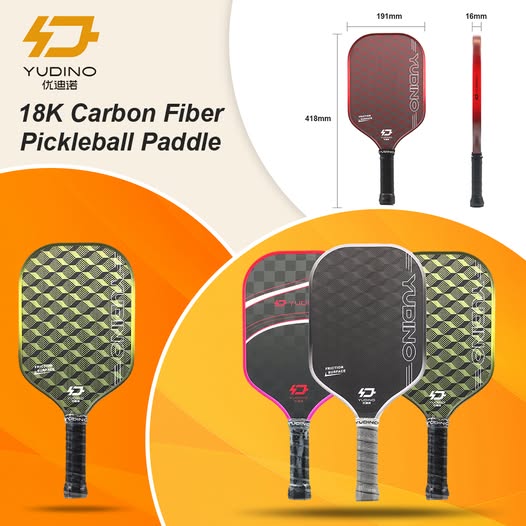
"18K" typically refers to carbon fiber tow bundles containing 18,000 individual carbon fiber filaments per bundle, classifying it as a type of high-density carbon fiber material. When considered alongside the general characteristics of carbon fiber pickleball paddles, the advantages and disadvantages of these high-density carbon fiber paddles can be summarized as follows:
Key Advantages: Tailored for Advanced Needs
1. Maximized Strength and Durability; Far More Resilient than Ordinary Materials
The strength of 18K high-density carbon fiber is over 30% greater than that of standard low-density carbon fiber or fiberglass. Not only can it withstand the frequent, high-impact collisions associated with powerful slams, but it also demonstrates superior resistance to deformation in the event of drops. Test data indicates that high-quality carbon fiber paddles can endure 500 drops from a height of 2 meters without deforming—a performance level 60% higher than the industry average. This ensures that issues such as frame cracking or warping are rare even after prolonged use, significantly reducing the frequency of replacements and overall ownership costs.
2. Distinct Lightweight Advantage; Reduces Fatigue During Extended Play
High-density carbon fiber allows for a lighter design while maintaining structural integrity. Most 18K Carbon Fiber Pickleball Paddles fall within the "golden weight range" of 220–240g—more than 20% lighter than entry-level wooden or fiberglass paddles, which typically weigh over 280g. This results in a lighter, more agile swing, minimizing physical exertion during quick directional changes at the net or during intense, continuous rallies. Consequently, older players or those engaging in extended doubles matches are less likely to experience wrist or arm soreness.
3. Precise Power Transmission; Crisp Shot Feedback
The high elastic modulus inherent in high-density carbon fiber ensures that power transfer at the moment of impact is direct and stable. After storing energy, the material releases it rapidly, resulting in faster, more powerful returns while simultaneously enhancing ball control precision. When combined with a textured (matte) paddle face, spin control can be improved by up to 30% compared to standard fiberglass paddles. Whether executing a powerful drive or a delicate drop shot at the net, players can precisely control the ball's landing spot, providing advanced players with a wider range of tactical options.
4. Superior Shock Absorption; Reduces the Risk of Sports Injuries
18K Carbon Fiber Pickleball Paddles typically feature a PP honeycomb core structure. The vibration generated upon impact is reduced to approximately one-third of that found in standard hard-shell fiberglass paddles. This effectively dampens the shock forces associated with powerful slams, thereby reducing stress on the wrist joints and, over the long term, lowering the risk of developing conditions such as carpal tunnel syndrome or tennis elbow.
Main Disadvantages: High Barrier to Entry; Not Suitable for Absolute Beginners
1. High Price Point and Higher Initial Investment: Due to the use of high-density carbon fiber raw materials and specialized manufacturing processes, the price of 18K Carbon Fiber Pickleball Paddles generally starts at over 200 RMB. Professional-grade, competition-level models can even range from 400 to 2,000 RMB. Compared to wooden paddles costing a few tens of RMB or fiberglass paddles priced between 100 and 200 RMB, the initial cost of entry is significantly higher.
2. Requires a Certain Level of Ball Control Proficiency: High-density carbon fiber offers greater elasticity and more direct feedback. For absolute beginners lacking fundamental skills, this high elasticity can make it difficult to control shot placement, potentially compromising shot consistency. For newcomers just starting out—and still developing their basic feel for the game—lower-elasticity fiberglass paddles are actually easier to pick up and master initially.
3. Inconsistent Product Quality and Susceptibility to Marketing Gimmicks: Currently, there are no standardized industry regulations regarding the labeling of "18K carbon fiber." Some vendors exploit "18K" as a marketing buzzword; in reality, they may apply only a thin surface layer of high-density carbon fiber to the paddle frame while utilizing ordinary materials for the core. Consequently, the paddle's performance fails to meet expectations. It is difficult for average consumers to verify the authenticity of the materials, making them prone to wasting money on inferior products.
Recommendations for Target Users
If you are an intermediate-to-advanced player with a solid foundation, a doubles enthusiast, or a player who prioritizes ball control, the performance advantages of 18K Carbon Fiber Pickleball Paddles will significantly enhance your playing experience. Conversely, if you are an absolute beginner simply trying out the sport—or if you have a very limited budget—it is advisable to start with a fiberglass paddle to practice your basic strokes; upgrading to a high-density carbon fiber paddle later on is a more cost-effective approach. When making a purchase, prioritize products that hold official USAPA certification to avoid inadvertently buying counterfeits or paddles with misleading material specifications.