Is an Aluminum or Fiberglass Pickleball Paddle Better?
In the rapidly evolving landscape of the pickleball industry, B2B buyers—ranging from specialized sports importers to high-volume wholesalers—frequently encounter a fundamental question: Aluminum or Fiberglass?
While the "Competition Pickleball Paddle" market has largely shifted toward advanced carbon composites, understanding the nuances of Aluminum and Fiberglass remains critical for portfolio diversification. Each material offers a distinct "play profile" that appeals to different market segments. This guide provides a deep-dive technical analysis into these materials, helping you make data-driven procurement decisions that align with 2025 market demands and USAPA standards.
1. The Aluminum Core Paddle: The Precision Instrument
Aluminum paddles are unique because the "Aluminum" usually refers to the core, not just the face. These paddles utilize an aluminum honeycomb grid, often paired with a fiberglass or graphite face.
Technical Characteristics & Advantages
Ultimate Control and Touch: Aluminum cores are renowned for being the "quietest" and most "controlled" on the market. The metal honeycomb structure is denser and less elastic than polymer cores, meaning it absorbs energy rather than reflecting it.
Lightweight Maneuverability: Aluminum allows for incredibly light builds (often 6.0oz to 7.2oz). For B2B buyers targeting the "senior" or "recreational touch" demographic, this is a major selling point.
Zero Power, All Precision: If a player’s strategy revolves around the "soft game" (dinks and third-shot drops), aluminum provides a dampening effect that polymer simply cannot replicate.
The Technical "Pain Point": Durability
From a B2B perspective, aluminum has a significant drawback: Denting. Unlike polymer honeycomb, which "bounces back," aluminum can suffer from structural deformation (dead spots) if hit too hard over time. This leads to higher return rates in high-intensity competitive environments.
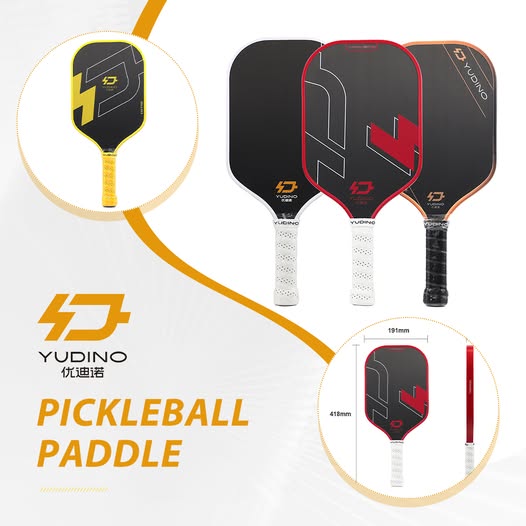
2. The Fiberglass (Composite) Paddle: The Powerhouse
Fiberglass is currently the most popular face material for entry-to-mid-level paddles and is a staple in the Competition Pickleball Paddle category for those who prioritize "pop."
Technical Characteristics & Advantages
The "Spring" Effect: Fiberglass is more flexible than carbon fiber or aluminum. When the ball hits a fiberglass face, it creates a "trampoline effect," propelling the ball with significantly more speed (Power).
Rough Texture for Spin: Because fiberglass is a composite weave, it allows manufacturers to apply specialized grit more effectively, helping players generate high RPMs.
Cost-Effectiveness: For wholesalers, fiberglass offers the best "Performance-to-Price" ratio. It allows you to offer a high-performance "Competition" feel without the premium price tag of 18K Carbon Fiber.
Technical Disadvantage: The Sweet Spot
Fiberglass paddles tend to have a smaller "sweet spot" compared to carbon fiber. In a professional setting, an off-center hit on a fiberglass paddle can feel unstable, leading to more unforced errors.
3. Aluminum vs. Fiberglass: The B2B Comparison Matrix
Feature | Aluminum Core Paddle | Fiberglass (Composite) Paddle |
Primary User | Touch/Control Players, Seniors | Power Players, Intermediates |
Durability | Low (Prone to denting) | High (Resilient to impact) |
Power Level | 2/10 | 9/10 |
Control Level | 10/10 | 6/10 |
B2B Marketability | Niche / Specialty / Injury-Prevention | Mass Market / High Growth |
Standard Core | Aluminum Honeycomb | Polypropylene (PP) Honeycomb |
4. From Scene Pain Points to Technical Selection
When acting as a brand owner or OEM customer, you must choose your materials based on the Player Archetype you serve.
Scenario A: The Competitive "Banger" (Fiberglass Selection)
Pain Point: The player struggles to finish points or put the ball away at the net.
Technical Solution: A Fiberglass Competition Pickleball Paddle with a 13mm or 14mm core. The thin core combined with the fiberglass "pop" provides the necessary velocity.
Scenario B: The Tennis Elbow / Injury Recovery Market (Aluminum Selection)
Pain Point: Heavy vibration from polymer paddles causes joint pain.
Technical Solution: An Aluminum Core Paddle. The metal grid vibrates at a different frequency that many players find more "muted" and easier on the elbow.
5. Common Sourcing Errors: Why "Competition" Matters
Many importers make the mistake of ordering "Fiberglass" paddles that are simply plastic sheets glued to a core. To truly market a Competition Pickleball Paddle, you must ensure:
Multi-Layer Lamination: The fiberglass should be cross-woven in multiple layers to prevent "face cracking."
UV Digital Printing: Avoid cheap stickers. Competition-grade fiberglass requires UV printing to maintain the surface texture required for spin.
Edge Guard Integrity: Because fiberglass is heavy, the edge guard must be chemically bonded to prevent the paddle from becoming "top-heavy" and unbalanced.
6. Why Carbon Fiber is Replacing Both in the Pro Circuit
While the question is "Aluminum vs. Fiberglass," industry strategists point to one trend: carbon fiber (Toray T700 or 18K).
In the "Competition" space, Carbon Fiber is the "Goldilocks" material. It offers more control than fiberglass and more power than aluminum, without the durability issues of the latter. For B2B buyers looking to capture the Premium market, we recommend transitioning your "Pro Line" to 18K Carbon Fiber while keeping Fiberglass as your "Value Line."
7. Consumer Perspective: Quick-Fire Answers
"Which one lasts longer?"
Answer: Fiberglass. Aluminum is prone to internal denting that ruins the "bounce" of the paddle over time.
"I want to hit the ball harder. Which should I pick?"
Answer: Fiberglass. It is the "power" material of the pickleball world.
"I'm a beginner. Does it matter?"
Answer: Yes. Most beginners find Fiberglass easier to use because the paddle "does the work" for them in getting the ball over the net.
8. Conclusion: The Strategic Recommendation for B2B Buyers
If you are a wholesaler or brand owner deciding where to invest your capital:
Invest in Fiberglass if you want high-volume sales, satisfied aggressive players, and a durable product that survives shipping and heavy use.
Invest in Aluminum only as a specialty niche for "control-only" or "injury-sensitive" markets.
For the modern Competition Pickleball Paddle category, the market is moving toward Composite Hybridization—paddles that use a polymer core (for durability) with a high-grit surface (for spin). To truly dominate your local market, ensure your supplier can provide these technical specifications under USAPA certification.
FAQ
Q1: Is Aluminum or Fiberglass more expensive to manufacture?
A: Aluminum cores are generally more expensive due to the cost of raw metal and the difficulty of bonding metal to composite faces. However, the market value of Fiberglass is often higher because it is more sought after by modern players.
Q2: Can a Fiberglass paddle be USAPA-approved?
A: Yes. Most USAPA-approved paddles on the market today are fiberglass (composite) or carbon fiber. Aluminum is also allowed, provided the surface roughness does not exceed USAPA limits.
Q3: Why don't we see many Pros using Aluminum anymore?
A: The "Pro Game" has become much faster. Aluminum lacks the "put-away power" needed for modern drives and speed-ups. Pros now favor Carbon Fiber or high-end Fiberglass for a more versatile performance.
Q4: What is the weight difference between the two?
A: Aluminum paddles are typically in the "Lightweight" category (sub 7.3 oz). Fiberglass paddles are usually "Mid-weight" (7.8 - 8.4 oz), which provides more stability during high-speed exchanges.
Q5: As a brand owner, which has a better ROI?
A: Fiberglass. Due to its popularity and durability, the return-on-investment is higher because of lower defect rates and higher consumer demand in the "Competition" segment.