Shop Pickleball Paddles Guide
Don't be fooled by appearances! A seasoned player teaches you how to choose your "third hand": A deep dive into pickleball paddles and avoiding pitfalls
In the pickleball community, there's a widely circulated joke: beginners choose rackets by color, intermediate players by specifications, and experts by whether the racket can become an extension of their arm.
Faced with rackets ranging from $20 to $300 and looking largely the same, it's easy to suffer from "choice paralysis." Most retailers won't tell you the "secrets behind the materials." Today, we'll break down the core technologies that determine your winning percentage.
I. Two "Hidden Parameters" Ignored by 90% of Beginners
Most salespeople only tell you that rackets are light, medium, or heavy, but what truly determines the feel are the following two "advanced indicators":
Swing Weight – Is it a "Hammer" or a "Dagger"?
Two rackets that are both 8 ounces can feel completely different when swung. Rackets with a high center of gravity have a high swing weight, like a hammer, resulting in powerful smashes, but they are half a beat slower at the net. Rackets with a low center of gravity have a low swing weight, like a dagger, suitable for quick reactions in the "non-volley zone."
Recommendation: If you are a power player, choose a high swing weight; if you prioritize drop shot control at the net, a low swing weight is your best choice.
Twist Weight – Determines Your Forgiveness
Twist weight determines the stability of the racket. When you don't hit the sweet spot, will the racket flip? A racket with high twist weight maintains a stable trajectory even if the shot is off-center.
Professional Tip: Modern "rectangular" narrow rackets typically have lower twist weight, while "wide" rackets offer higher forgiveness.
II. 13mm or 16mm?
This isn't just about thickness. The core thickness of a racket is key to determining whether you're an "offensive" or "defensive" player:
13mm (thin core): Pop. Like a trampoline, the ball bounces immediately upon landing, resulting in high speed. Suitable for players who like to attack and crave the thrill of smashes. The downside is the direct vibration, requiring strong hand joints.
16mm (thick core): Control. A thick core absorbs more impact, giving you a more "sticky" feel when handling short shots at the net, resulting in more precise control. This is currently the choice of most intermediate and advanced players because it helps you neutralize powerful smashes.
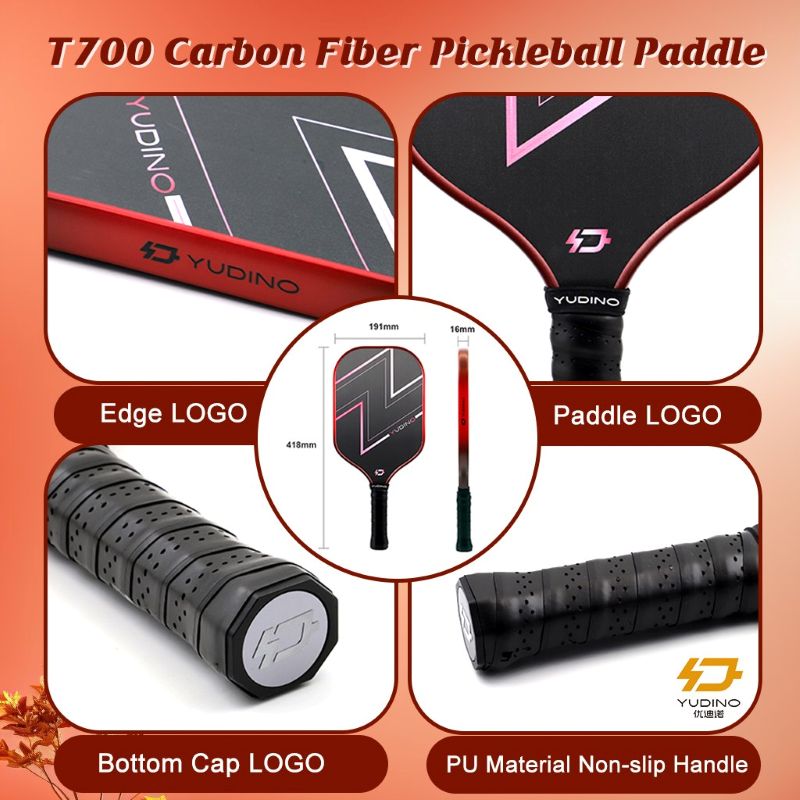
III. Don't be misled by the term "carbon fiber."
Everyone claims to have a "carbon fiber surface," but there's a lot to it:
Grit Paint: A layer of sand is sprayed onto the racket face to increase friction. These rackets spin a lot when you first buy them, but after two or three months, the "sand" wears off, and they become like a skateboard.
Raw T700 Carbon Fiber: This is currently the industry benchmark. Its texture is woven, utilizing the inherent friction of carbon fiber to generate extremely strong spin, and it boasts durable performance.
Avoidance Guide: Touch the racket face. If it feels rough like sandpaper, it's sandblasted; if it feels smooth and has a fabric-like resistance, it's the expensive raw carbon fiber.
IV. Scenarios and Matching: Which Type of Player Are You?
To help you make a quick decision, we've summarized three typical "racket purchasing profiles":
"Tennis/Badminton Transition Player":
Needs: Accustomed to long handles and two-handed backhands.
Selection: Choose a long handle (5.5 inches or more) and a teardrop-shaped head. This compensates for your accustomed swing trajectory and provides stronger leverage.
"Net Play Control Master":
Needs: Enjoy rallies in the kitchen area, winning by changing the direction of the shot and using drop shots.
Selection:16mm thickness, native carbon fiber facet, standard or wide-body design. You need maximum forgiveness and control.
For Players Lacking Power (Easy Players):*
Needs: Wrist protection and the ability to make the ball travel far with a light swing.
Selection: Lightweight (7.5-7.8 ounces), fiberglass facet. Fiberglass is more flexible than carbon fiber, helping to compensate for a lack of power.
V. The Money-Saving Secret Retailers Won't Tell You: Lead Tape
This is the little secret that distinguishes professional players from amateurs.
If you bought an $80 racket and feel it's too light and lacks power, don't rush to buy a new one. Buy a few rolls of lead tape and attach them to both sides of the racket head. For just a few dollars, you can increase the racket's torsional weight and swing weight, instantly gaining the stability of a $200 racket.
In summary, choosing pickleball paddles isn't about picking the most expensive, but about choosing the ones that best compensate for your weaknesses.
Beginners should consider weight: 7.8-8.2 ounces is the safest bet.
Intermediate players should consider thickness: for more stability, choose 16mm.
Experienced players should consider the material: look for T700 virgin carbon fiber.
Before heading to the court next week, test the grip with your other index finger: if you can easily fit your other index finger between your fingertip and palm when holding the paddle, congratulations, you've found the perfect "weapon" for you.