Why Use a Carbon Fiber Pickleball Paddle?
In the world of pickleball equipment, carbon fiber has become synonymous with high performance. Yet most players who pay a $200 premium for a carbon fiber paddle don’t fully understand how that black fiber layer actually affects ball feel.
If you still think carbon fiber is used to reduce weight, you may be missing its most important competitive advantages.
1. Energy Dissipation and the Success Rate of the “Third Shot Drop”
One of the most difficult techniques in pickleball is the third shot drop. Fiberglass paddles provide strong rebound, but their energy return is often nonlinear, behaving like an uncontrolled spring.
The deeper science:
Carbon fiber—especially high-performance T700 grade—has excellent energy dissipation properties. When a 60 mph power shot hits the paddle face, the molecular structure of carbon fiber distributes and absorbs the impact more evenly.
This creates a physical effect known as “dwell time.”
The ball remains on the paddle face for a few extra milliseconds, giving you the control needed to gently place the ball into the opponent’s kitchen instead of popping it up too high—something that often happens with overly elastic fiberglass paddles.
2. Microscopic “Grip”: Friction Is More Than a Sandpaper Texture
Many low-end paddles generate spin by spraying quartz sand onto the surface. Unfortunately, this “grit coating” usually wears smooth within two weeks.
High-end paddles rely on the microstructure of raw carbon fiber fabric instead.
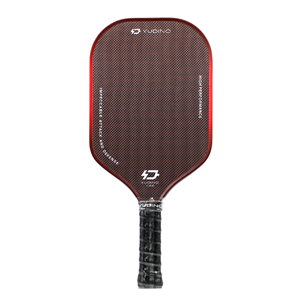
Top-tier carbon fiber paddles use a Peel Ply process, which leaves the natural woven texture directly on the carbon fiber surface. This friction does not come from glued particles—it comes from the material’s own structure.
Under a microscope, the texture looks like thousands of tiny hooks. These create strong mechanical grip the moment the ball contacts the paddle face.
Even when your hands are sweaty or the paddle surface is slightly damp, this structure can maintain stable RPM (revolutions per minute) levels. If your playing style relies on heavy topspin to control baseline shots, raw carbon fiber is the best choice.
3. “Stiffness” and Joint Health: The Misunderstood Vibration Logic
A common myth is that hard materials hurt your arm. In reality, it’s unstable vibration, not stiffness, that causes injuries like tennis elbow.
Professional explanation:
Carbon fiber’s high modulus (stiffness) means it produces very little residual vibration after impact. Fiberglass paddles often generate subtle, continuous low-frequency oscillations after a shot—vibrations that travel through the handle directly to your elbow.
When carbon fiber is combined with modern thermoformed foam edge technology, it creates an extremely stable paddle structure.
For players concerned about injuries, the clean “contact-and-stop” feel of carbon fiber can actually provide better protection.
Does Your Playing Style Really Need Carbon Fiber?
You can determine whether it’s time to upgrade from wood or composite paddles using these three indicators:
1. “Bounce Rate” Test
If your drop shots consistently pop too high because of a trampoline effect, you may need the lower rebound characteristics of carbon fiber for better control.
2. “Visual Arc” Test
Watch your baseline drives. If the ball flies in a straight line with very little downward curve, your paddle may not be generating enough friction. Carbon fiber’s woven surface can dramatically increase spin.
3. Fatigue Check
If your forearm feels strong vibration after a two-hour match, it may indicate structural instability in your current paddle.
Pitfall Guide: Not All Carbon Fiber Is the Same
When reading paddle specifications, watch out for these two hidden traps:
T300 vs T700
T300 is entry-level carbon fiber with lower toughness and a higher risk of cracking.
High-performance paddles should specify T700 or Toray carbon fiber, which indicates industrial-grade strength and longer-lasting performance.
3K vs 12K Weave
A higher number doesn’t always mean better.
3K weave: typically stiffer and provides stronger feedback.
12K weave: softer and smoother.
For players seeking predictable ball feel, 3K weave is often preferred.
FAQ
Q1: Do carbon fiber paddle surfaces wear out?
A: Yes—but the process is different.
Spray-coated paddles lose grit because the particles fall off. Carbon fiber paddles lose friction because plastic particles from the ball gradually fill the weave gaps.
Tip: After each game, use a carbon fiber cleaning eraser to restore more than 90% of the surface friction.
Q2: Why are carbon fiber paddles usually more expensive?
A: The cost comes not only from the carbon fiber material but also from the thermoforming manufacturing process.
Thermoforming requires expensive precision molds and several hours of high-temperature curing to fully wrap the carbon fiber around the core. This is fundamentally different from low-end paddles that simply glue two faces onto the core.
Q3: Are carbon fiber paddles better for singles or doubles?
A: Their advantages are particularly noticeable in doubles.
Doubles involves frequent dinks and resets at the net, and the exceptional touch and ball-dampening control provided by carbon fiber allows you to manage ball depth precisely in fast exchanges.
Final Recommendation
Using a carbon fiber paddle is not about following trends—it’s about achieving consistent shot outcomes.
If you have moved beyond the stage of “just hitting the ball back” and are now aiming for placing the ball exactly where you want it, carbon fiber is a technology upgrade you cannot ignore.