How Do You Choose A Pickleball Paddle? What Should You Look Out For When Buying One?
Seven Key Factors for Choosing a Pickleball Paddle
Paddle Weight: Under 80 oz (Beginner-friendly) | Balance Point: Balanced (Beginner-friendly) | Handle Length: Standard/Slightly Short (Beginner-friendly) | Grip Circumference: Standard or Slim | Face Size: Large (Beginner-friendly) | Face Thickness: 14+ mm (Beginner-friendly) | Face Texture: Relatively Smooth (Beginner-friendly)
Common pickleball paddle dimensions on the market are 40.48 x 19.88 cm, with a typical weight of around 220g. The most common materials for the paddle face are fiberglass and carbon fiber, while handles are typically made from materials such as rubber or PU.
What are the differences between these materials?
Fiberglass vs. Carbon Fiber
Fiberglass: Suitable for beginners. Due to its smooth surface, it offers less "pop" (elasticity), making it easier to control; it is also more affordable.
Carbon Fiber: Suitable for intermediate to advanced players. The paddle face offers relatively strong elasticity and power, requiring a certain level of control to handle effectively.
PP Polymer vs. Others
The mainstream core material is PP polymer (plastic).
Other core materials include aluminum, aramid (Kevlar), carbon fiber, EVA, and others.
Smooth Finish vs. Textured (Matte) Finish
Smooth Finish: Features a smooth surface; suitable for beginners. It offers less control and spin potential, and is relatively lower in price.
Textured (Matte) Finish: Features a textured surface; provides superior control and spin capabilities. Suitable for players with some foundational skills, though typically higher in price.
Cold-Pressed vs. Hot-Pressed
Cold-Pressed: Cold-pressed paddles are manufactured by laminating core materials, CNC-cutting them into a honeycomb structure, and finally finishing them with edge guard tape. This process requires no heat molding and does not involve reinforcing the paddle's side edges. While the manufacturing process is simple, the resulting structural strength is relatively low, creating a potential risk of the handle snapping during use.
Hot-Pressed: Hot-pressed paddles require the use of molds and heat during production, along with material reinforcement applied to the paddle's side edges. Although the manufacturing process is more complex, it significantly enhances the overall structural integrity of the paddle. Hot-pressed paddles demonstrate a fracture resistance that is more than three times higher than that of cold-pressed paddles. Furthermore, because hot-pressed paddles feature reinforced edges, they possess a larger "sweet spot" (the optimal hitting area), resulting in superior overall durability and hitting performance.
One-Piece Handle Construction vs. Joined Handle Construction
One-Piece Construction: The paddle structure is more robust and durable, offering superior strength and stability.
Joined Handle Construction: Strength is relatively lower, carrying a potential risk of the handle breaking during play.
How Should Players of Different Skill Levels Choose a Pickleball Paddle?
The most common mistake people make when purchasing a pickleball paddle is:
"Simply buying the most expensive paddle available."
In reality, however, finding a paddle that truly suits *you* is often far more important than simply choosing the "most expensive" option.
Players of varying skill levels, playing styles, and power profiles have vastly different requirements when it comes to their paddles.
Novice Players: Prioritize "Forgiveness" and "Ball Control Stability"
For players just starting out in pickleball, the most important factors are not spin or explosive power, but rather:
Easier ball reception
Easier ball control
Reduced errors
Faster development of touch and feel
Therefore, novice players are best suited for the following types of paddles:
| Specifications | Recommended |
| Weight | 200–220g |
| Head Size | Large Face Size |
| Thickness | 14mm+ |
| Material | Fiberglass |
| Surface | Smooth or Lightly Textured Finish |
| Balance Point | Balanced |
Why is it generally not recommended for beginners to start directly with a carbon fiber racket?
Many players assume:
“Carbon fiber must be superior.”
However, once they actually pick one up and play, they discover:
Carbon fiber rackets provide more direct feedback and generate faster shot speeds, but they demand a much higher level of stability in one's swing technique.
If your movements haven't yet developed into muscle memory, you are highly prone to issues such as:
Hitting the ball into the net
Hitting the ball out of bounds
Missing the sweet spot
Losing control over shot power
Consequently, most beginners actually end up feeling:
“This racket is difficult to control.”
Although fiberglass rackets may offer slightly less power, they make it much easier to develop a fundamental feel for the ball.
For players just starting out, this makes them a far more beginner-friendly option.
How Should Female Players Choose a Pickleball Paddle?
When selecting a paddle, female players—in addition to considering performance—should pay particular attention to:
Swing fatigue
Wrist strain
Grip comfort
Stability during prolonged use
Therefore, the following are generally recommended:
| Specifications | Recommended |
| Weight | Approx. 200g |
| Grip Size | Relatively slender |
| Balance Point | Slightly head-light |
| Handle Length | Standard length |
| Thickness | 14–16 mm |
Why are lightweight rackets better suited for female players?
If a racket is too heavy, continuous swinging can easily lead to:
Wrist fatigue
Shoulder soreness
Reduced reaction speed
This is particularly critical in doubles matches, where quick reflexes at the net are essential.
Lighter rackets help enhance:
Swinging agility
Defensive speed
Consistency in consecutive returns
Advanced Players: Focusing on Spin and Explosive Power
Once players have established a solid foundation, they typically begin to seek:
Stronger spin
Faster shot speed
More precise shot placement
Greater shot dominance
At this stage, they may wish to consider:
Carbon fiber faces
Thermal compression molding
Textured (matte) surfaces
One-piece construction
Why do advanced players prefer textured carbon fiber?
A textured surface increases friction at the precise moment of impact.
In actual gameplay:
The effects of spin serves, chop shots, and topspin shots become significantly more pronounced.
This is particularly critical during the third-shot attack phase:
High-spin shots make it easier to suppress the quality of the opponent's return.
However, when it comes to textured surfaces, "rougher" is not necessarily better.
Low-quality sandblasted paddles may suffer from issues such as:
Shedding of surface grit
Surface wear and tear
Diminished spin performance
Therefore, a consistent and reliable carbon fiber texturing process is far more important than mere surface "roughness."
Competitive Players: Prioritizing Overall Structural Integrity
During high-intensity training and competitive matches, a racket influences not only the player's feel but also directly impacts:
Stability
Sweet Spot Consistency
Long-term Durability
Consequently, professional and advanced players typically place greater emphasis on features such as:
Integrated Thermal Molding
Perimeter Foaming
Integral Carbon Fiber Structure
Handle Reinforcement
Why are thermoformed paddles becoming increasingly popular?
Currently, in the mid-to-high-end pickleball paddle market, the thermoforming process has gradually become the mainstream standard.
Compared to the traditional cold-pressing process:
Thermoformed paddles demonstrate significantly greater structural stability.
The key advantages of thermoformed paddles:
| Process | Features |
| Cold Pressing | Simple manufacturing process, low cost |
| Hot Pressing | Higher strength, larger sweet spot |
Why do heat-pressed rackets have a larger sweet spot?
The heat-pressing process ensures that the stress distribution across the entire racket frame is more uniform.
During actual play, even if the ball does not make contact precisely in the center zone:
The racket still maintains a relatively stable response.
This provides a distinct advantage in situations involving:
Rapid-fire exchanges
Continuous returns in doubles play
Defensive counter-attacks
How to Choose the Right Pickleball Paddle Thickness?
Paddle thickness directly impacts:
Power
Control
Feel
Forgiveness
Currently, the most common thicknesses are:
| Thickness | Features | Target Audience |
| 13mm | Fast Ball Exit, Powerful Explosiveness | Offensive Players |
| 14mm | Balanced Power and Control | Most Players |
| 16mm | Stable Control, Significant Shock Absorption | Defensive Players |
Why is a 13mm paddle suitable for offensive players?
A thinner core provides faster rebound speed.
When executing a smash:
It allows for more direct power feedback.
However, the downsides are also evident:
Lower forgiveness (smaller sweet spot)
More pronounced vibration feedback
Greater difficulty in ball control
Therefore, it is not suitable for beginner-level players.
5 Common Misconceptions When Buying a Pickleball Paddle
1. More expensive does not necessarily mean better.
Many professional-grade paddles:
Are better suited for high-level players.
When used by beginners, the intense feedback can actually compromise stability.
2. Don't focus solely on "Carbon Fiber."
Many factors determine a paddle's feel:
• Core structure
• Thermoforming process
• Balance point
• Foam injection structure
• Weight distribution
The mere presence of the words "Carbon Fiber" does not guarantee a superior playing experience.
3. Ultra-light paddles aren't suitable for everyone.
While an overly light paddle allows for a faster swing, it may lack sufficient stability.
Especially when returning heavy shots:
The paddle face is prone to wobbling.
4. A coarser textured surface doesn't necessarily indicate higher quality.
Some low-quality grit-blasting processes may result in significant grit loss after just a few months of use.
Spin-generating capability will decline rapidly.
Truly consistent spin performance relies more on:
• Carbon fiber weave texture
• Thermoformed structure
• Surface finish durability
5. Splice-jointed handles carry a long-term risk of loosening.
During high-frequency training:
Splice-jointed structures are more susceptible to:
• Rattling or strange noises
• Loosening
• Risk of breakage
Consequently, an increasing number of mid-to-high-end paddles are now adopting:
A one-piece (unibody) molded structure.
How can you determine the quality of a pickleball paddle?
In addition to technical specifications, you can assess its quality based on the following details:
Is the edge guard sturdy?
High-quality paddles typically feature an edge guard that is:
Flatter and more uniform
Free of visible glue residue
Resistant to cracking
Is the Handle Stable?
If you experience any of the following while swinging the paddle:
Unusual noises
A sensation of looseness
A twisting sensation
This typically indicates insufficient structural integrity.
Is the Surface Texture Uniform?
High-quality carbon fiber paddle faces feature:
A texture that is notably uniform and fine.
Lower-quality products, conversely, are prone to:
Localized wear
Loss of surface grit
Surface unevenness
Pickleball Paddle Trends for 2026
As the sport of pickleball continues its rapid growth, distinct trends regarding upgrades have already begun to emerge within the mid-to-high-end market:
Thermoformed Unibody Construction
Enhances overall structural strength and sweet spot stability.
Foam Edge Technology
Reduces vibration and improves shot stability.
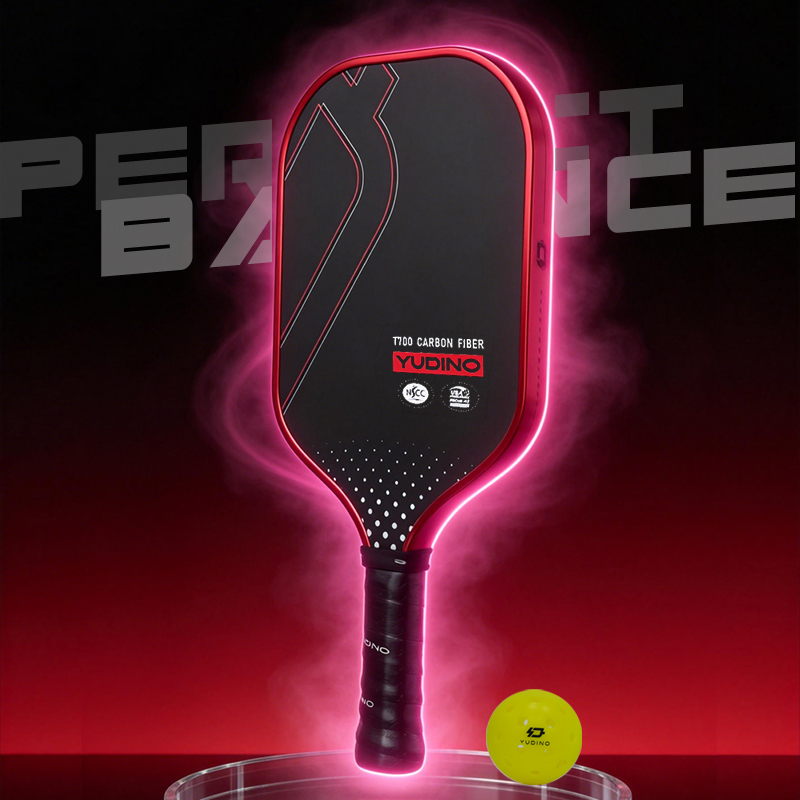
Raw Carbon T700 Fiber
Delivers more consistent spin and shot feedback.
Extended Handle Design
Increasingly caters to players who utilize a two-handed backhand.