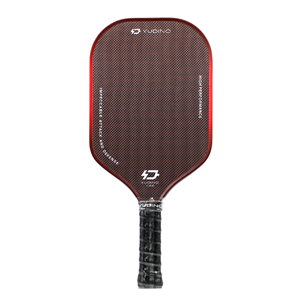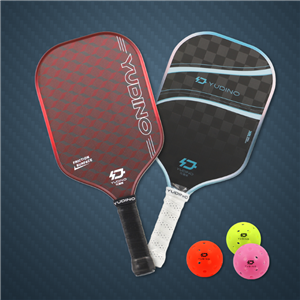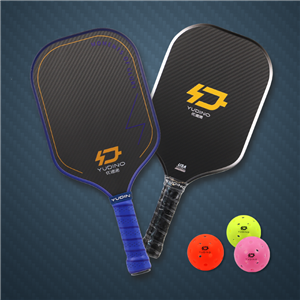
pickleball paddle
-
This guide gives you a systematic, step-by-step framework for making the selection correctly. Each step addresses one of the variables that actually determines whether a paddle works for you — in plain language, with specific recommendations rather than vague guidance. By the end, you will know exactly what to look for, what to avoid, and how to make a confident, informed decision.
-
Let's answer the question directly: yes, for most players above the beginner level, a carbon fiber pickleball paddle is worth it. But that answer comes with important context that most reviews skip over entirely. "Worth it" depends on who you are, how you play, and what you are comparing the carbon fiber paddle against. A $180 carbon fiber paddle is not worth it for a player who has been on a court twice. A $60 T700 carbon fiber paddle is absolutely worth it for a 3.0-rated player who has been grinding with a wood composite paddle for six months and wondering why their drops keep sailing long.
-
This guide cuts through the noise. It covers what actually separates a high-performing carbon fiber pickleball paddle from an average one, which specifications matter for different playing styles, and what the top-performing options look like across budget, skill level, and court role. Whether you are buying your first serious paddle or upgrading after years of play, this review gives you the technical foundation to make the right choice.
-
The pickleball industry has exploded. With over 36 million players in the United States alone and rapidly growing adoption across Europe, Southeast Asia, and Australia, the global pickleball equipment market is projected to surpass $1.7 billion by 2028. At the center of this boom is one product category that has redefined performance standards at every level of play: the carbon fiber pickleball paddle.
-
The Friction V4 paddle recently completed USA Pickleball certification testing and received a compliant result. As a manufacturer involved in OEM and ODM pickleball paddle projects, we regularly review certification reports because many distributors, private-label brands, and sports equipment importers ask the same question:
-
To find a reliable pickleball paddle manufacturer in China, verify factory ownership, test product samples, assess quality control procedures, review OEM and ODM capabilities, and confirm experience with international exports and USAP-compliant paddle production. Manufacturers that can provide transparent production processes, consistent product quality, and proven export experience are generally more reliable than suppliers competing primarily on price.
-
If your goal is to hit harder drives, faster serves, and more aggressive put-away shots, a 14mm pickleball paddle is usually the best choice. Compared with thicker paddles, a 14mm paddle delivers a more explosive response and transfers more energy to the ball. That's why many power-oriented players prefer 14mm designs when they want maximum offensive performance. However, power is not just about hitting harder. The best power paddle also needs enough control to keep shots on target. For most players, a 14mm carbon fiber paddle with a polypropylene honeycomb core offers the ideal balance between power and playability.
-
If you've looked at modern pickleball paddles, you've probably noticed that most of them use a honeycomb core. The reason is simple: Honeycomb cores provide the best balance of power, control, durability, and weight. Compared with solid-core designs, honeycomb structures make paddles lighter, stronger, more forgiving, and more comfortable to play with. That's why nearly every premium pickleball paddle on the market today uses some form of honeycomb core construction. For most players, the honeycomb core isn't just a design feature—it's one of the biggest reasons modern paddles perform so well.
-
If you're choosing a carbon fiber pickleball paddle and aren't sure which core to select, the simplest answer is: A polypropylene honeycomb core is the best match for most carbon fiber paddles. Whether the paddle uses T700 raw carbon fiber, 3K carbon fiber, 12K carbon fiber, or 18K carbon fiber, a polypropylene honeycomb core provides the best balance of power, control, comfort, and durability. This combination has become the preferred setup for most intermediate, advanced, and tournament-level players because it performs well in nearly every aspect of the game.
-
If you're confused by the hundreds of pickleball paddles on the market, here's the simplest answer: For most players, the best pickleball paddle combines a carbon fiber face, a polypropylene honeycomb core, and a 16mm thickness.