How to Build a Pickleball Paddle Product Line for Your Brand
Launching a pickleball brand does not necessarily mean starting with a large catalog of products.
For a new brand, one of the more important decisions is how to build a paddle product line that is easy to understand, clearly positioned, and practical to manufacture.
A common mistake is to start by choosing materials first: 3K, 12K, 18K, T700, fiberglass, or another construction.
But material selection should come after product positioning.
A more practical product-development process is:
Target customer → Product positioning → Paddle specifications → Product differentiation → Sample development → Production
This approach helps brands avoid creating several paddles that look different but serve essentially the same customer.
1. Start With the Customer, Not the Material
Before discussing paddle specifications with a manufacturer, define who the product is designed for.
A brand may target:
Beginners and recreational players
Club players
Intermediate players
Performance-oriented players
Competitive players
Premium sports consumers
Sporting goods retailers
Pickleball clubs and distributors
These customer groups can have different expectations for paddle weight, shape, thickness, materials, appearance, price, and overall positioning.
For example, a paddle designed for recreational players may focus on accessibility, comfortable handling, and a straightforward specification.
A performance-oriented product may require a more specific combination of surface material, core construction, weight, shape, and handle design.
The important point is that the target customer should determine the product specification—not the other way around.
2. Decide How Many Product Levels Your Brand Actually Needs
A new brand does not necessarily need five or ten paddle models at launch.
A smaller product line can make it easier for customers to understand the differences between products and easier for the brand to manage inventory, marketing, and production.
A practical starting structure could be:
Entry Series
Designed for beginners and recreational players.
Possible priorities:
Accessible price positioning
Comfortable weight
Standard paddle shape
Fiberglass or entry-level carbon fiber construction
13 mm, 14 mm, or 16 mm configuration depending on the product concept
Performance Series
Designed for more experienced players who want more defined performance characteristics.
Possible priorities:
Carbon fiber construction
More specific weight targets
Different shape options
14 mm or 16 mm core configurations
More specialized surface construction
Premium Series
Designed for customers looking for advanced materials or differentiated construction.
Possible priorities:
T700 or advanced carbon-fiber construction
Titanium-carbon-fiber hybrid structures
Thermoformed construction
Customized shape or weight targets
Premium graphics and packaging
These are examples of product-line architecture, not fixed industry categories.
The exact specifications should be developed according to the brand's target market, selling price, channel, and product strategy.
3. Build Product Differences Around More Than Carbon Fiber
One of the easiest mistakes is to create a product line where every paddle uses a different carbon fiber label but the rest of the specification remains almost identical.
For example:
Model A: 3K
Model B: 12K
Model C: 18K
Model D: T700
If the paddles have nearly the same shape, weight, thickness, core, handle, and surface construction, changing the carbon fiber terminology alone may not create a meaningful product hierarchy.
A stronger product line uses several specifications to create clear differences.
These can include:
Face material
Surface construction
Core thickness
Paddle shape
Paddle length and width
Weight
Handle length
Grip specification
Edge construction
Appearance
Packaging
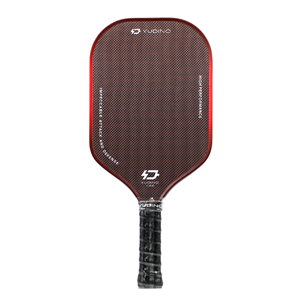
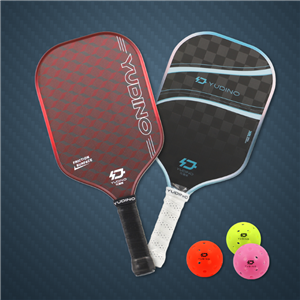
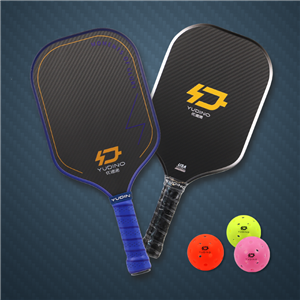
YUDINO's current product configurations support different carbon fiber options, fiberglass, paddle thicknesses, shapes, weight ranges, handles, graphics, colors, and packaging. This gives brands multiple variables to work with when developing a product family. (ydnlntuyp.com)
4. Choose the Paddle Face Based on Product Positioning
The paddle face is an important part of the product specification, but it should be selected according to the intended product rather than simply choosing the most advanced-sounding material.
YUDINO works with several carbon fiber configurations, including:
3K carbon fiber
12K carbon fiber
18K carbon fiber
T700 carbon fiber
Titanium-carbon-fiber constructions
Fiberglass
These materials and constructions can be used to develop products for different positioning.
However, 3K, 12K, 18K, and T700 should not be treated as four directly comparable material grades.
T700 refers to a carbon fiber grade, while 3K, 12K, and 18K refer to tow constructions.
For product development, the more useful question is:
How should the selected material be combined with the core, surface, thickness, shape, weight, and manufacturing process to create the intended product?
This is where a manufacturer with product-development capability can contribute more than a supplier that only provides a material catalog.
5. Use Paddle Thickness to Create Product Differentiation
Thickness is another practical variable for building a product line.
YUDINO supports paddle configurations including 13 mm, 14 mm, and 16 mm options depending on the product design.
A brand does not necessarily need to use every thickness.
Instead, thickness can be selected based on the intended product characteristics and target customer.
For example, a brand might develop:
Model A — 14 mm
Positioned around a more responsive paddle concept.
Model B — 16 mm
Positioned around a thicker-core product concept.
These descriptions are product-positioning examples rather than universal performance claims.
The important point is to give each model a clear reason to exist.
6. Shape and Weight Can Create Different Products
Product differentiation does not have to come entirely from materials.
Paddle shape and weight can also create meaningful differences within the same brand.
Possible shape options include:
Standard
Square
Rounded
Elongated
Custom shapes
Weight can also be defined according to the product concept.
For example, YUDINO's product configurations include light, midweight, and heavyweight options, with some models specified around 230 g ± 5 g or other target ranges. (ydnlntuyp.com)
For a brand, the key is not simply choosing a weight.
It is defining a target weight and acceptable tolerance so the manufacturer can reproduce the product consistently.
This becomes particularly important when the same paddle is reordered.
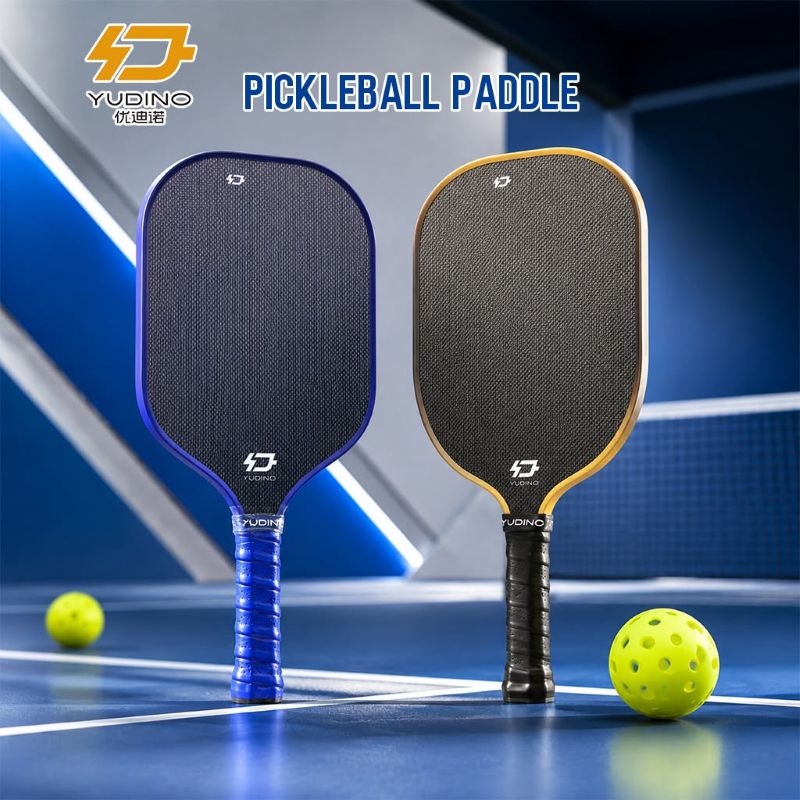
7. Do Not Ignore the Handle
The handle is sometimes treated as a secondary specification, but it can be an important part of product differentiation.
Brands can consider:
Handle length
Grip size
Grip material
Grip shape
Handle appearance
Branding
An elongated paddle, for example, may require a different handle configuration from a standard-shape paddle.
The handle should therefore be developed together with the paddle shape rather than treated as an afterthought.
8. Create a Product Specification Matrix Before Sampling
Before asking a factory to produce samples, create a simple product matrix.
For example:
| Specification | Entry Series | Performance Series | Premium Series |
| Face material | Fiberglass / 3K | 12K / 18K | T700 / Hybrid |
| Core | PP Honeycomb | PP Honeycomb | Advanced configuration |
| Thickness | 14 / 16 mm | 14 / 16 mm | 16 mm |
| Shape | Standard | Standard / Elongated | Custom / Premium |
| Weight | Light / Mid | Mid | Target specification |
| Surface | Standard / Textured | Textured | Advanced surface |
| Handle | Standard | Customized | Customized |
| Graphics | Brand graphics | Custom graphics | Premium custom |
| Packaging | Standard | Custom | Retail-ready |
This table is not a fixed YUDINO product catalog.
It is an example of how a brand can organize product development before requesting samples.
The actual specification should be confirmed with the manufacturer based on the target price, customer, sales channel, and production requirements.
9. Make Sure Every Paddle Has a Clear Reason to Exist
Before adding a new model, ask:
What problem does this paddle solve?
If two products have almost identical:
Material
Thickness
Weight
Shape
Core
Handle
Surface
then customers may have difficulty understanding why they should choose one over the other.
A stronger product line gives each model a clear role.
For example:
Model 1: entry-level recreational paddle
Model 2: balanced performance paddle
Model 3: elongated performance paddle
Model 4: premium thermoformed paddle
The exact product names and specifications can then be developed around the brand's positioning.
This approach is more useful than simply adding models because a new carbon fiber material becomes available.
10. Develop Samples Before Finalizing the Product Line
Product specifications on paper cannot replace physical samples.
A brand should evaluate samples for:
Overall weight
Dimensions
Balance
Handle feel
Surface appearance
Graphics
Edge finish
Core response
Overall construction
Packaging
For products intended for different market segments, it can be useful to test several prototypes before finalizing the product matrix.
The purpose of sampling is not only to determine whether one paddle is good.
It is to determine whether the whole product line makes sense together.
11. Think About the Sales Channel When Designing the Product
The same paddle specification may not work equally well across every sales channel.
For example:
E-commerce
The product needs clear visual differentiation and easy-to-understand specifications.
Sporting Goods Retail
Packaging, product appearance, weight, and shelf presentation can become more important.
Clubs and Distributors
Consistency, supply capability, customization, and repeat-order support may be major considerations.
Premium Direct-to-Consumer Brands
Product story, materials, construction, graphics, packaging, and differentiation may all play a larger role.
This is why product development should begin with the intended sales channel instead of starting with a factory's existing catalog.
12. Plan for the Second and Third Production Batch
A product line should not be designed only for the first order.
Brands should also consider what happens when the product sells successfully.
Ask the manufacturer:
Can the same materials be sourced consistently?
Can the same weight tolerance be maintained?
Can the same surface specification be reproduced?
Can the same graphics and colors be repeated?
Can packaging remain consistent?
Can production capacity support larger orders?
Can future product improvements be developed without changing the entire product line?
YUDINO's reported production facility covers approximately 3,000 m², with more than 20 hot-press machines and an annual paddle production capacity of approximately 50,000 units. Its production process includes material preparation, precision cutting, hot-press forming, core assembly, finishing, inspection, and final testing. (ydnlntuyp.com)
For a growing brand, manufacturing scalability matters because a product that is easy to sample but difficult to reproduce at larger volumes can create supply problems later.
13. A Practical Product-Line Development Process
A practical development process can be divided into eight steps:
Step 1: Define the Target Customer
Identify the player, market, price range, and sales channel.
Step 2: Define the Product Structure
Decide how many product levels the brand needs.
Step 3: Set the Core Specifications
Define:
Face material
Core
Thickness
Shape
Weight
Handle
Surface
Step 4: Create the Product Matrix
Make sure every model has a clear role and does not unnecessarily overlap with another model.
Step 5: Develop Samples
Produce prototypes and evaluate the physical product.
Step 6: Finalize Branding
Confirm:
Logo
Graphics
Colors
Grip branding
Packaging
Step 7: Confirm Quality Requirements
Define:
Weight tolerance
Dimension tolerance
Appearance standards
Surface requirements
Logo placement
Packaging requirements
Inspection procedures
Step 8: Launch and Collect Market Feedback
After launch, monitor:
Customer reviews
Return reasons
Sales by model
Product complaints
Repeat purchases
Distributor feedback
Use this information to decide whether the next product should be a new model or an improvement to an existing one.
14. How YUDINO Can Support Product-Line Development
YUDINO focuses on pickleball equipment and integrates product development, design, and manufacturing.
Its current paddle offerings include different carbon fiber and composite constructions, fiberglass paddles, textured carbon fiber paddles, thermoformed designs, and other customized configurations.
For OEM and private-label projects, YUDINO supports customization of:
Face material
Core thickness
Paddle shape
Weight
Handle
Surface
Graphics
Logo
Color
Packaging
YUDINO also reports an approximately 3,000 m² production facility, more than 20 hot-press machines, and an annual production capacity of approximately 50,000 paddles. (ydnlntuyp.com)
This allows brands to start with a defined product concept and then adjust specifications during sample development before moving into production.
FAQ
How many pickleball paddles should a new brand launch?
There is no universal number. A smaller, clearly differentiated product line can be easier to manage than a large catalog with overlapping specifications.
Should every paddle in a product line use a different carbon fiber material?
No. Product differentiation can also come from thickness, shape, weight, handle, surface, construction, graphics, and other specifications.
Is T700 automatically the right choice for a premium paddle?
Not automatically. T700 is a carbon fiber grade, but the finished paddle depends on the complete construction and manufacturing process.
Should I design the paddle first or choose the manufacturer first?
The two decisions are connected. The brand should define its target product and core requirements first, then work with a manufacturer that can realistically produce and refine those specifications.
Can YUDINO develop different paddle models for one brand?
Yes. YUDINO supports different materials, thicknesses, shapes, weights, handles, surface configurations, graphics, logos, and packaging for customized paddle projects.
Conclusion
Building a pickleball paddle product line is not simply a matter of choosing several carbon fiber materials and putting different logos on them.
A stronger approach is to start with the customer, define the product positioning, build clear differences between models, confirm specifications through samples, and then establish a production system that can reproduce those specifications consistently.
A well-planned product line should make three things clear:
Who is this paddle for?
Why is it different from the other paddles in the range?
Can the manufacturer reproduce it consistently as the brand grows?
For brands developing a new pickleball paddle line, YUDINO can support the process from material and specification selection through sampling, customized production, branding, packaging, and quality inspection.